60 AMERICANWAY
FEBRUARY 1 2008
Books
Founder’sDinner
What doyou getwhen three of our nation’s greatestmendrink
five bottles ofwine?We’re living in it.
ByKristinBairdRattini
Charles Cerami has
been labeledby crit-
ics as a popular his-
torian and an author
whose cinematic,
you-are-there narra-
tive style, more than
his scholarship, has
made best sellers
out of his previous
works,
Jefferson’s
Great Gamble
and
YoungPatriots
. So
one couldbe for-
given for expecting
Cerami’s newest
book,
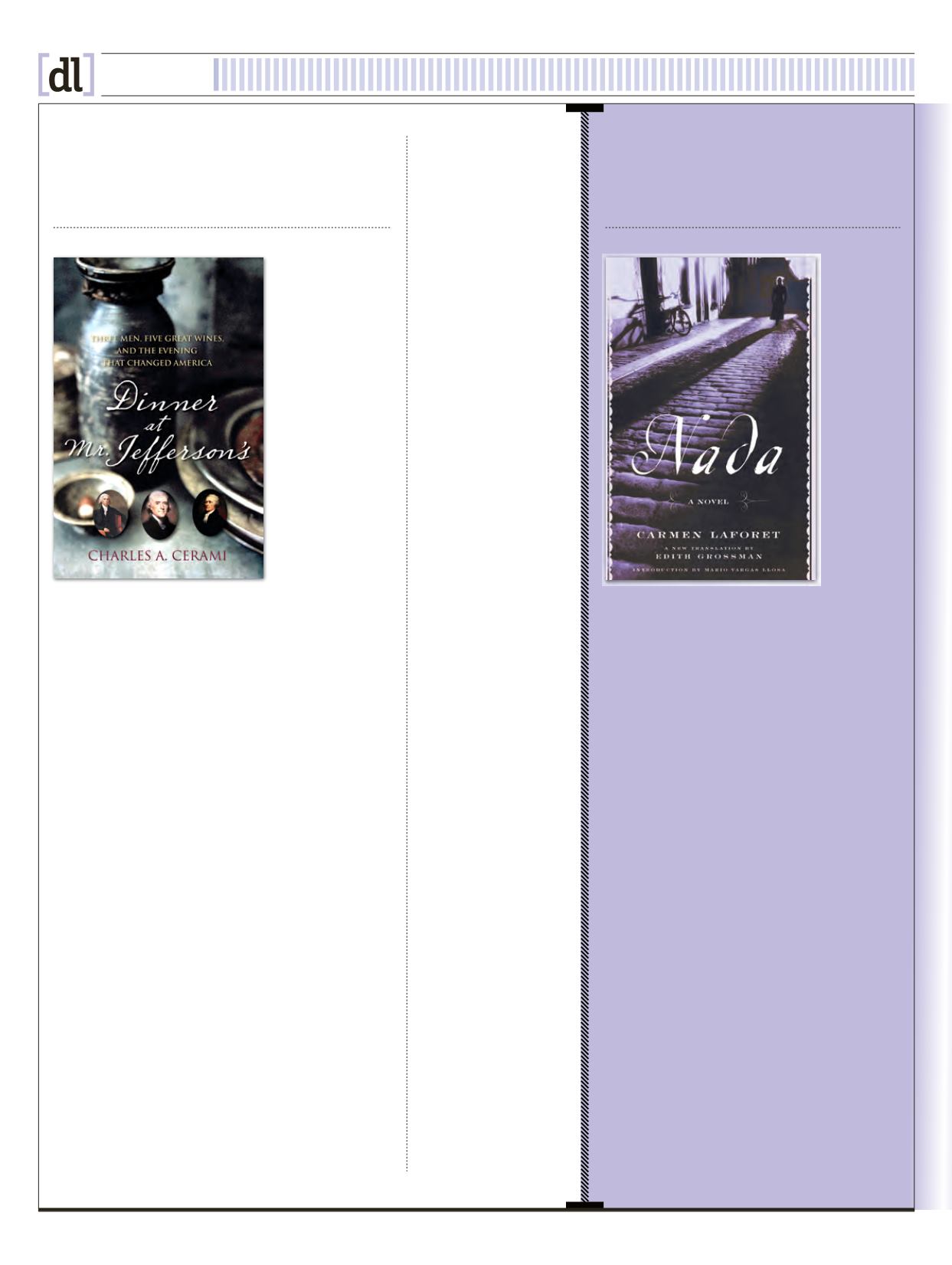
Dinner atMr.
Jefferson’s
(Wiley,
$26), to bemore of a cross between theHistoryChanne
l
and the
FoodNetwork than a straight history tome, especially given the
promisesmade in the subtitle,
ThreeMen, FiveGreatWines, and
the Evening that ChangedAmerica
.
Ah, but promises, promises. Thewines and the eveningget ex-
tremely short shrift— just one chapter, amere 13pages among
288. But as for the threemen—Republicans Thomas Jefferson
and JamesMadison and their rival, FederalistAlexander Hamilton
—Cerami delivers soundly. He knows thesemenwell, havingwrit-
ten extensively about them in his previousworks, and confidently
sets them inmotion here. At times, it’s an unforgivingportrayal of
their roles inwhat historians call the dinner-table bargain.
Far frombeing a chicken-or-beef quandary, the dinner-table
bargain of June 1790was an act of brilliant gamesmanship, one
that held together the fragile, two-year-oldUnitedStates. At issue
were the location of the nation’s permanent capital andHamilton’s
proposal to have the federal government assume the existing
debts of all 13 states, consolidating themwith the federal debt.
The compromise? To appease powerful Virginians, who saw the
debt consolidation as a loss of state power, the capital wouldbe
carved out of Virginia swampland along thePotomacRiver.
Though the issues are old, Cerami’s take on them isn’t. A former
foreign-affairs editor at the high-dollar newsletter service
Kiplinger
WashingtonEditors
, Cerami seems to viewhis subjects through a
current-events filter, with an eye for parallels between the politics
practicedby our FoundingFathers and the politics perpetratedby
their progeny today. Credit crises, illicit affairs, andparty battles
fought in the pressmay be found in stories ripped from today’s
headlines, but Cerami has taken them from the annals of history
instead and shownhow thesemenhandled such crises—not from
atoppedestals andpodiums but around the dinner table.
DrinkUp
Thomas Jefferson didn’t
leave notes onwhat he
served to eat and drink
on the evening of the
dinner-table bargain, the
night that inspired Charles
Cerami’s book. But Cerami
offers several educated
guesses as towhat might
have been available,
based onwhat the author
of the Declaration of
Independence had been
known to drink. All these
wineswouldmake excel-
lent choices for your next
important gathering.
•A 1786Bordeaux from
Graves, France. Today, the
2005Bordeaux vintage is
all the rage inwine circles.
But it’s still too young to
drink. The 1786, on theother
hand, is probably ready.
•AMontepulciano, from
Tuscany, Italy. Itwas once
declared the king of all
wines, and the best ver-
sions today are labeled
Vino
Nobile diMontepulciano
.
A very differentwine, one
carrying a similar name
but a cheaper price tag,
Montepulciano d’Abruzzo, is
made in theAbruzzo region
of Italy.
•A
non-mousseux
(meaning
still, not sparkling)white
wine fromChampagne,
France. Thiswouldbe an
uncommonfind onState-
sidewine lists today.
In all, only six pages are
devoted to thewines and
courses served that night.
In an appendix, Cerami
includes six recipes from a
modern book called
Dining
atMonticello: InGoodTaste
andAbundance
, but only
half of those recipeswere
written in Jefferson’s own
hand.
Decoder King
Youmaynot knowher name, but you’ll lovewhat Edith
Grossman candowith a Spanishbook.
By J.D. Reid
If not for
those name-
less book
translators,
we’d have
to learn a
whole lot of
languages
in order to
be able to
enjoy clas-
sicworks
of fiction.
Greek for
TheOdyssey
.
Russian for
War and
Peace
. Brit-
ish for Shakespeare. It’s a frightening thought.
Luckily, translators likeEdithGrossmanmake it easy
on us. Grossmanwaswidely praised in literary circles for
her 2003 translation of
DonQuixote
. HaroldBloom even
calledGrossman “theGlennGould of translators,”which
wouldbe prettymeaningful to you if you’d ever heard
of any of these people. The bottom line is: Grossman is
good. She not only translateswords from one language to
another, she also ably captures the original author’s voice
in her translations. That’s the case again— so I’m told
—withGrossman’s latest Spanish-to-English project, Car-
men Laforet’s
Nada
(Modern Library, $15), which is out in
paperback thismonth.
Nada
is as classic inSpain as the rain is on the plain.
The bookwon thePremioNadal and thePremioFasten-
rath de laReal AcademiaEspañola, which are prizes that
have very prettySpanish names. Laforetwrote the book
when in her early20s, and it tells a coming-of-age tale of
Andrea, a youngwomanwhomoves inwith relatives in
Barcelona just after theSpanishCivilWar. Andrea has to
livewith an ever-present cast of vicious andbitter char-
acters— an eccentric has-been violinist, a violent uncle,
a sneaky gambler, a religious nut, a grandmother, a baby,
and a parrot. Just howdo you come of agewhen your
relatives linger over your shoulder at all times?Better yet,
howdo you respondwhen someone says, “If I’dgotten
hold of youwhen youwere younger, I’d have beaten you
to death”?
It’s a thinker. But, by putting the story intowordswe
can understand, Grossman hasmade some of the thinking
easy on us.


