BigScreen
72 AMERICANWAY
DECEMBER 15 2008
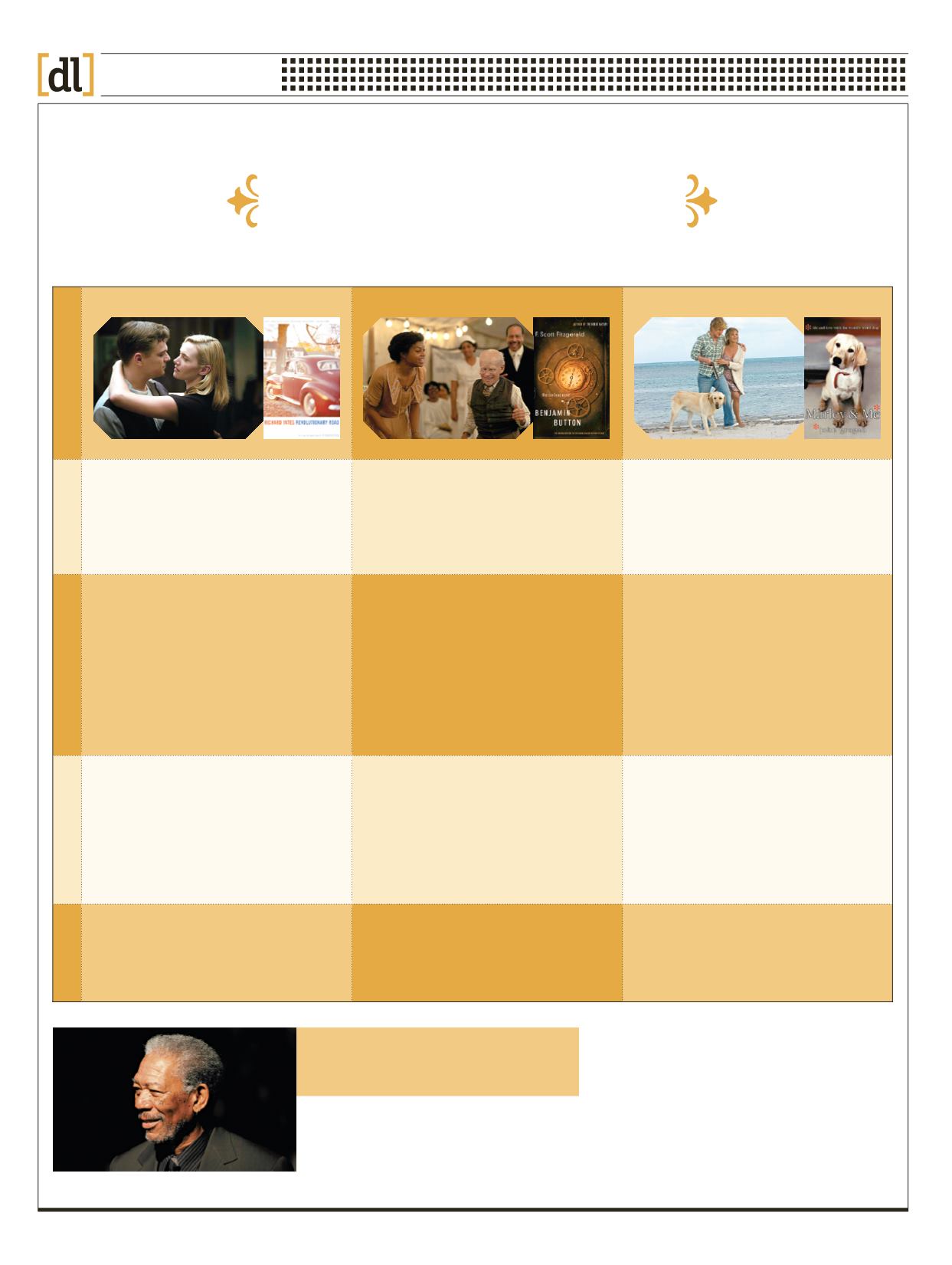
“In grade school, I pulled a chair out from under a girl namedBarbaraCurry. Of course, thatmade her extremely
angry, so I had to run, and Iwas caught bymy English teacher, Miss Cosburn. She frog-marchedme to the class-
room of another English teacher, whowas looking for somebody to be in a play that was going to compete in a
statewide contest. I did the play, wewon the contest, and I became an actor. That’s how lifeworks.” —Morgan
Freeman, on how he got turned on to acting
PICTUREBOOKS
Three of thismonth’s new releases have been adapted frompage-turningworks of fiction.
Butwhichflicks areworth seeing— andwhich are better on paper?By JosephGuinto
MOVIE
RevolutionaryRoad
Marley&Me
TheCurious CaseofBenjaminButton
PREMISE
READ IT?
SEE IT?
OURTAKE
A couple—playedby LeonardoDiCaprio and
KateWinslet—becomes disenchanted
with their suburban existence in 1950sAmerica.
Butwhen they decide to depart from the
predictable path, their relationship crumbles.
A newlywed (OwenWilson) gets a dog to
keep hiswife (JenniferAniston) fromwanting
children right away. The dogdoes bad things, but
they still love it. It’s kind of like
Turner&Hooch
,
onlywithout themurder at the beginning.
BenjaminButton (BradPitt) is born
as an oldman and ages backward. He
lives his lifewhile growing younger,
eventually dying as an infant.Weird.
If you’ve everwanted to ditch the
cul-de-sac for theChamps Élysées, you can
relate toRichardYates’s 1961 novel about
Americans Frank andAprilWheeler and their
escape toParis. The characters are both
compelling and repellent— you see yourself
in them andwish you didn’t. That’swhy
Slate.com recently called the book “one of the
most depressing novels everwritten.”
The best-sellingbook is great for dog
lovers, in part because author JohnGrogan’s
prose is kind of like a pooch— cute, pleasantly
approachable, and slightly bothersome.
Consider the openingparagraph: “Wewere
young.Wewere in love.Wewere rollicking
in those sublime early days ofmarriage
when life seems about as good as life can get.
We could not leavewell enough alone.”
TheGreat Gatsby
author F. Scott Fitzgerald
wrote this short story in 1922 after doing
a little deep thinking aboutMarkTwain’s
remark that the best part of life comes at
the beginning and theworst part at the
end. Fitzgerald sets the story inBaltimore
just before theCivilWar and ends it inwhat
would have been his own future: 1930.
The script sticks close to the book, right
down to the time frame, the
MadMen
-esque
set stylings, andFrank’s rantings and
ravings. Thefilmmix could leadDiCaprio
to another Oscar nomination. If not,
maybe they’ll let him keep one of those
grayflannel suits; they’re very hip now.
While the book followsMarley’s entire
life span and the birth of the couple’s three
kids, themovie focusesmostly on the
pre-kidphase, whenAniston’s character is
discovering hermaternal instinct (didn’t TMZ
just have an item about that?) andWilson’s
is trying to rememberwhen hewas funny.
EricRoth, thewriter behind
Forrest Gump
,
significantly expandedFitzgerald’s story for
thefilm. Themovie’s time frame is now from
1919 to2005, Button’s home city is now
NewOrleans, and the name of his love interest
has thankfully been changed fromHildegarde
to themore
Gatsby
-esque forenameDaisy.
Themovie clocks in at about two hours.
The book is 368depressingpages. Sowe’re
inclined to skip the book, unless that’s too
predictable. In that case, we’re reading it.
The film’s tagline is “This Christmas, Heel
the Love.” Seriously. Doesn’t thatmake
youwant to stick to the book?Goodboy.
Because Fitzgerald’s story is a breezy short
story, andbecause the filmmakers deserve
credit formakingBradPitt look like awrinkly
oldman, we’re going to read
and
watch.
SpeakEasy
By J. Rentilly


