7.3.12
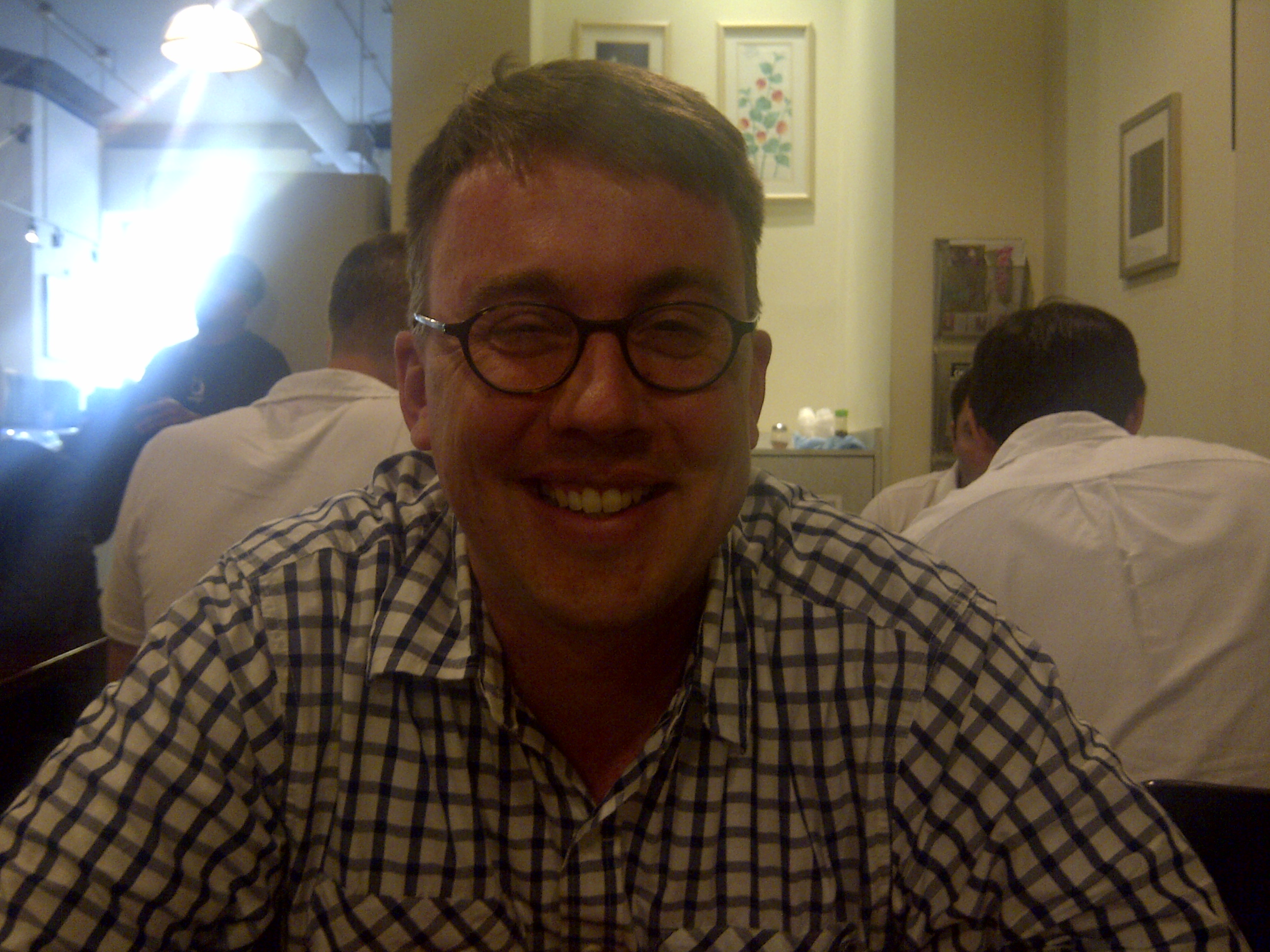
Face to Face with EJ McAdams
Meet at Ennju, Japanese restaurant on 17th St. and Union Square.
EJ says that community is the glue that creates survival. He points out that no matter what, when we create work through time we're always creating narratives, even if they're abstracted.
He noticed that, in the first group iteration of The Pronouns at Mount Tremper Arts, how the people were interconnected changed the length and rhythm of the piece, and that by leaving the order of the pieces to chance, there was a freedom over time. He found it challenging to interpret something (The Pronouns poems) that already exists.
EJ, as a poet, is interested especially in the specificity of Jackson's instructions, and thinks of Jackson as a performance-maker as much as a poet (maybe more so). He says that performance-making is like war--you go through it, and when you get to the other side, you're bonded in a strong way that people outside the process can't understand.
He brings up interesting questions--how did people about collaboration in the past? What's the language of collaboration? We talk about "team-building" in a corporate (or other organizational) context. EJ talks about anarchism, and how it can function as a "utopian community vision where emotions are channeled towards a common good." This mutual benefit and horizontal collaborative process were central to the ideas behind The Pronouns, and to the way I work with people to make performances.
EJ's children
Lyla (11) and Jane (5) are part of the piece, and he notices, watching me work with them, that I create an open invitation for creativity, with established parameters, but allowing for many different versions. He sees this as an effective tool for working with a spectrum of abilities and a spectrum of ages. He feels like you don't usually see the full spectrum within a performance context, and he likes the idea that in this context everybody has the chance to "shine." In greek philosophy, to shine is put something "in the light."
He notes that he's far too busy to participate, but that he probably will anyway. He sees the way that people end up in the piece as being a tripartite commitment; the participants are committed to me, committed to Jackson, and committed to dance, and that creates the mission and the world of the piece.