We are encountering an increasing number of heavy goods vehicles with large HIAB-type loader cranes where vehicles have often been converted to accommodate cranes of 80 tonnes lifting capacity or more.
The additional weight caused by these conversions make the vehicles very close to their maximum carrying capacity meaning they are often unable to tow a standard semi-trailer without exceeding the permitted vehicle length.
Operators, transport managers and drivers must take note of this when transporting a load on such a vehicle and look at the regulations. Operators need to make sure they are familiar with how they transport loads and understand whether they come under STGO (Special Type General Order) regulations or fall under Construction & Use (C&U) requirements.
The information below should help operators better understand the circumstances around transporting cargo on vehicles with HIAB cranes attached.
Can I operate under Special Type General Order regulations?
Some manufacturers have indicated to operators they can run these “HIAB tractor units” under STGO (Special Type General Order) regulations. This is not the case. Operators need to make sure loader crane vehicles are working according to the correct regulations.
We have found number of issues. These include:
- tractor units with large cranes over the permitted length and weight allowable which then make them non-compliant from a safety point of view
- some confusion regarding the amount of allowable front or rear projection
Operators are liable where vehicles do not meet the requirements.
What have we found at the roadside?
We have seen increasing non-compliance partly due to a lack of understanding or incorrect information being shared.
Example 1
A vehicle combination seen at the roadside with maximum length of 17.8mts and the tractor unit 1,200kgs overweight (16.5mts is the maximum under C&U regs). In this case, the vehicle was carrying 2 x 20ft empty containers which do not constitute an abnormal load
In March 2021 this vehicle combination was checked by DVSA in Devon. It was a tractor unit with a large HIAB fitted towing a semi-trailer. After being measured by examiners, it was found to be a total length of 17.65mts. The maximum permitted length for this type of vehicle is 16.5mts.
Initially, the court ruled against the enforcement action taken by DVSA. However, following an appeal, the judge upheld DVSA’s view as correct. It was determined that the overall length of the vehicle should include all parts of the vehicle including the parts the crane is mounted on. Any fittings which overhang the front or rear of the vehicle combination would not be included in the overall length. It is also worth remembering that allowable vehicle lengths and overhangs differ depending on whether the vehicle is a rigid one or if it is a cab towing a trailer.
The result of this case will be used to inform future enforcement work and we will look to prosecute operators who are not keeping to the rules. This will help us support fair competition in industry and keep roads safe.
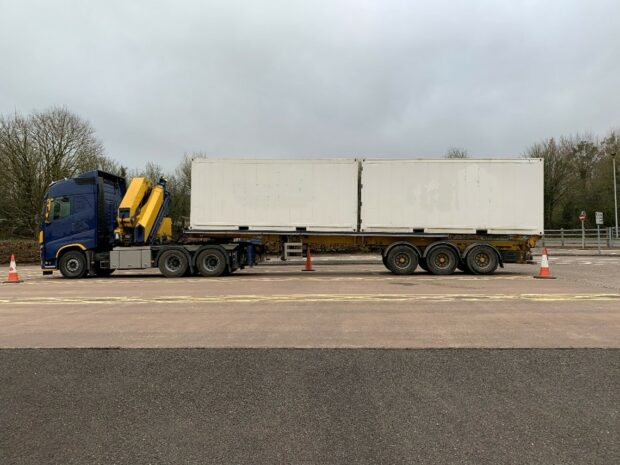
Example 2
A vehicle loaded with pontoon sections which was not an abnormal load but being transported incorrectly as STGO (Special Type General Order).
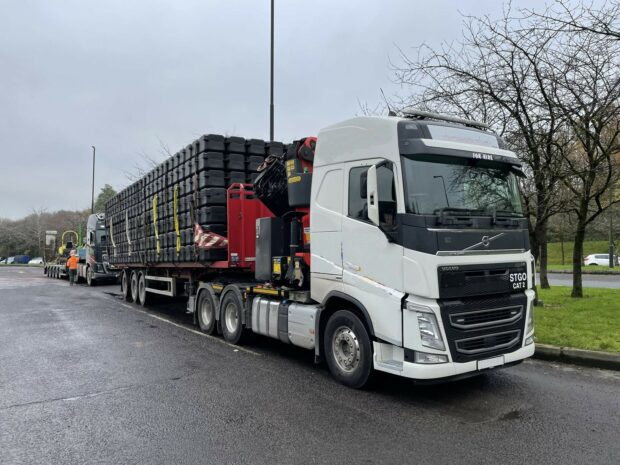
In this case, the vehicle was found to be overloaded at 29,460kgs (permitted 26,000kgs) on the tractor unit and measured at 18.mts (permitted 16.5mts). The operator claimed to have been told by the company which fitted the crane that it could be used legally and the dimensions of the crane could be subtracted. However, a DVSA examiner explained that this was incorrect and the vehicle needs to meet C&U dimensions.
The vehicle was prohibited for being overloaded. The following day the overloading issue was rectified when the operator informed Driver and Vehicle Standards Agency they had replaced the existing tractor unit with a lighter tractor unit. This enabled the driver and vehicle to continue their journey.
Overhangs and weights
The diagrams below demonstrate where to measure the front and rear of the total length of the vehicle. You can see the difference between the part of the “apparatus” that extends beyond the front or rear of the vehicle. In this instance, the length can be discounted and the HIAB type crane can be included in the vehicle length.
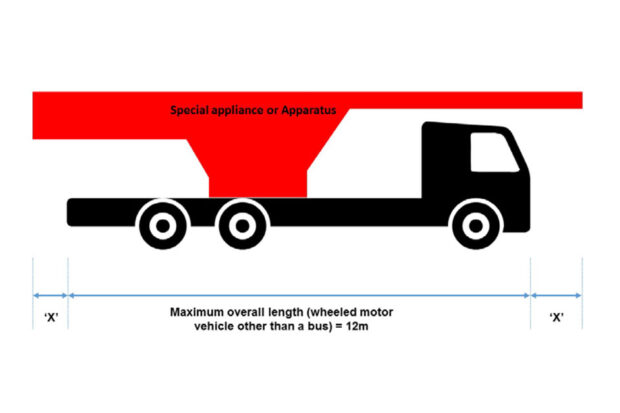
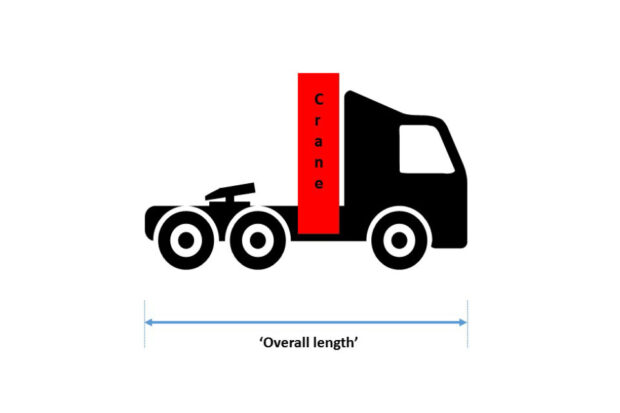
To help make sure your vehicle is operating at permissible length and weight:
- consider using a shorter trailer with the cab – to keep the length down and weight lighter
- check the total weight of a lorry and trailer combination - the maximum for a tractor unit is 26,000kgs and the weight of the crane has a significant impact on the payload
It is your responsibility as an operator to be aware of the rules before you put your vehicle on the road.
If you have any questions, please let us know using the comments box below.
36 comments
Comment by Stephen Harris posted on
I don’t believe there are any lorry loader vehicles on Uk roads with a lifting capacity of 80 tonnes. A 85 tonne/metre lorry loader would have a safe working load of under 30 tonnes
Would an answer to the overlengh problem be to shorten your standard trailer to a length that suits the extended wheelbase of a tractor unit with lorry loader then have the load on your trailer overhang at the rear of the trailer?
Comment by Julia (DVSA) posted on
Hi Stephen. Yes, you are correct using a shorter trailer is the answer if the load can overhang at the rear. As long as the C&U exemption requirements are met. The other issue with large cranes could be the reduction in carrying capacity which is also a consideration for operators.
Comment by Adrian posted on
You talk about 26000kg maximum weight. What if the tractor unit has 4 axles
Comment by Julia (DVSA) posted on
Hi Adrian. The maximum weight for a 3-axle tractor unit under C&U regs is 26,0000 kgs. Articulated vehicles satisfying certain conditions within the Authorised Weight Regulations with 6 or more axles can have a maximum train weight of 44,000kgs.
Comment by Adrian Hamill posted on
So the 4 axle unit is allowed to run 32000kg and 44000kg with 3 axle trailer. Is this correct?
Comment by Julia (DVSA) posted on
Hi Adrian A 4 axle tractor unit towing a semi-trailer cannot exceed 26,000kgs GVW within C&U Regs. If the vehicle is plated at 32,000kgs it is likely to be incorrectly plated as a rigid vehicle.
Comment by John posted on
Grandfather law
Comment by Julia (DVSA) posted on
Hi John. Grandfather rights do not have any relevance in this context. The rules are set down in the Construction and Use regulations, Authorised Weight Regulations.
Comment by Henry patterson posted on
Hi so at 16.5m is that the maximum you can extend the trailer to if the truck is under the 16.5m
Comment by Julia (DVSA) posted on
Hi Henry. 16.5 metres is the maximum length for an articulated combination including the tractor unit and semi-trailer. Under C&U exemptions, vehicles may exceed this if carrying a load of exceptional length provided the required conditions are met.
Comment by Henry patterson posted on
Thanks you just for record what is the penalty one could receive for being over the 16.5m rule
Comment by Julia (DVSA) posted on
Hi Henry The current penalty for a driver at the roadside would be a £50 fixed penalty. Follow up enquiries would be carried out for an operator which may result in court/public inquiry.
Comment by Steve Coombe posted on
Hi interesting article, that I totally agree with. But just out of interest, if you used a shorter trailer within the legal length but had say 3m rear overhang. Notified the rear overhang to the Police and correctly marked it would this then be a legal way to get over the length limit?
Comment by Julia (DVSA) posted on
Hi Steve. C&U regulations provide exemption for front or rear projections provided certain conditions are met relating to notifications and marking. The maximum rear overhang under C&U Regs would be 1-2 metres provided it is clearly visible, 2-3 metres with end marker boards and over 3metres with end and side markers, 2 days police notification and attendant/escort. There is no C&U exemption relating to weight.
Comment by paul wood posted on
Hi Julia,
I assume the court case in example one was used to establish a clear interpretation of the rules regarding special appliances and apparatus as Lorry Loader cranes were I believe previously placed under this heading regardless of their position on the vehicle/combination?
Comment by Julia (DVSA) posted on
Hi Paul. The guidance on GOV.UK (12 October 2017) is that only a part of special appliance or apparatus that extends beyond the extreme front or rear of the vehicle combination should be discounted when determining the vehicles overall length not the section of the vehicle where a crane mounted behind the cab of the tractor unit. There appears to some confusion within the industry. We are are hoping this blog will further clarify the position for operators.
Comment by Matt Hunt posted on
About time too. I can't count how many times I have lost work to companies running illegally overlength or overweight but doing it cheaper because they do it on one vehicle when the job needs to be seperate lifting and transport.
Comment by Steve posted on
This puts artic lorry loaders at a disadvantage over a lorry and drag lorry loader that can easily carry 2x 20' container and run at 18.75m
Comment by Julia (DVSA) posted on
Hi Steve Many companies operate within the regulations and feel at a commercial disadvantage because of vehicles and trailers operated over length overweight.
Comment by Dlift posted on
So will this affect operators running artic hiabs and low loaders on STGO?
Or just lighter divisible loads on 13m trailers?
Comment by Julia (DVSA) posted on
Hi. It is the load which is moved under STGO, the vehicle or trailer cannot be the reason for operating under STGO regulations.
Comment by A hiab operator posted on
The 80 tonnes Liftimg capacity is also wrong
There no hiabs that can lift that much weight
I think this is a farse pure, money making behaviour
Where is the safety issue ?
Detail the safety issues !
These trucks are not only essential to the UK construction industry but also contribute massively to many sectors of the economy.
there will be thousands of artic hiabs on the uk roads that now won’t comply to this rule which can only be described as a moving of the goal posts !!
It has always been known that the length of the hiab is not to be included in the overall length of the vehicle and Companies like MV commercial and Mac trucks even build the trucks with that in mind
So what are the operators to do with their £350,000 vehicles that will now not be fit for purpose ??
DVSA at their finest
Just a bunch of ill Informed government tax collectors
Last month low loaders
This month hiabs
What’s next month ??
You may as well give us a heads up !
Comment by Julia (DVSA) posted on
Hi. There has been no change to the regulations - we are simply raising awareness that these tractor units with large cranes fitted are potentially not fit for purpose reducing the length of trailer towed and weight capacity.
Comment by Richard posted on
Mistake was using standard 13.6m trailers. If they’d had the correct shorter trailers, so compliant length unladen, they could have just had the load overhang at the rear with projection markers etc as required.
Although the containers aren’t indivisible it seems so widely ignored, where loads like this, vehicles and machinery are concerned, so presumably not enforced.
Comment by Julia (DVSA) posted on
Hi Richard. You are correct - containers are not indivisible loads and should be moved under C&U Regs. If they are moved outside C&U requirements enforcement action will be taken where identified. The article does reference the movement of 2 containers as not being indivisible.
Comment by Neill posted on
26000kg? The combination should be 44000kg?
The unit running solo shouldn't weigh more than 26000kg?
Comment by Julia (DVSA) posted on
Hi Neil. That is correct the maximum train weight for the combination is 44,000kgs and 26,000kgs for the tractor unit.
Comment by Fern posted on
The maximum C&U length on a wagon and drag is 18.75 meters .
Can it legally have a 1 meter overhang on the the rear of the trailer ?
Comment by Julia (DVSA) posted on
Hi Fern. The maximum rear overhang under C&U Regs would be 1-2 metres provided it is clearly visible, 2-3 metres with end marker boards and over 3metres with end and side markers, 2 days police notification and attendant/escort.
Comment by Colin posted on
If the 2 20ft containers had been a 40ft would this then be legal at 17.65m?
Comment by Julia (DVSA) posted on
Hi Colin. The maximum permitted length for an articulated combination is 16.5metres. The containers are not an indivisible load so need to comply with C&U requirements. In this instance the issue was created by the length of the tractor unit.
Comment by Hazdriver posted on
Not before time, crane ballast weights are not indivisable
Comment by ALAN LIVINGSTONE posted on
80 TONNES?
Comment by Julia (DVSA) posted on
Hi Alan - this has now been amended to say '80 tonnes lifting capacity or more'. Thanks
Comment by Ron posted on
It made me laugh when I read that in the email, glad to see it got rectified in the article quickly.
We have a four axle 32T rigid that we maintain for a customer, it has a large crane. I was surprised at just how heavy it was - I had to keep taking our weights off until I got it right for the brake test the first time we did it! Even putting a 1T weight at the front of the bed made it overweight on axle two, it can barely carry 8T!
Comment by Julia (DVSA) posted on
Hi Ron. You are right this is exactly the issue we are trying to highlight.