Check your payslip if you work through an umbrella company
If you're a contractor or agency worker, find out how to check your payslip to make sure you are not involved in a tax avoidance scheme, operated by some umbrella companies.
Many umbrella companies follow the tax rules but some do not. You need to be aware of umbrella companies who attract people by claiming that you’ll be able to take home a higher percentage of your pay.
You need to understand how you get paid to make sure you are not involved in a tax avoidance scheme and are paying the right amount of:
- Income Tax
- National Insurance contributions
Read more about what it’s like to work through an umbrella company and how you’ll get paid.
How to check your Income Tax and National Insurance
If you receive more money in your bank account than shown on your payslip, it could be a sign of tax avoidance.
You should use:
- HMRC’s online tax calculator to check how much tax you should expect to pay on your income
- HMRC’s online National Insurance calculator to check what National Insurance contributions you should expect to pay on your income
When using the online calculator, make sure you include any payments you receive that may be described as non-taxable, such as loans paid into your bank account.
What to look out for
Some payslips will not show all payments made by the umbrella company, particularly where they involve loan type payments. Your payslip may only show payments paid through PAYE, to make it look compliant with the tax rules.
You may receive additional payments directly into your bank account and get an email to confirm you have received an amount of money in loans. This could be a sign of tax avoidance.
These payments could be described as one of the following:
- loan
- annuity
- bonus
- profit share
- fiduciary receipt
- credit facility
- capital payment
- capital advance
This list is not exhaustive.
You should look out for any payments that have not been subject to PAYE. If you have been told some of your employment income is not taxable this could be a sign of tax avoidance.
Pay rates, loan amounts and ways in which umbrella companies calculate these, will vary.
If you’re charged fees
If you’re charged fees by the company or person selling the arrangement for their services, these fees may not always be visible on your payslip.
You should have been made aware of these charges when signing your contract.
You should also compare the fees with other companies to make sure you are not paying higher than the normal fees, as this could be a sign of tax avoidance.
Payslip examples
Joe is a 30-year-old supply teacher and is paid monthly. He works a 40-hour week and is paid £14 per hour. Joe works through an umbrella company for an agency.
The 2 examples of payslips for the month ending July 2021 show different amounts of net pay (also known as take home pay).
Payslip 1 — A standard payslip
The hourly rate for Joe shows on payslip 1 as £14 an hour. The total hours worked shows 173.33 and the total net pay shows £1,878.98.

Payslip 1 shows the correct amount of pay and deductions for Income Tax and National Insurance contributions that Joe should be expecting to see.
Payslip 2 — A payslip involving tax avoidance
The hourly rate for Joe shows on payslip 2 as National Minimum Wage (NMW) rate of £8.91 an hour. The total hours worked shows 173.33 and the total net pay shows £1,314.34.
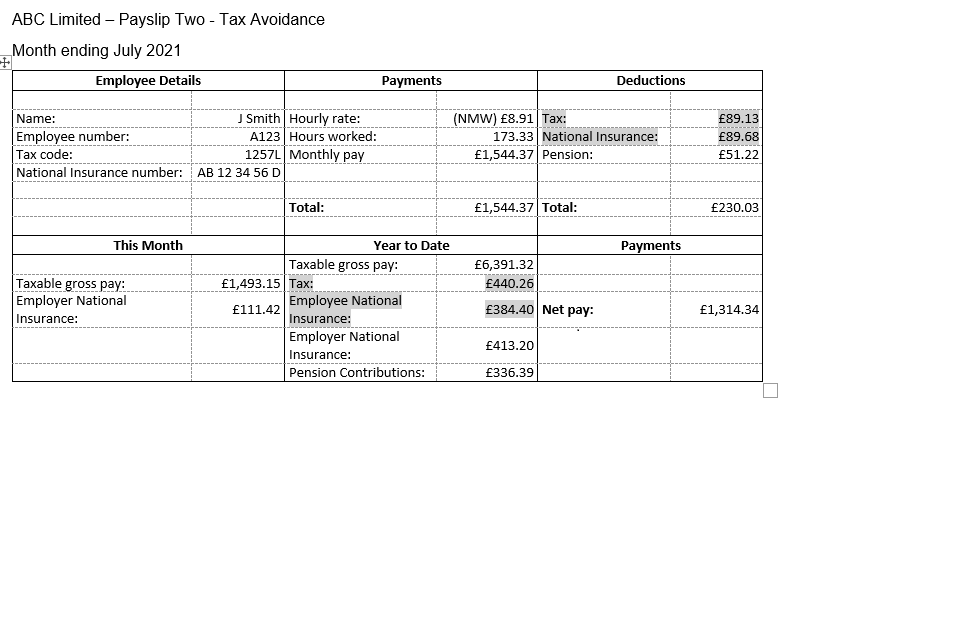
Payslip 2 is an example of what could be seen if Joe used a disguised remuneration tax avoidance scheme.
What are the differences between the payslips
Payslip 2 differs from payslip 1 because:
- Joe has been paid at the National Minimum Wage (NMW) rate which gives him a lower net pay
- Joe’s employer has not used his actual hourly rate of £14 an hour
- the rest of Joe’s salary gets paid directly into his bank account as a loan of £882.25, which does not appear on his payslip
Both payslips show the correct amount of tax and National Insurance contributions have been deducted, based on the gross pay shown. For payslip 2, Joe used a disguised remuneration tax avoidance scheme so he paid less tax and National Insurance contributions.
This is because the loan has not been included in PAYE calculations so he will need to pay this tax.
You need to check that your payslip includes all your income and that tax and National Insurance has been correctly deducted.
What are the risks of using disguised remuneration schemes
Using an umbrella company that claims you’ll be able to take home a higher percentage of your pay is very risky for you personally.
Anyone found using a tax avoidance scheme will be personally liable to pay:
- the tax and National Insurance contributions that are legally due
- interest on tax legally due
- any associated penalty
That is on top of any fees that you have paid to those selling the scheme.
What your responsibilities are
You are responsible for your own tax affairs, and to make sure you understand how you are being paid.
If you have concerns about the schemes you are currently using, you should consider:
- getting independent professional tax advice
- speaking to one of the tax charities
You can also contact HMRC by email: counteravoidancecampaign@hmrc.gov.uk.
HMRC does not approve or endorse umbrella companies or tax avoidance schemes.
How to report an umbrella company
You should report any tax avoidance arrangements to HMRC by either:
- using the online form
- calling HMRC to report a suspicious scheme
Add the reference ‘COCA’ to the box in section 1 of the online form called ‘other information you think may be relevant’, or give this reference when you call HMRC.
More information
Use the interactive risk checker to check if you are at risk of tax avoidance.
Find out more about:
- Payslips: employee rights
- Understanding your pay
- Check your pay campaign focussed on the National Living Wage and National Minimum Wage
- ACAS guidance on payslips