Professor Charlotte Watts
Biography
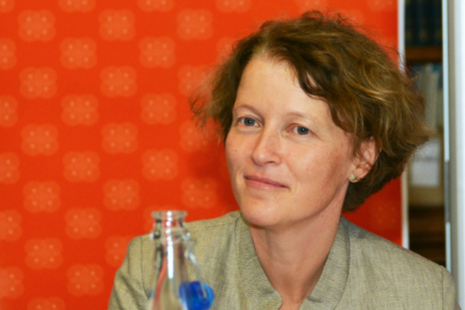
Professor Charlotte Watts is the Chief Scientific Adviser and Director for Research and Evidence in the Foreign, Commonwealth and Development Office (FCDO). She is seconded from the London School of Hygiene and Tropical Medicine (LSHTM), where she is Professor of Social and Mathematical Epidemiology.
Charlotte has over 200 peer review academic publications, commentaries and book chapters. She is a Fellow of the Academy of Medical Sciences and Foreign Associate Member of the US National Academy of Medicine.
Charlotte is committed to using science and evidence to achieve impact, and in 2019 was included in Apolitical ‘The World’s 100 Most Influential People in Gender Policy’. She also has a Chelsea Flower Show gold-medal for ‘the CAMFED garden’, that conveyed the transformative power of education for girls in Africa.
Charlotte is a global expert in violence prevention. She was Senior Technical Advisor to the WHO 10 country population surveys on women’s health and domestic violence. Charlotte founded the Gender, Violence and Health Centre at LSHTM. She has been senior researcher/principle investigator on 5 randomised controlled trials, to assess the impact of different forms of violence prevention, with the findings showing that domestic violence is preventable. Charlotte has Chaired the Technical Working Group to assess the Global Burden of intimate violence and was lead editor of the 2014 Lancet Series on Violence Against Women and Health.
In 2019 Charlotte was made a Companion of the Most Distinguished Order of St Michael and St George in the Queen’s birthday honours, for her services to domestic violence prevention, and in 2020 was awarded the Sir Edwin Chadwick medal by LSHTM, for her contributions to the prevention of violence against women.
Charlotte originally trained as a mathematician, with a PhD in Theoretical Mathematics from the University of Warwick. She became interested in global health whilst conducting post-doctoral research on the epidemiology of HIV at the University of Oxford. Charlotte moved to LSHTM in 1994, where she founded the Social and Mathematical Epidemiology Group. She built up a multi-disciplinary team that used mathematical, epidemiological and economic research to assess the impact of current and new HIV prevention technologies, and to evaluate interventions that tackle the determinants of HIV risk.
DFID Chief Scientific Adviser
The Chief Scientific Adviser is responsible for:
- providing or quality assurance of scientific advice to ministers, senior civil servants and government more widely
- providing leadership and management of DFID’s research budget
- championing the use of robust evidence, including from research and evaluation, across DFID
- providing professional leadership to the specialists within DFID
- working with the wider community of Chief Scientific Advisers to address cross departmental issues