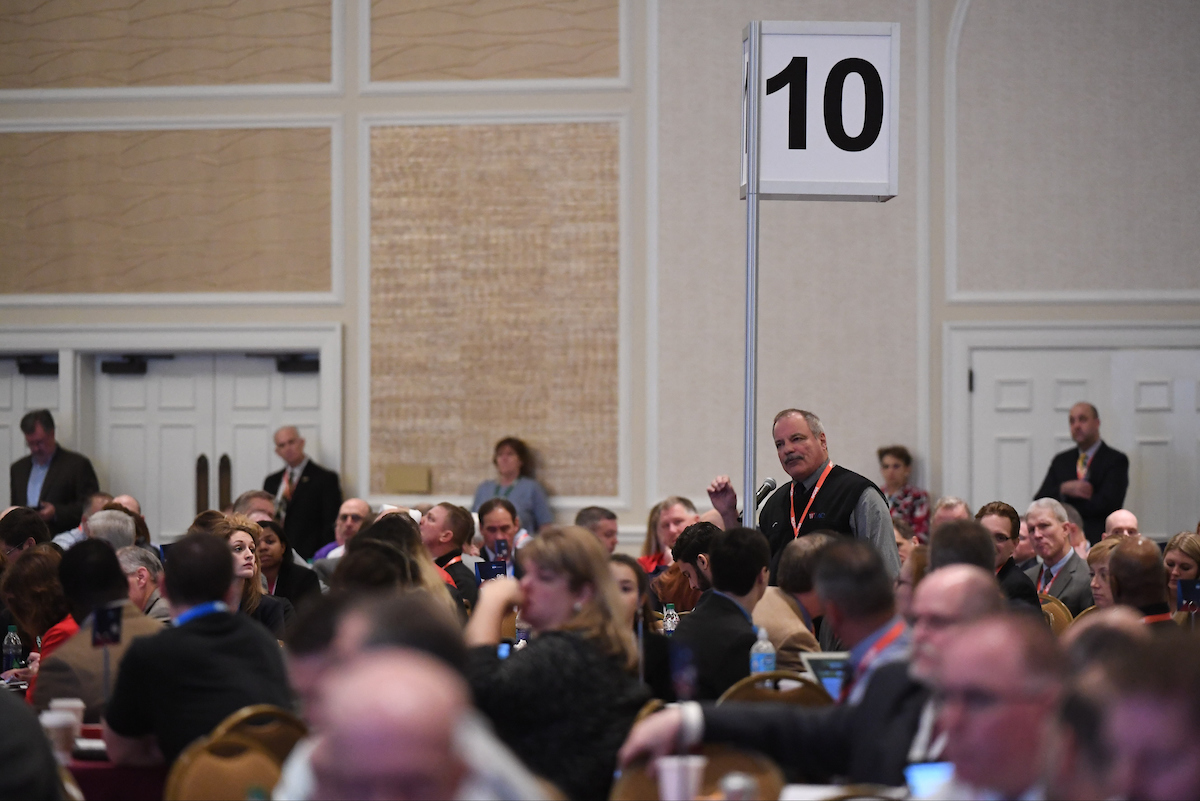
A proposal that would permit graduate students to participate in athletics at the Division III institution of their choice took center stage amid a series of wide-ranging discussions at Friday’s Division III issues forum at the 2017 NCAA Convention in Nashville, Tennessee.
In a lengthy dialogue, proponents noted that the proposal would provide more flexibility for student-athletes. Others, however, voiced concerns that it could have a drastic impact on competitive balance within the division.
Gary Karner, commissioner of the Wisconsin Intercollegiate Athletic Conference – one of the proposal’s cosponsors – noted students who have received their degrees are subject to more restrictive transfer rules than their peers who have not graduated. He also said in other divisions, data show graduate transfers make up less than 1 percent of the total population of student-athletes.
“The simple fact that the most restrictive transfer rule we have in Division III applies only to those student-athletes who have done exactly what we’ve asked them and expect them to do – earn an undergraduate degree – is counterintuitive to what we value most in Division III,” Karner said. “And to suggest that if we pass this proposal, we’re going to have this impactful migration of Division I and Division II student-athlete graduate transfers is a distortion of the facts.”
But opponents of the proposal, including Jeffrey Docking, Adrian College president and a member of the Division III Presidents Council, expressed concern that the rule change would draw student-athletes from other divisions, which could create competitive imbalances. He said he believed coaches would examine Division I rosters in hopes of finding student-athletes bound to graduate with remaining eligibility.
Docking was joined in his dissent by a handful of others who expressed similar concerns. Some worry about the disadvantage the rule change might place on schools without or with limited graduate programs. And in a meeting Thursday, the Presidents Council reiterated its opposition to the proposal.
“Recruiting will now start, if this passes, by scouting the landscape for Division I athletes that have not been playing or that want to go to another school, thereby tipping the balance of power,” Docking said. “I don’t think that’s in our DNA. I don’t think that’s who we are as an organization.”
Rob Wingert, Division III Student-Athlete Advisory Committee chair and former volleyball student-athlete at Stevenson University, articulated SAAC’s position of support. Wingert noted SAAC felt the proposal was designed in the best interest of student-athletes because it would broaden their athletic and academic opportunities.
Todd Clark, vice president of student affairs at Guilford College, illustrated how those opportunities might manifest when he addressed the room. He mentioned a women’s soccer player at his school who missed a season due to injury and hoped to be able to use her remaining year of eligibility at another school, where she planned to pursue a graduate degree. “She’s not a star on our team; she’s just someone who loves to play,” Clark said. “I love the idea that the legislation would give them that opportunity.”
Division III delegates will decide the proposal’s fate at Saturday’s business session, which begins at 8 a.m.
Other Issues Forum discussions:
- Alan Cureton, Presidents Council chair and president of the University of Northwestern-St. Paul, and Jay Lemons, Presidents Council vice chair and president of Susquehanna University, fielded questions from members on a range of issues. They offered insight on ongoing discussions regarding the composition of the NCAA Board of Governors, which now has 12 representatives from Division I and two each from Divisions II and III. A proposal for a revised structure – with more representation from Divisions II and III – could be presented to the board as early as April, though conversations are still ongoing. They also addressed the potential for academic misconduct legislation akin to a proposal Division II will vote on Saturday. The topic is currently being discussed at the committee level in Division III.
- Dr. Brian Hainline, NCAA chief medical officer, shared insight on key NCAA Sport Science Institute initiatives, including concussion research and efforts to address student-athlete mental health.
- He also fielded questions regarding the proposal related to independent medical care that Division III members will vote on Saturday. During the session, he addressed a question about how to ensure unchallengeable autonomous authority for athletics health care providers in situations where athletics directors also serve as coaches, a relatively common practice in Division III. Hainline noted that, should the proposal be adopted, athletics departments would need to implement a structure that ensures someone in a dual coach-athletics director role would not have sole hiring or firing authority over health care providers. He also offered details on the duties of the athletics health care administrator – a role that would need to be filled on each Division III campus if the proposal is adopted. The position is a designation and could be given to someone already on staff and would be the Sport Science Institute’s primary point of contact at each institution, enabling the group to provide up-to-date guidelines, resources and other information seamlessly to each campus.