Nathan Hatch, Rita Cheng and Harris Pastides, members of the NCAA Division I Board of Directors, detail the restructuring of how schools and conferences will govern themselves, paving the way for student-athletes to have a voice – and a vote – at every level of decision-making.
The Division I Board of Directors today restructured how schools and conferences will govern themselves, paving the way for student-athletes to have a voice – and a vote – at every level of decision-making.
The 16-2 vote adopted the updated Division I model that was released to the membership last month. Board members changed little from that proposal, only reducing the number of conferences required to sponsor a proposal within the group of five conferences from three to one (what is currently required to sponsor Division I legislation). Any amendment is subject to approval by a five-conference presidential group before consideration by the full voting group. The steering committee, which will continue as a transition committee, indicated it was open to tweaks over the next year.
“Today’s vote marks a significant step into a brighter future for Division I athletics,” said Nathan Hatch, board chair and Wake Forest University president, who also chaired the steering committee that redesigned the structure. “We hope this decision not only will allow us to focus more intently on the well-being of our student-athletes but also preserve the tradition of Division I as a diverse and inclusive group of schools competing together on college athletics’ biggest stage.”
NCAA President Mark Emmert praised the results of more than 18 months of work.
“I am immensely proud of the work done by the membership. The new governance model represents a compromise on all sides that will better serve our members and, most importantly, our student-athletes,” Emmert said. “These changes will help all our schools better support the young people who come to college to play sports while earning a degree.”
Much of the conversation among the presidents on the board emphasized the need for presidents to retain leadership of athletics, both on their campuses and within the NCAA, for the restructuring to be successful.

The final model expands the Division I Board of Directors to include not only more presidents, but also a student-athlete, faculty representative, athletics director and female administrator.
A new body known as the Council will be responsible for day-to-day operations of the division and include more voices: two seats for student-athletes, two for faculty and four for commissioners.
The new model also grants flexibility to schools in the Atlantic Coast, Big 12, Big Ten, Pac-12 and Southeastern conferences to change rules for themselves in a list of specific areas within Division I. The legislative process for these 65 schools, which could begin as early as Oct. 1, includes three student-athlete representatives from each conference who will vote on rule changes within those conferences.
The Council governance process will be streamlined and simplified as well: Rules can be adopted in April only, instead of April and January. Additionally, the process for requesting reconsideration of a rule will be simplified (see graphic). If a rule change is defeated, that same change can’t be considered again for at least two years.
The proposed governance redesign legislation is subject to a 60-day override period as specified in the current legislative process. For the board to reconsider the change, at least 75 schools must request an override. Generally, reconsideration occurs at the next scheduled board meeting, set for Oct. 30.
The new model was adopted as a single piece of legislation, and any override request must override the entire model, not specific portions.
HIGHLIGHTS
Board Composition

The 24 members would consist of:
- Five presidents from the five highest-resource conferences (Atlantic Coast Conference, Big Ten Conference, Big 12 Conference, Pacific 12 Conference and Southeastern Conference)
- Five presidents from the remaining five Football Bowl Subdivision Conferences (American Athletic Conference, Conference-USA, Mid-American Conference, Mountain West Conference and Sun Belt Conference)
- Five presidents from the Football Championship Subdivision
- Five presidents from Division I schools without football
- Chair of the Division I Student-Athlete Advisory Committee, Chair of the Council (the governance body charged with the day-to-day work of the division, intended to be an athletics director), a Division I member of the Faculty Athletics Representatives Association appointed by the group’s executive board and a campus senior woman athletics representative chosen by the executive committee of the National Association for Collegiate Woman Athletics Administrators.
The FCS and Division I conferences would determine the rotation of conferences with representation on the board.
Council Operations
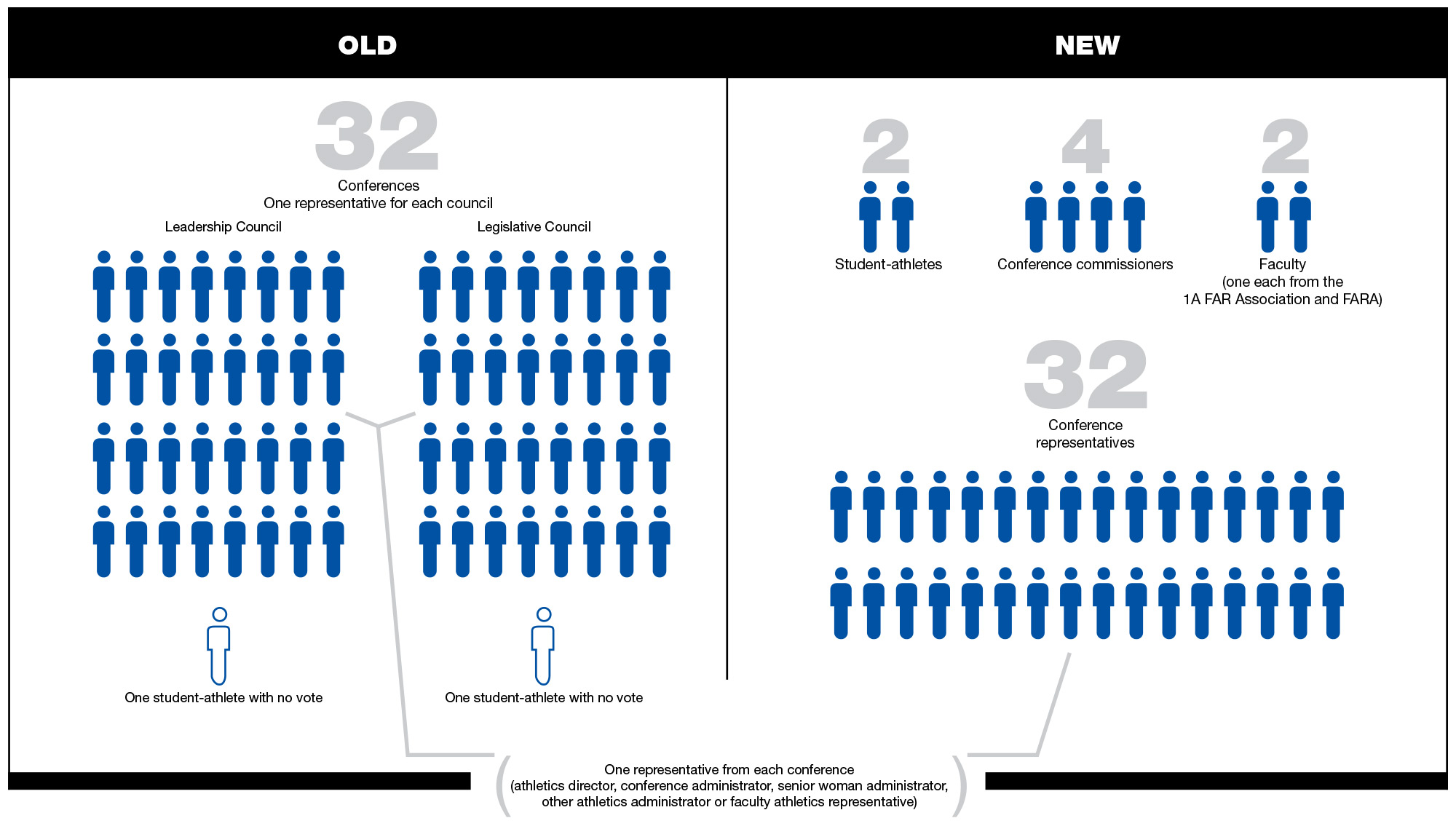
The increase in size would make the weighted voting totals on the Council:
- 37.5 percent for the five highest-resource conferences
- 18.8 percent for the five remaining FBS conferences
- 37.5 percent for the FCS and Division I (no football) conferences
- 3.1 percent for the student-athletes
- 3.1 percent for the designated faculty athletics representatives
Flexibility

- The steering committee removed transfers from the list of rules that the 65 schools in the five highest-resource conferences could change– with a caveat. The five conferences requested flexibility over transfers if substantial change isn’t accomplished within the new structure’s first two years.
- In order for more flexibility to be granted over an area, three of the five major conferences would have to agree. If 12 of the 20 presidents or chancellors on the board approve, the item can be moved to the list. The steering committee chose to lower these thresholds because feedback from within the five conferences indicated that the previous standard could impede the ability of the conferences to advance an agenda to support student-athletes.
- To conduct business within this category, each of the five conferences would appoint one representative from each of the 65 member schools and three student-athlete representatives from each conference to cast votes, for a total of 80 votes. Items could be approved in two different ways:
- 60 percent of all votes (48 votes) and a simple majority support from schools in three of the five conferences, or
- A simple majority of all votes (at least 41) and simple majority support from the schools in four of the five conferences.
Substructure
- The substructure would include a Committee on Academics, which will report to the board of directors while still maintaining a close relationship with the council and other groups that will address legislative and championship/competition/student-athlete well-being issues.
- The substructure for shared governance will not be prepared to consider and adopt legislation until the 2015-16 legislative cycle.
Timeline
The new governance model will move forward toward full implementation by mid-2015.
