LEFT:
© XXXXXXXX
PARSLEY
ROOT
Parsley is our everyday herb, so common
that it’s often used as a throwaway, a
garnish that goes uneaten but is set on the
edge of a plate for its cheerful color. Parsley
root, however, is seldom seen, and that’s a
shame. Like the leafy herb, its flavor is lively and
clean. Long stems support amass of dark leaves that
closely resemble flat-leafed parsley in appearance,
smell, and taste, except that they are darker green,
rougher, and less delicate than the bunch of parsleywe
buy at themarket or snip from the garden. It’s easy to
see that parsley and parsley root are closely related,
but one is grown for the green leaves, the other for its
root, and therein lies the difference.
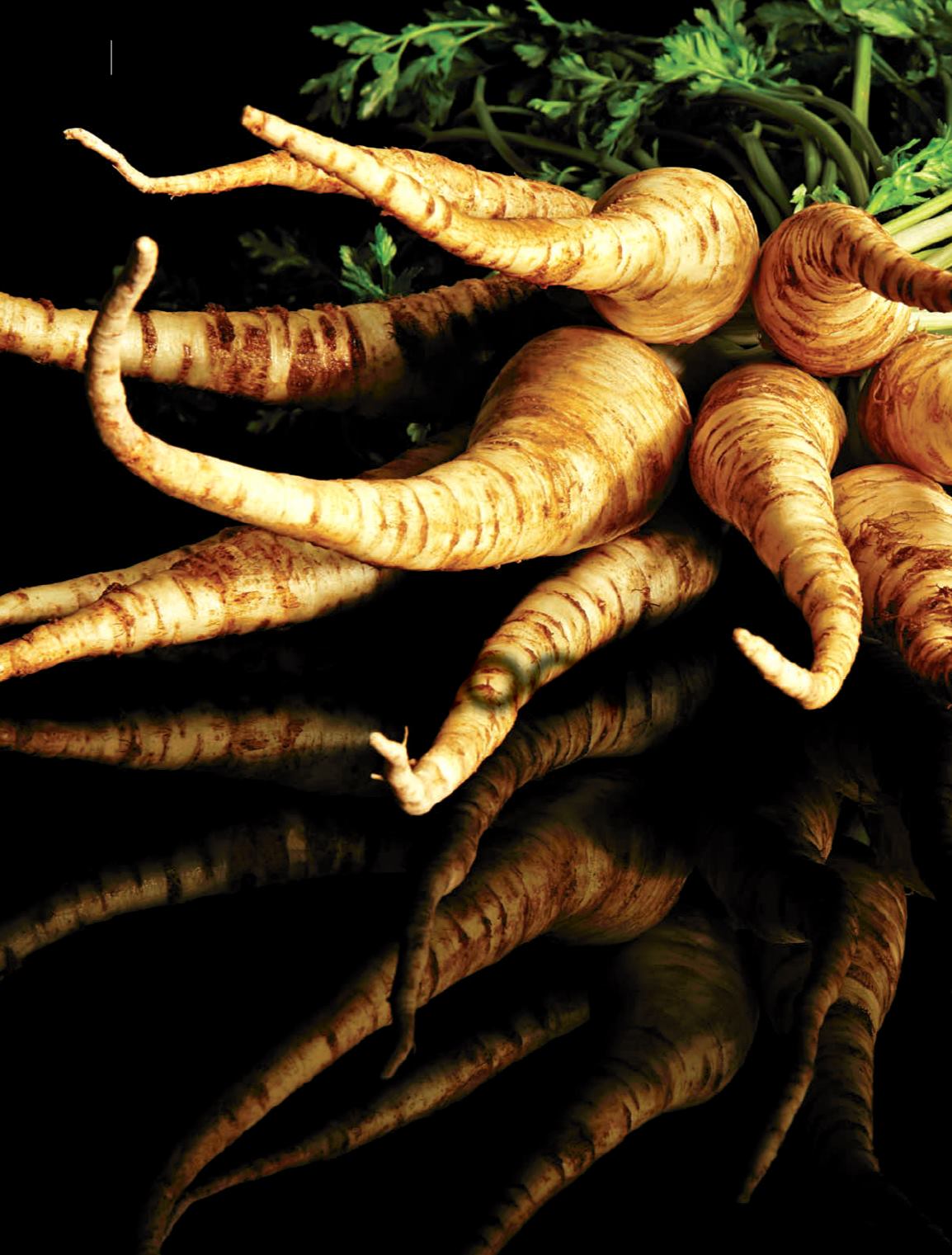
Parsley root has many names, among them
Hamburg parsley (it’s popular in eastern and central
Europe and in Germany). It’s not as hefty as a parsnip,
which it superficially resembles, and a bunch of five
small roots canweigh as little as eight
ounces. When you can find them, they are
often only five inches or so long, depending
on the variety. As root vegetables go, parsley
root is one of themore subtle ones; bright but
not bombastic.
Because they’re still an unusual find here, you’ll
want to tease out every possibility, using the peels
in a stock as well as the stems and some of the
leaves to underscore the flavor of your final dish, be
it a braise, puree, or soup. Parsley root can easily be
pairedwith other root vegetables. They are delicious
inmashed potatoes, lending their brightness to the
subtle tuber, or with celeriac or parsnips. They also
work well simply braisedwith diced shallot, butter,
and some of the stockmade from the trimmings,
and no onewill guess what these delicious little
burnished vegetables arewhen you serve them.
FALL 2012
celebratedliving.com
66
FOOD
Fresh Focus


