Take a moment and review some of the comments from the participants in the
Colloquium on Participant-Centered Learning.
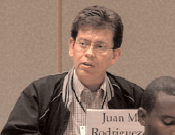
Juan Manuel Rodriguez-Garza, EGADE-ITESM, Mexico: The move to participant-centered learning was led by the president of the school. The redesign of
the learning process was based on making the school more student-focused.
Professors were offered $4,000 and a new computer if they would redesign
their courses to the new model. A new technology platform was created to help
professors to design and deliver their content. Professors were given training in
the new skills needed for case teaching. (paraphrased)
“We went to a training program. We worked on how to teach, so to speak; how
to make a student learn in a participant-centered learning environment. So we had to change our approach
and redesign all the activities that we had in the class, in our syllabus. So it was no longer, ‘Listen to me talking about economics,’ but rather, ‘Do something.’”
The school also changed the way professors were evaluated. No longer were teachers evaluated on how they taught, but rather on how their students learned. Initially, professors who were considered to be innovators were encouraged to try participant-centered learning. Their success led to increased support. (paraphrased) "The new teaching model is an ongoing system-wide effort that involves thirty-three campuses and more than 5,000 professors."
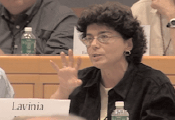 Lavinia Rasca, Institute For Business And Public Administration,
Romania: We started in a state-owned university as an MBA program, and
together with the University of Washington, in Seattle. When we had our first
alumni, the alumni were directors of very different, successful companies. And
when the word spread in the business community, we started being seen as a
prestigious school, and people started to look at us as a serious school. And
actually, we ended up leaving the state-owned university and started from
scratch on our own. And we are almost 100 percent based on case teachings
and participant-centered learning. And actually, we started as ten professors coming here, because Professor Piper and Professor Aguilar came to Romania and included us in the CDP program. So we were trained here in order to teach with cases, and that helped tremendously.
Lavinia Rasca, Institute For Business And Public Administration,
Romania: We started in a state-owned university as an MBA program, and
together with the University of Washington, in Seattle. When we had our first
alumni, the alumni were directors of very different, successful companies. And
when the word spread in the business community, we started being seen as a
prestigious school, and people started to look at us as a serious school. And
actually, we ended up leaving the state-owned university and started from
scratch on our own. And we are almost 100 percent based on case teachings
and participant-centered learning. And actually, we started as ten professors coming here, because Professor Piper and Professor Aguilar came to Romania and included us in the CDP program. So we were trained here in order to teach with cases, and that helped tremendously.
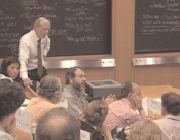 Professor Heskett: So it starts with a critical mass again.
Lavinia Rasca: We were training the same way, and we could resist all the
trends in the university, in the ministry of education, and everywhere. And we
knew that what we were doing was right, even if everybody was, at the beginning,
against us.
Professor Heskett: Again, it was the business community that provided a big
boost and a certain authentication of what you were doing.
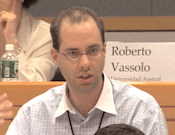 Urbi Alain Garay, IESA, Venezuela: Well, our students may be afraid of using cases if they are not used to that, because it's something new, and you are
afraid of new things. But, on the other hand, sometimes in the programs they
demand more real-life situations in the class.
Urbi Alain Garay, IESA, Venezuela: Well, our students may be afraid of using cases if they are not used to that, because it's something new, and you are
afraid of new things. But, on the other hand, sometimes in the programs they
demand more real-life situations in the class.
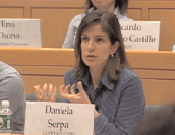 Daniela Abrates Serpa, COPPEAD/UFRJ, Brazil: Some cases are not so complex and don't demand too much experience to discuss. And also, you have to do some
different things with the discussion. You have to give them more incentive to get
more self-confidence for them to behave in class. But at the end, it's very gratifying to
see how they also show interest in being a participant.
Daniela Abrates Serpa, COPPEAD/UFRJ, Brazil: Some cases are not so complex and don't demand too much experience to discuss. And also, you have to do some
different things with the discussion. You have to give them more incentive to get
more self-confidence for them to behave in class. But at the end, it's very gratifying to
see how they also show interest in being a participant.
I deal with MBA students also, and we are always complaining that they are not prepared
for the case-study method. But if you don't start with undergraduate students,
how can you expect, that when they do an MBA or something, they will be willing to participate?
 Roy Zuniga, INCAE, Nicaragua: What we do in order to keep it alive may be of some interest for some of you. We have this applied research center. We keep
between five or seven students. I mean, we call them professional case writers, but
these are people who finished their MBA two or three years ago. They are going
through their PhD track, but we kept them with us so they will help us to write
cases. So in order to increase our production of cases along the year, every professor
is supposed to produce two cases, or to read the materials.
Roy Zuniga, INCAE, Nicaragua: What we do in order to keep it alive may be of some interest for some of you. We have this applied research center. We keep
between five or seven students. I mean, we call them professional case writers, but
these are people who finished their MBA two or three years ago. They are going
through their PhD track, but we kept them with us so they will help us to write
cases. So in order to increase our production of cases along the year, every professor
is supposed to produce two cases, or to read the materials.
We have forty professors. So per year, we will end right in between one hundred and 150 new cases. But this is really an institutional approach, and there are even budgets for writing cases. And there is a budget for every area of the MBA. So the university really has to invest in order to keep the system alive. And the other policy is that every course should change at least 20 percent every year, if you want to keep it updated. So you have to keep producing new cases. Executive education is really about sponsoring our MBA courses and our research.
 Jonathan Coles, IESA, Venezuela: I think executive education tends to be the one that pays all the bills. But we don't use it as rigorously as we could, to get the buy-in
from the business sector, and to get them to see, with high-level teaching at the
executive education level, how valuable it is for their needs. They tend to not see it.
I think we're overestimating that. They tend to not see it at all. As a matter of fact,
many of them just want the quick fix. So that's a big challenge.
Jonathan Coles, IESA, Venezuela: I think executive education tends to be the one that pays all the bills. But we don't use it as rigorously as we could, to get the buy-in
from the business sector, and to get them to see, with high-level teaching at the
executive education level, how valuable it is for their needs. They tend to not see it.
I think we're overestimating that. They tend to not see it at all. As a matter of fact,
many of them just want the quick fix. So that's a big challenge.
 Benito Revah, Instituto Tecnologico Autonomo de Mexico (ITAM), Mexico: We use a type of case method, but just at the very end of the undergraduate courses.
We believe that we have taught them all the lessons that they have to learn. And at
the end of the course, we have to develop skills. And we are committed, that to
develop skills is a center for participant-learning process. We are committed to that.
And in the MBA, we use a lot of cases, and try to make our graduates the best
entrepreneurs in Mexico.
Benito Revah, Instituto Tecnologico Autonomo de Mexico (ITAM), Mexico: We use a type of case method, but just at the very end of the undergraduate courses.
We believe that we have taught them all the lessons that they have to learn. And at
the end of the course, we have to develop skills. And we are committed, that to
develop skills is a center for participant-learning process. We are committed to that.
And in the MBA, we use a lot of cases, and try to make our graduates the best
entrepreneurs in Mexico.
 Marcelo Paladino, IAE-Universidad Austral, Argentina: In Argentina, for instance, business education, management education, postgraduate education is
pretty new. We are only twenty-five years old, and we are in the line of training by
cases. It's barely beginning. And now any other institution that is created really
needs to put, at least in postgraduate education, a bit of teaching with cases, especially
when you go to MBA. When you go to managers and talk management—
presidents, owners of companies—it's like they need cases to be used. Private
institutions and state-owned institutions all over the country are now trying to use
cases.
Marcelo Paladino, IAE-Universidad Austral, Argentina: In Argentina, for instance, business education, management education, postgraduate education is
pretty new. We are only twenty-five years old, and we are in the line of training by
cases. It's barely beginning. And now any other institution that is created really
needs to put, at least in postgraduate education, a bit of teaching with cases, especially
when you go to MBA. When you go to managers and talk management—
presidents, owners of companies—it's like they need cases to be used. Private
institutions and state-owned institutions all over the country are now trying to use
cases.
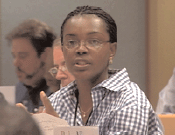 Chinyelu (Chichi) Amangbo, Lagos Business School, Nigeria: I think, in terms of the minimum, it's the fact that you're here, and you got the training, and
then that you go back to your institution and you use it to teach. I think that's the
minimum. It's not something that is going to happen overnight. It's something
that starts gradually. It starts with the will to do it, and then gradually more people
adopt the method, more people use it, and it just moves on like that.
Chinyelu (Chichi) Amangbo, Lagos Business School, Nigeria: I think, in terms of the minimum, it's the fact that you're here, and you got the training, and
then that you go back to your institution and you use it to teach. I think that's the
minimum. It's not something that is going to happen overnight. It's something
that starts gradually. It starts with the will to do it, and then gradually more people
adopt the method, more people use it, and it just moves on like that.
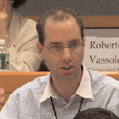 Urbi Alain Garay, IESA, Venezuela: I would say, thinking about some professors in my school, a number of them would think the case method is an inferior thing. You
can have the classrooms. You can have all the money. Well, they would react to
money. But there is not much you can do unless you change that philosophy or that
thinking. You have to convince them in some way, and then the other things will
come. But for those people, there is nothing you can do unless you change their
thinking of the method, which, basically, they don't know it.
Urbi Alain Garay, IESA, Venezuela: I would say, thinking about some professors in my school, a number of them would think the case method is an inferior thing. You
can have the classrooms. You can have all the money. Well, they would react to
money. But there is not much you can do unless you change that philosophy or that
thinking. You have to convince them in some way, and then the other things will
come. But for those people, there is nothing you can do unless you change their
thinking of the method, which, basically, they don't know it.
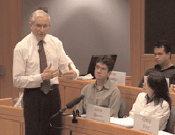 Professor Heskett: That's a very difficult first step.
Urbi Alain Garay: But it's the first and biggest obstacle. I don't know.
Professor Heskett: What Chichi was recommending was that Joe just start to do it
in his own classroom. And then do you invite colleagues in to allow them to
observe, or what? Chichi?
 Chinyelu (Chichi) Amangbo: I think you allow colleagues in, and you gradually get people within your school, the faculty, to start teaching that way. But the way you want to go out.... I remember what we did in my school. We actually started with the
chief executive program. So we first got a group of chief executives together. They
went through the program and they liked it, and that helped build consensus.
Chinyelu (Chichi) Amangbo: I think you allow colleagues in, and you gradually get people within your school, the faculty, to start teaching that way. But the way you want to go out.... I remember what we did in my school. We actually started with the
chief executive program. So we first got a group of chief executives together. They
went through the program and they liked it, and that helped build consensus.
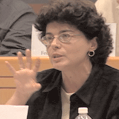 Lavinia Rasca: Well, an advantage to sell to the other, in order to convince them how important the case method is, is the fact that the executives who come to get
the courses don't only seek attitudes and information, but also seek networking and
exchange of opinion. And, well, maybe you don't have cases of the mother country
available, but there are plenty of cases from Harvard and other business schools
that relate to the issues that you want to teach in the course. And then during the
discussion process, they can tell, well, in this case it's like this, but in our country it's
like this. In my company it's in this way. So the exchange of opinion enhances learning, and it is very important. And for them networking is very, very strong.
Lavinia Rasca: Well, an advantage to sell to the other, in order to convince them how important the case method is, is the fact that the executives who come to get
the courses don't only seek attitudes and information, but also seek networking and
exchange of opinion. And, well, maybe you don't have cases of the mother country
available, but there are plenty of cases from Harvard and other business schools
that relate to the issues that you want to teach in the course. And then during the
discussion process, they can tell, well, in this case it's like this, but in our country it's
like this. In my company it's in this way. So the exchange of opinion enhances learning, and it is very important. And for them networking is very, very strong.
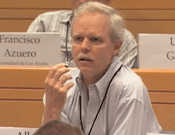 Alberto Arturo Franichevich, IAE-Universidad Austral, Argentina: Thinking how we started, it's pretty much related to the fact that having the constraint on faculty availability and experience or expertise, the way we started is bringing in professors
that had that expertise, and that way we had the capability already there. We were
able to teach high-quality courses and give credibility to the case method. And our
teachers, our local teachers, would be able to learn from some experts, and in a way
also eventually be coached. Because the experts could see our non-expert people's
classes, and in a way give them that help. That was at the beginning. Now it's a little
bit different. But at the beginning maybe that helps, because you don't have to invest
so heavily up front.
Alberto Arturo Franichevich, IAE-Universidad Austral, Argentina: Thinking how we started, it's pretty much related to the fact that having the constraint on faculty availability and experience or expertise, the way we started is bringing in professors
that had that expertise, and that way we had the capability already there. We were
able to teach high-quality courses and give credibility to the case method. And our
teachers, our local teachers, would be able to learn from some experts, and in a way
also eventually be coached. Because the experts could see our non-expert people's
classes, and in a way give them that help. That was at the beginning. Now it's a little
bit different. But at the beginning maybe that helps, because you don't have to invest
so heavily up front.
back to top



