| **These are clickable page links** | ||
| HOME | TECH INFO | SPECIALS |
| FRIDGES | SOLAR | INVERTERS |
| CHARGERS | BATTERIES | OTHER |
| CONTACT | FIND US | LINKS |
 |
Dual
Battery Systems |  |
| Auxiliary
Batteries are used to operate appliances while you are away
from mains 240v power,
and also so you don’t run the risk of compromising you vehicles main starting battery (I'm sure that you agree that jump or push starting your vehicle is not much fun and best avoided.)  People
have been using and charging auxiliary batteries in their cars and
caravans with varying degrees of success for over a century. These days we expect much more, we like to run lights, TV’s, Laptops, DVD’s, pumps, fridges, winches, and charge camera batteries and mobile phones etc, some even run microwaves, it is true that some of us like all the luxuries of home when we go ‘camping’. So over the years our demands on the humble auxiliary battery have increased to the point that we need much more usable energy, and over a longer period of time, and we need fast and safe ways to recharge our batteries. Many of the old ways used to charge these batteries are now antiquated, and they mostly never did the job very well anyway, neither were they conducive to long battery life. So
lets look at what we need to build a system that will deliver the best
performance for our hard earned dollars. What’s needed. Well
I guess a good place to start would be an auxiliary battery, then we
need an efficient way of charging this battery using the cars
alternator, and most importantly, a way of isolating the auxiliary
battery
from your
starting battery, so that your starting battery is not compromised, and
so you will always be
able to start you vehicle and not be left stranded. Auxiliary Batteries. Basically
you should be thinking about how big a battery can you fit, and less
about how small and cheap a battery you can get away with, now I know
money does not grow on trees, however the larger
the battery the less percentage wise you will be draining it each day,
and the
longer it will last for you, both in power usage (battery capacity),
and in battery life
(longevity), with the
extra advantage of some extra capacity available to you if needed. Hot
Tip …Batteries LOVE
being fully charged,
they do
NOT (never)
much like being discharged at
all, they do LIKE it when you only take
them down to about 50% of their capacity, and then top them back up
soon as you can (within a day or so). Deciding on what size and type of Auxiliary Batteries to use is really a whole other story, please read my article on AGM (Absorbed Glass Matt) batteries >>Please click here for my article on AGM batteries<< The Battery Isolator. The battery isolator is a device that allows the cars alternator to recharge the auxiliary battery while protecting the cars starting battery from discharging, if these batteries are simply linked together you run the very real risk of draining them both to a level that you can not start the engine, and there are many other reasons why you should not do it this way. So hence we have the battery isolator, there are many different methods used to isolate the batteries, most use some form of solenoid, this is an electronic switch that can handle large (charging) currents, much more than standard switches can, and they are operated by applying a small amount of power to them, this is turn actuates a solenoid that links the batteries together so that large currents and be passed between the batteries. There are many ways to operate these battery isolators, some much better that others. The cheapest way is that you manually turn them on and off, I call these idiot switches, because sooner or later some idiot (and I've been there) will forget to turn the switch on (no charge goes into the auxiliary battery) or off at the right time (and then the starting battery gets drained as well). Another way of doing it is to have the solenoid turn on as soon as you start the engine up, and turn off when you shut down the engine, this has been the cheap way of doing it for many years, but it’s far from ideal and does have a few pitfalls. I believe the best way for most situations is to use a VSR (Voltage Sensitive Relay) activated solenoid, and I explain a little further on how they work and why I think they are so good. Now
for
years I had used the Redarc Smart Start VSR with great success,
and I've sold hundreds of them,
they really are a good unit. However a while ago after doing more research and testing I came across another VSR that I found I liked even better, with many great features, and I've listed some of them below in my explanation of how it works. This
one I like the best and now use is also one of the
least expensive ones, and it does the
job
very well, truly
ultra reliable (has been used in the boating/marine industry for many
years), and
I believe these are as good as, and often better than many of the much
more expensive VSR's. My choice now is the Enerdrive VSR battery isolator, and I explain below how it works.  These Enerdrive VSR's are priced at around $79.95 Please note, if you have already bought, or prefer to use the Redarc Smart Start VSR, I have an information page on how they work and how to install them >>please click here for the Redarc Smart Start VSR details<< otherwise please read on below.When you start your engine the Enerdrive VSR works by first letting your starter battery recover it’s charge from the alternator, it lets the cranking battery achieve 13.3 volts, at this point that battery now has about as much charge in it as it's going to get, now once the Enerdrive VSR sees this 13.3 volts it closes the contacts on the solenoid, this links both batteries together for charging purposes. The next thing the Enerdrive VSR is looking for is 12.8 volts, in other words it's likely that you have now shut down your engine and started to draw power from the batteries, so after a short while the voltage across both batteries will slowly fall, and when they get down to 12.8 volts, the Enerdrive VSR will see this voltage it will open up the solenoid contacts and isolate the batteries, leaving your starting battery for starting, and your auxiliary battery for auxiliarying ;-) Some
of the Enerdrive VSR's major
features
are............
I love how compact it is, with no ugly exposed cable posts sticking out. The unit is waterproof, so a bit or even a lot of water is not going to stop the Enerdrive VSR from working. The Enerdrive VSR battery isolator is rated at 140Amps constant duty. It also has Surge Protection so it won’t upset the delicate electronics on newer vehicles. When the VSR is engaged (closed, linking the batteries together) a red LED comes on the top of the Enerdrive VSR . This VSR consumes no power at all while it is not engaged, i.e. the voltage of both batteries has dropped below 12.8V, and then it consumes only 0.34A when it is engaged.  The Enerdrive VSR
has one more huge
advantage in that it is Dual
Sensing (bi directional),
what this means
is that if you have a battery charger, or solar power connected to
your auxiliary
battery, and that battery gets charged enough to hit the Enerdrive
VSR's
set points, then it will allow your charging source to back
charge the cranking battery as well,
making sure that it's kept fully charged too, but again, if the voltage
drops below 12.8 volts, the Enerdrive
VSR will again disconnect
(isolate) the
batteries, so how cool is that
The Enerdrive VSR
has one more huge
advantage in that it is Dual
Sensing (bi directional),
what this means
is that if you have a battery charger, or solar power connected to
your auxiliary
battery, and that battery gets charged enough to hit the Enerdrive
VSR's
set points, then it will allow your charging source to back
charge the cranking battery as well,
making sure that it's kept fully charged too, but again, if the voltage
drops below 12.8 volts, the Enerdrive
VSR will again disconnect
(isolate) the
batteries, so how cool is that

The Wiring & Cabling. Wiring…this is without doubt where many people get it wrong and end up with a system that may work, BUT barely, and nowhere near as well as it could and should, doing it right can double the usable capacity of your auxiliary batteries over and above what many people normally have, and it will also help them charge much faster, and in turn they will last longer too. Please understand that when charging from a vehicle alternator one of your biggest enemies is voltage drop, you need to have the highest possible voltage at the auxiliary battery, this will allow it to charge as quickly as possible, and as fully as possible. Some standard set-ups I see regularly that have been fitted by the so called professionals is where they use twin 6mm auto cable (really 4.59mm²), this is next to useless for fast, deep charging. A very basic explanation would be, that the larger the current draw, the larger the wire (cable) needs to be, and the further the distance the wire/cable needs to run, the increasingly larger again the wire/cable needs to be, resistance over distance is the problem. Water
and power analogies work well here, so think about it, if you want to
fill a bucket full of water fast, would you use a hose the size of a
straw, or a ½ inch garden hose, or bigger (bigger is always
best!), what one do you think will
fill the bucket quicker? Fusing
& Cable Protection!   Putting
fuses in is necessary because of the potential of a short circuit, now
seeing as we are installing good heavy cable so that we can transfer
large amounts of current quickly, there is a possible downside
...................... After
having a few
failures sometime back using 100A Maxi fuses (they were melting, not
blowing, melting because of high
resistance, this
created heat with the high currents),
so after doing a lot of
testing I found that the MEGA fuse performed best in this situation,
the MEGA fuse has been used for many years when connecting Inverters
and other very heavy draw appliances to
batteries. Battery placement. A very important thing to consider is where you are going to place your batteries, standard open wet cell batteries give off hydrogen gas when they are charging and discharging, this is a very explosive gas, remember the Hindenburg, there is no problem if you are putting the auxiliary battery under the bonnet of your vehicle, or mounting it somewhere on the chassis with good ventilation to the open air. Just throwing them under a seat or in a cupboard is far from ideal and just down right dangerous, even worse some people place battery chargers and even inverters next to these batteries, just think about that for a moment, a hydrogen producing device next to a possible spark producing device, I guess some people just don't know or don’t think! Wet cell batteries must be housed in a properly vented area, and must be well vented externally away from any ignition source and from human habitat areas, hydrogen gas rises so sealed battery enclosures should be vented externally top and bottom. If you need to place batteries inside vehicles, then AGM batteries should be seriously considered here as they are totally sealed, AGM batteries if placed in an enclosure only need to be vented to atmosphere not necessarily vented externally. Putting AGM batteries under the car bonnet is fine as far as safety goes, the only consideration here is that AGM’s and any fully sealed batteries should be kept away from the extreme temperatures of turbochargers, and if they must be placed close to the turbocharger, then heat shields should be used. How
to wire it all up. Now
this is much simpler than most people think, it is not complex, and as
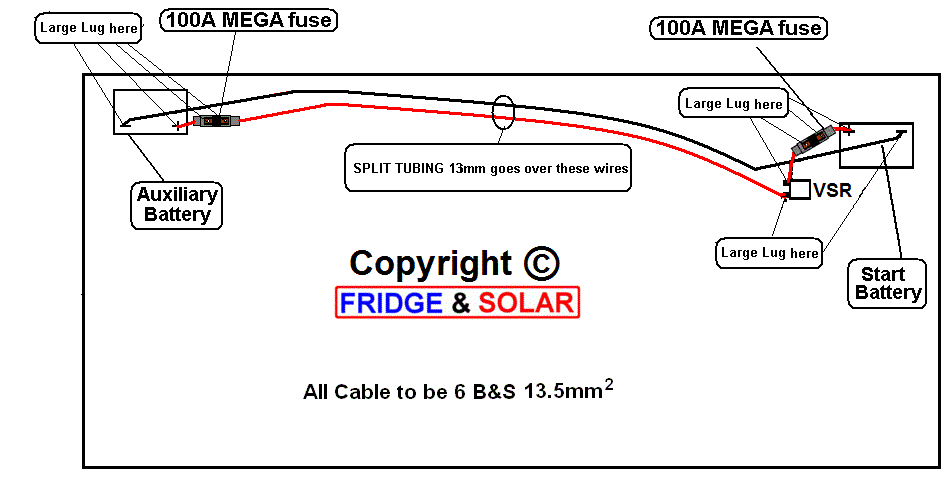
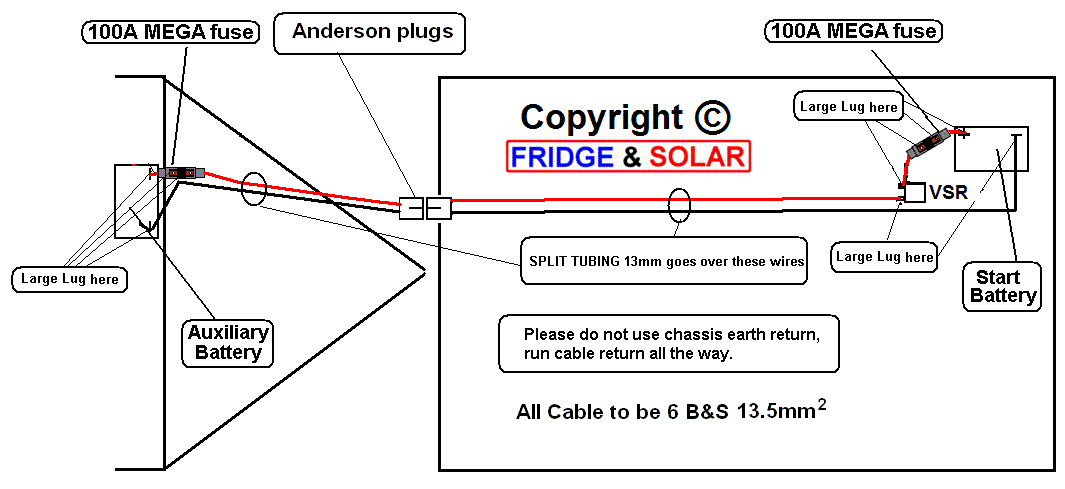
long as you take care almost anyone can do it. Safety Tip * Do not install the Mega fuses until the last thing, when you have completely finished all the cable runs and tightened up all other connections first. Note: * Some people can use the chassis for earth return, but my advice is don't, and to always (and it really is best) run the earth/negative cable all the way between the start and auxiliary batteries, for the extra few dollars in cable it really is worth it, and you only have to do it once, so do it right the first time please. When running
the cables
between the batteries you should take great care with where you place
the cable, making sure that it won’t rub or be cut through,
also be careful to keep it clear of sharp corners etc, and if the
auxiliary battery is going to be placed anywhere other than under the
bonnet, you should seriously consider using a protective covering like
split convoluted tubing and secure it well with clips or
cable
ties at
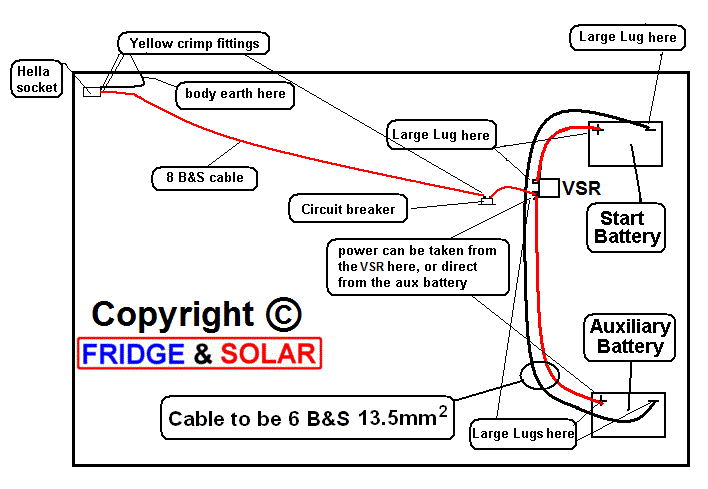
well spaced intervals. If your auxiliary battery is in a caravan or trailer then the standard trailer lights connectors are way too small for the 6 B&S cable, and can’t even come close to handling the high currents for effective battery charging, so here we use 50A Anderson plugs (Pictured below). All cable lugs used with the 6 B&S cable are far too big to be crimped with standard crimping tools, so they should be crimped by an auto electrician, or you can solder them if you have a gas torch, they do take a lot of heat to solder on properly. The Enerdrive VSR
battery
isolator has two main cable posts underneath it, these are for
connecting the main positive
battery link cables to, so here the one with the red dot on the stud,
this is where you connect the cable coming from the MEGA fuse
on the starting/cranking battery, and the other post is for
the
link cable that
is running to the auxiliary
battery positive
MEGA fuse. It
really is simple, next
the earth/negative
cable simply gets connected
to the negative terminal of both batteries, but again using the good
sized 6 B&S cable.............. Below are some examples of how an auxiliary battery set-up may be done, but there are many many other combinations that can be done to suit almost all needs. |
|


Val's
hot tip>> If
you need a helping hand in Queenslands
South East, |  |
 Note, latest update November 2017 I
have now semi-retired.
Note, latest update November 2017 I
have now semi-retired.
I am concentrating more on updating and writing more of my-
'Technical and not so technical information' articles,
these have become very popular!
(I'm
real chuffed, thank you for all your kind words and encouragement folks).

Copyright
© Val Rigoli

www.batteryfuse.info
www.batterymonitor.info www.dualbattery.info
www.folding-solar.info
www.midi-fuse.info www.mega-fuse.info
www.fridge-fuse.info
www.dc-to-dc.info
Copyright © FRIDGE & SOLAR Last revised: Nov 2018
