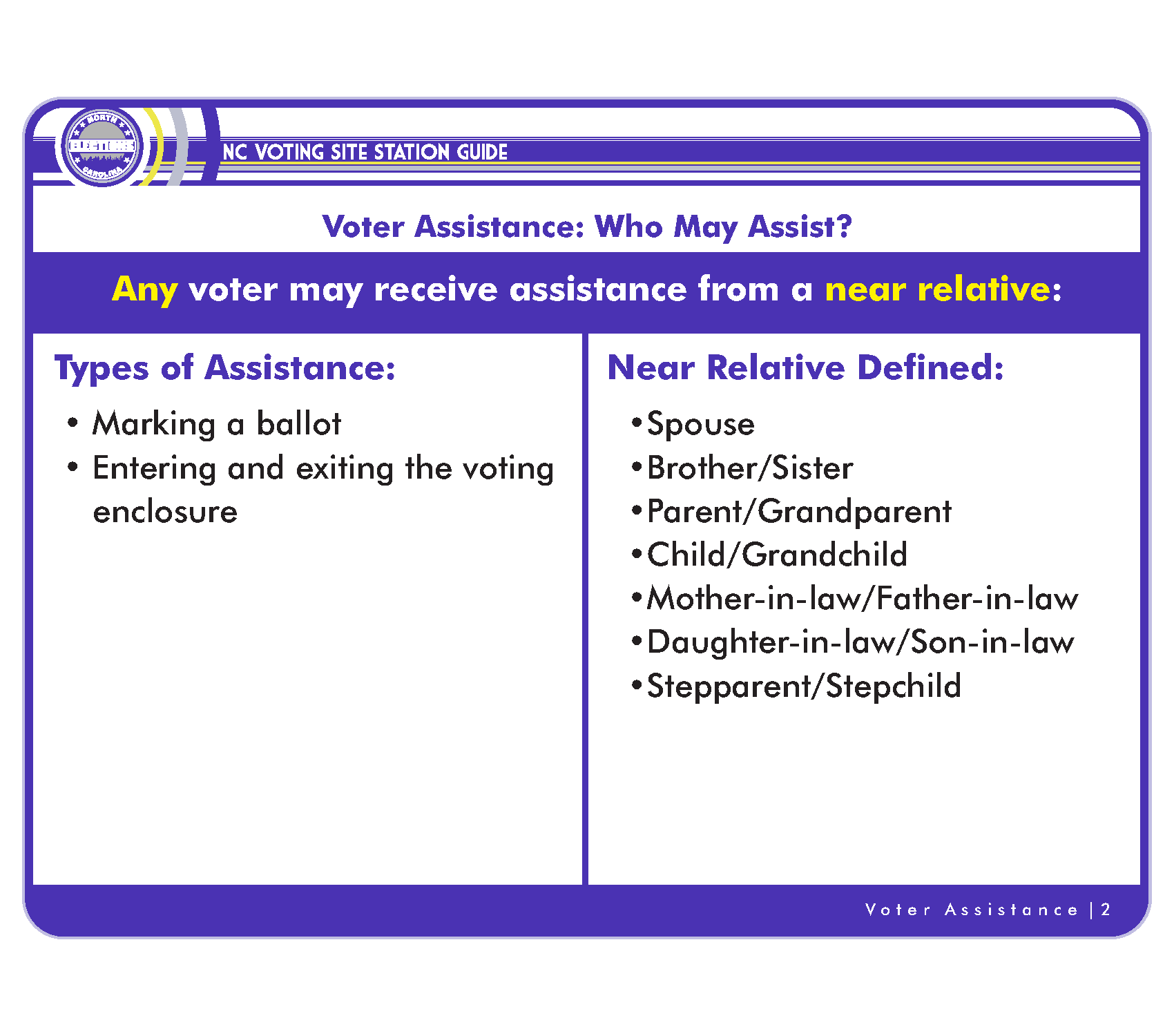
Any voter is entitled to assistance from the voter's spouse, brother, sister, parent, grandparent, child, grandchild, mother-in-law, father-in-law, daughter-in-law, son-in-law, stepparent, or stepchild, as chosen by the voter. The voter need not be disabled in order to receive assistance from his or her near relative, and elections officials should avoid prying or overly-probative questions regarding the voter’s preference for assistance.
A voter in either of the following categories is entitled to assistance from a person of the voter's choice, provided that choice is someone other than the voter’s employer or agent of that employer or an officer or agent of the voter's union:
A voter whose disability prevents him or her from entering the voting booth or marking a ballot without assistance; or
A voter who, due to his or her inability to read, write, or speak in English, is unable to mark a ballot without assistance.
Not all disabilities are immediately apparent. A voter who requires assistance entering the voting booth or marking a ballot due to a mental disability is just as entitled to assistance as a voter whose disability may be easily seen.
Candidate are not prohibited:
There is no prohibition against a candidate assisting a voter if the voter is qualified for assistance (due to a physical disability, visual impairment or illiteracy) unless the candidate is the voter’s employer or agent of that employer or an officer or agent of the voter's union:
Repeat Assisters are not prohibited:
There is also no prohibition against a person assisting multiple voters if those voters are entitled to assistance (due to a physical disability, visual impairment or illiteracy).