
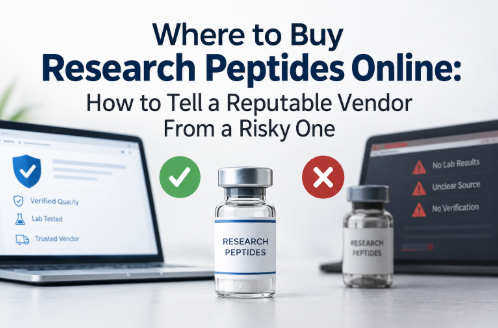
Search "where to buy peptides" and you'll find hundreds of storefronts, forum threads and affiliate lists, many of them contradicting each other. Most buyers compare prices first. That's usually the wrong starting point. The difference between reputable research peptide suppliers and risky ones rarely shows up in the price. It shows up in documentation, labeling and what the vendor is willing to put in writing.
The cheapest vial can be the most expensive data point in your study.
A vendor that won't show a COA before checkout has already answered your question.
First, Be Clear About What You're Buying
"Peptides" covers very different products, and where to buy depends on which one you need:
FDA-approved peptide medicines such as semaglutide or insulin come from licensed pharmacies with a prescription.
Compounded peptides come from licensed compounding pharmacies, also on a prescription.
Research-use-only (RUO) peptides are sold for laboratory and scientific research, not for human or veterinary use.
This guide covers the third category. If you're looking for treatment, the right place to start is a licensed clinician, not a research supplier.
Why "Where to Buy" Is Really a Quality Question
Research peptides aren't FDA-approved products, so no regulator checks each batch before it ships. The buyer is left to judge quality from what the vendor shows. In practice, that means evaluating three things:
Evidence: can the vendor show what's in the vial?
Positioning: does the vendor present its products honestly as research materials?
Accountability: is there an identifiable company behind the website?
Price is the one thing every vendor shows. Evidence is the thing that separates them.
Green Flags: What Reputable Vendors Do
Batch-linked documentation, before you buy
A reputable vendor provides a Certificate of Analysis tied to a specific lot number, with HPLC purity data and, ideally, mass spectrometry identity data. It's available on the product page or on request before checkout, not only after delivery.
A stated purity standard with a method behind it
"99% purity" means something when the method (usually HPLC) and the batch are stated. It means much less as a badge on its own.
Consistent research-only positioning
Product pages, labels and documentation all say the same thing: research use only, not for human use. There are no dosing protocols, health claims or transformation photos.
An identifiable company
A business name, physical location, contact details and clear terms, shipping and refund policies. For U.S. researchers, domestic operations also mean predictable shipping and easier communication.
Organized, specific product information
Correct compound names, sequences or molecular weights, vial amounts and storage guidance. Vague listings are often a sign of vague sourcing.
Red Flags: When to Walk Away
No COA, or a COA "available on request" that never arrives.
The same COA reused across products or batches, or one with no lot number.
Human dosing charts, "protocols" or health promises. A seller promising results in people isn't really selling research materials.
Claims of FDA approval for research products.
Prices far below the market, especially on complex or long-sequence peptides that are expensive to synthesize properly.
Payment only through irreversible or untraceable methods, with no clear business entity.
Brand-new sites with aggressive discounts and no company history.
A red flag doesn't prove a product is bad. It proves the vendor hasn't given you a way to know.
Are Forums and Reddit Reliable Sources?
Community threads are useful for spotting patterns, such as repeated complaints about shipping, missing documents or inconsistent batches. They're weak evidence for quality. Recommendations are often years old, anonymous and sometimes affiliate-driven, and a vendor's reputation can outlast a change in its supply chain.
Forum recommendations age faster than batches do. Treat them as a starting list, then verify each vendor against documentation.
A Quick Vendor Checklist
Before placing an order, check whether you can answer "yes" to each of these:
Is a batch-specific COA available before purchase?
Does the COA include both purity (HPLC) and identity (MS) data?
Does the lot number on the COA match what the vendor ships?
Is research-only positioning clear and consistent?
Is the company identifiable, with real contact details?
Are shipping, storage and refund policies stated in writing?
A vendor that passes all six is worth considering. For a more detailed framework, see this guide on how to choose a research peptide supplier. Once you've shortlisted vendors, it's worth taking time to compare research peptides and their documentation product by product, not just brand by brand.
FAQ
Where is the best place to buy research peptides online?
There's no single best place, but the best vendors share traits you can check: batch-linked COAs with purity and identity data, clear research-only positioning, an identifiable company and stated shipping and refund policies.
How can I tell if a peptide vendor is legitimate?
Ask for a COA before buying and check that its lot number, lab name and methods are specific and verifiable. Be cautious of vendors offering human dosing advice, health claims or prices far below the market.
Is it safer to buy peptides from a U.S. supplier?
Domestic suppliers can offer faster, more predictable shipping and clearer accountability. Location alone doesn't guarantee quality, though. Documentation still matters most.
For research use only. Not for human use.