
You don’t need to be an expert to buy a used car safely. A few minutes and one number can tell you almost everything that matters before you commit.
By Theresa Lindqvist
Buying a used car can feel like a gamble. The listing looks fine, the photos flatter, and the seller seems honest — but how do you actually know what you are getting? The reassuring answer is that you no longer have to guess. A short, repeatable routine built around the vehicle’s identification number turns an anxious purchase into a methodical, well-informed decision, and it requires no mechanical knowledge at all.
Every vehicle carries a unique seventeen-character Vehicle Identification Number, and that number is the key to its entire documented past. You will find it where the dashboard meets the windshield on the driver’s side, on a sticker inside the driver’s doorjamb, and on the title and most online listings. Write it down — it is the single most useful piece of information you can carry into a used-car purchase.
Source: ZILOCAR vehicle history data.
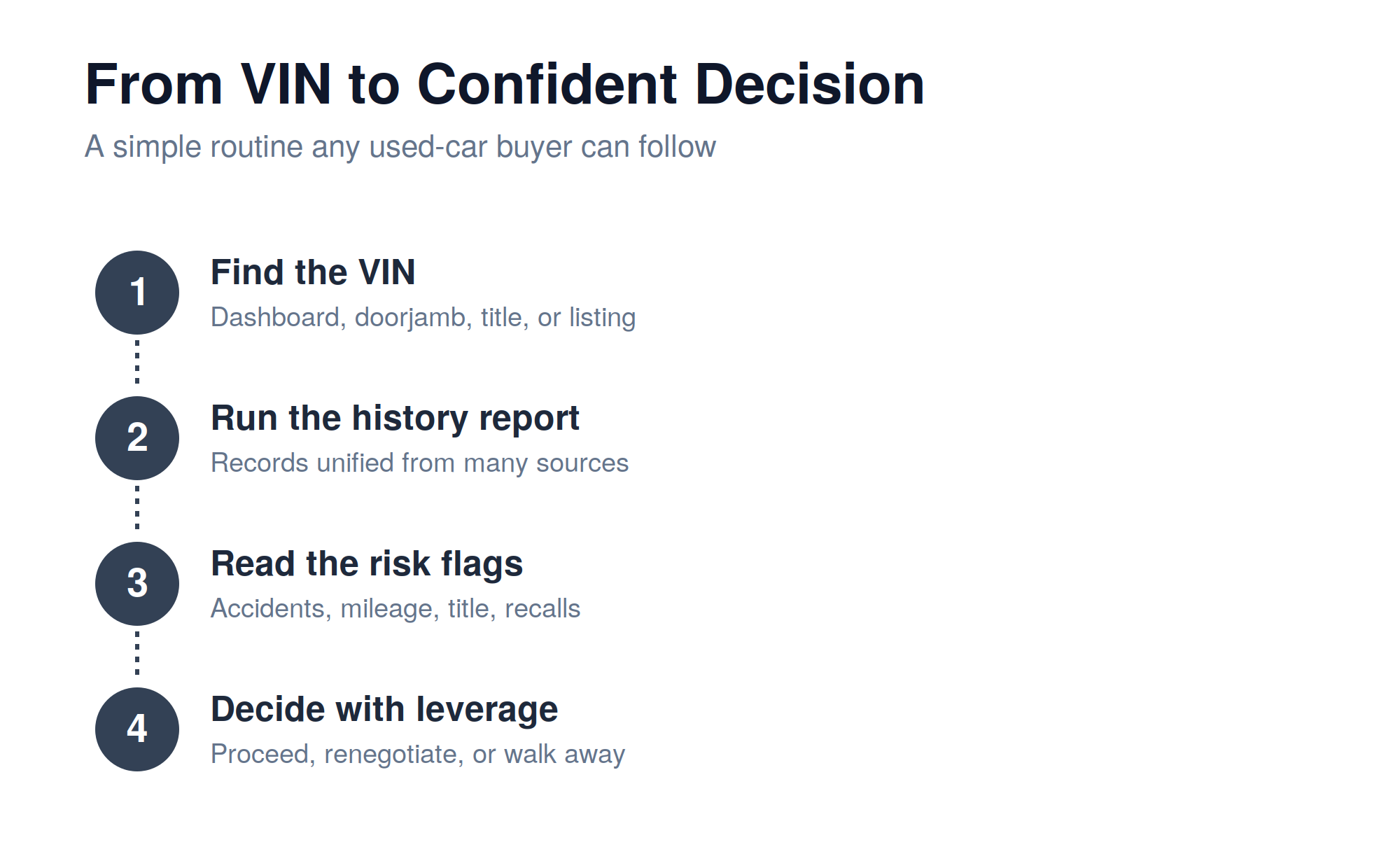
The routine above has four steps. Find the VIN. Run a history report. Read the risk flags. Then decide. Enter the number into a service such as a full VIN history report and, within seconds, you receive a record compiled from insurers, motor-vehicle agencies, auction houses, and federal safety databases. What was scattered across dozens of systems arrives as one readable document.
Reading the flags is where the report earns its keep. You are looking for four things above all: reported accidents and their severity, the odometer timeline and whether the mileage adds up, any title brands such as salvage or flood, and open safety recalls that were never repaired. Each is a question answered before you ever sit in the driver’s seat — and any one of them can be the difference between a sound purchase and an expensive regret.
Source: ZILOCAR vehicle history data.
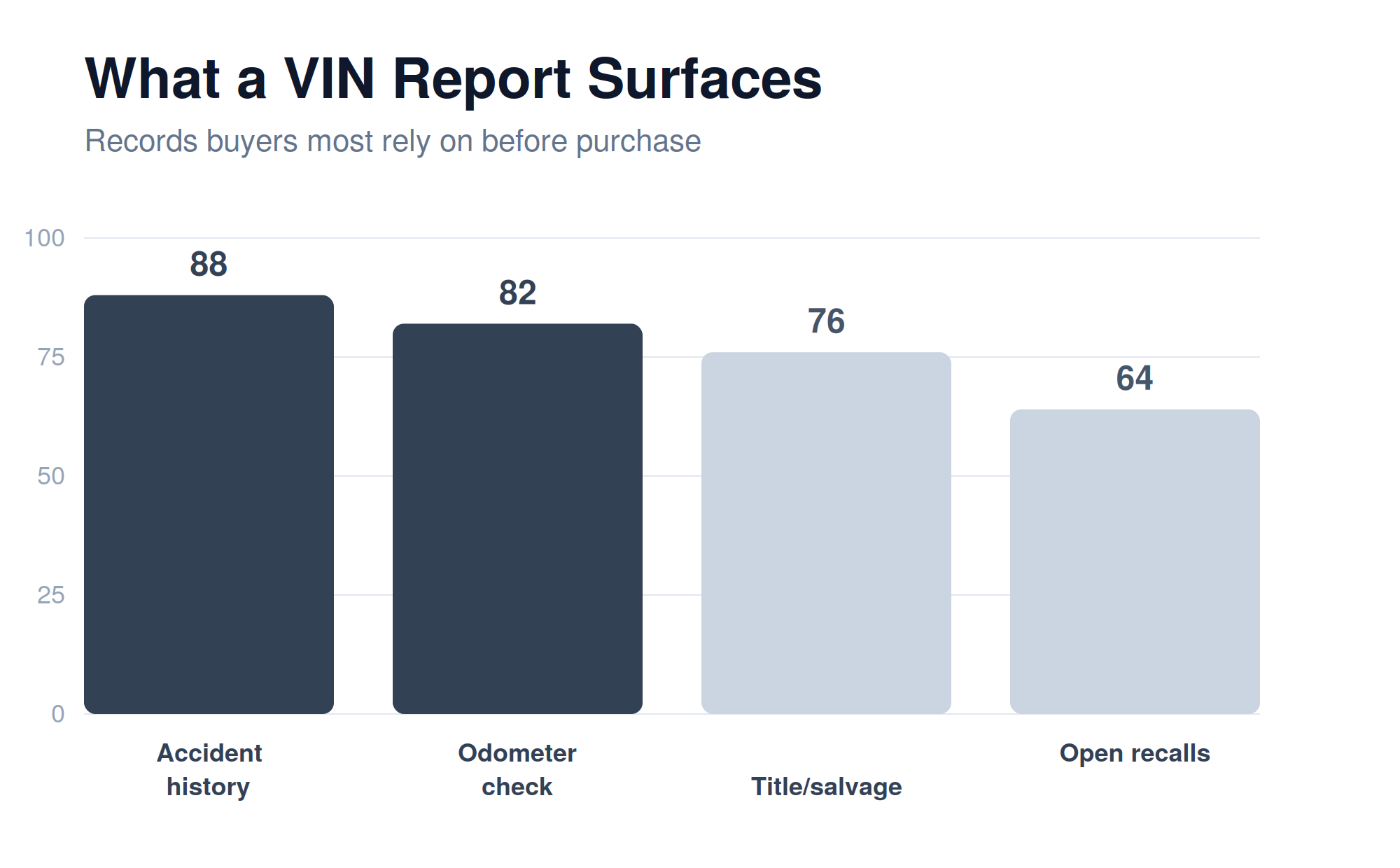
The records buyers rely on most, shown above, map directly onto those flags. Accident history tells you what the car has survived. An odometer check catches the classic rollback, where recorded mileage drops impossibly between readings. Title and salvage status reveals whether the vehicle was ever declared a total loss. And open recalls flag manufacturer-acknowledged defects that are usually repairable for free — but only if you know they exist.
What makes a report trustworthy is the breadth of its sourcing. A single record proves little on its own; the value comes from cross-referencing. When a service record shows higher mileage than a later sale, that contradiction is the warning you needed, and only an aggregated report catches it. The more sources behind the report, the harder it becomes for a hidden problem to slip through unnoticed.
On a larger purchase, it is worth confirming the picture with a second, independent source. Running the same VIN through a separate provider such as an independent second report lets you compare findings. When two services agree, your confidence is well founded. When they differ on something important, you have learned exactly which record deserves a closer look before you commit any money.
A word about limits, because the honest services say it themselves: a clean report is powerful reassurance, not an absolute guarantee. If an incident was never reported to a source the service can access, it will not appear, and coverage varies by region. The sound approach treats the report as one essential layer of due diligence and pairs it with a pre-purchase inspection by a qualified mechanic. The report covers the documented past; the mechanic covers the present condition.
The mechanics could not be simpler, which is what makes skipping them so costly. The VIN sits on the dashboard at the base of the windshield, on the driver’s doorjamb, and on the title and virtually every online listing. Copy it, run it, and read the result before you commit to anything. The whole process fits comfortably inside the time it takes to schedule a test drive, and it costs a small fraction of what a single undisclosed problem would.
It also helps to picture the kinds of problems a report routinely catches, because they are more common than most buyers expect. There is the clean-looking sedan whose record shows a major collision two owners back, repaired just well enough to hide. There is the bargain truck advertised with surprisingly low mileage whose service history reveals a far higher reading recorded years earlier. There is the crossover from a coastal state carrying a flood brand the listing never mentioned. In each case the car looked fine and the price looked fair — and in each case the record told a different story than the seller did.
That pairing is the whole strategy. The history report tells you what the car has been through on paper; the inspection tells you what shape it is in today. Run both, and the universe of nasty surprises shrinks dramatically. The old way of buying a used car relied on instinct and hope. The new way replaces hope with records — find the VIN, run the report, read the flags, confirm, and decide. It is simple enough to remember and powerful enough to save you from a costly mistake.