
When someone makes a payment online, they hand over their card details to a system they cannot see. The merchant collects the card number, sends it to the acquiring bank, then to the payment network, and finally to the issuing bank. At every stage, checks take place. If the card is issued abroad or by a less common bank, the process becomes more complex. Merchants cannot always predict how the system will respond and that uncertainty creates risk.
For the buyer, what matters is that the “Pay” button works. For businesses, the picture looks different. If a card fails to authorise, they lose a customer. If a transaction later becomes disputed, they lose money. In some cases, the acquiring bank may tighten terms of cooperation or impose restrictions. The result is direct and indirect losses.
To reduce these risks, companies use BIN checkers. BIN stands for “Bank Identification Number” — the first six or eight digits of a card number. These digits reveal the issuing bank, the country of issuance, the payment network and the card type. A BIN checker processes these digits and returns reference data. It does not reveal balances, nor does it provide access to funds. Its role is to help businesses understand the card profile before the transaction is complete.
Why BIN Checkers matter
Consider a practical case. An online store sells access to a digital service for $20. A customer enters a card issued in a market with high chargeback rates. Without a BIN checker, the merchant will only discover this risk when a dispute arises. With a BIN checker, the risk is visible at once. The system can trigger an additional check, saving both revenue and operational cost.
Another case concerns a payment service provider handling thousands of transactions per minute. If a cluster of cards comes from banks in a less stable region, the provider can reroute these transactions through a separate processing stream. This keeps the main system running smoothly. Without BIN checkers, such flexible routing is not possible.
It is important to note that BIN checkers are not designed for consumers. Shoppers gain no direct protection by running their cards through such tools. Instead, consumer protection relies on 3D Secure, bank limits and fraud monitoring. BIN checkers are business tools, used by those who accept and process payments.
Businesses often deploy several BIN checkers at once. Each database updates at a different pace. One may add new banks faster; another may categorise corporate cards more precisely. Combining them provides a fuller picture of transaction flows.
Leading tools in the market
Below are three BIN checkers commonly used in e-commerce and digital payments.
1. PSTNET
Pulse by PSTNET is a free web-based tool for card verification. It integrates with multiple platforms and supports API connections.
It provides country, payment network and issuing bank information. For cards issued directly by PSTNET, BIN checker also shows billing thresholds, approval and decline rates, and average spend per card. These insights allow businesses to prepare for specific transaction patterns.
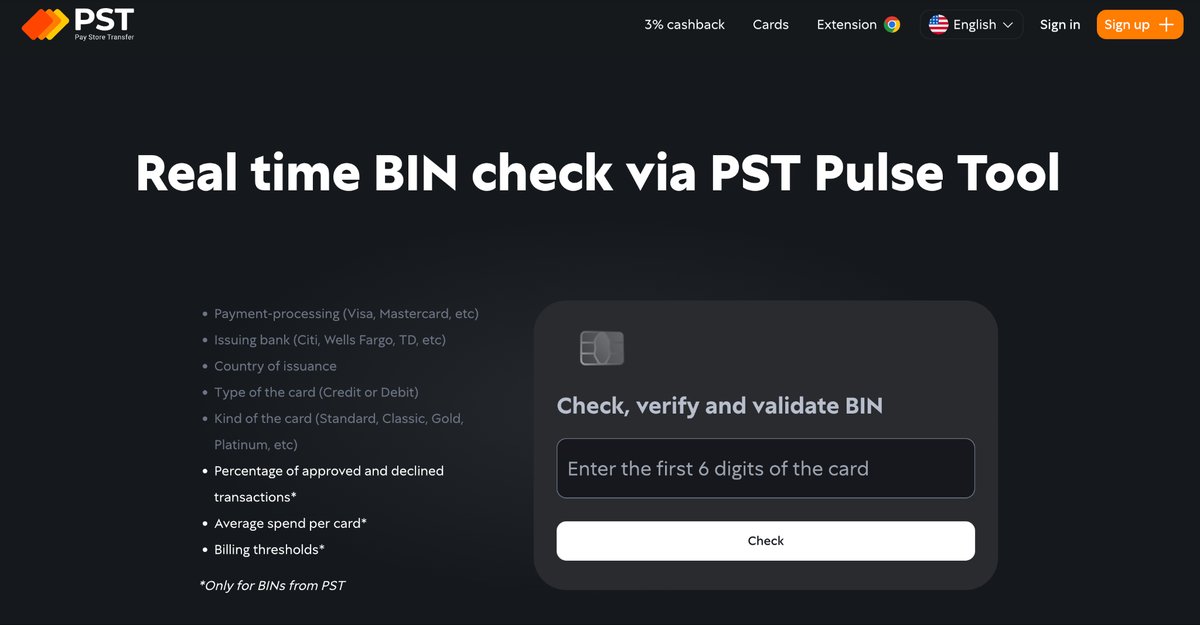
Pulse covers more than 500,000 BINs and updates its database daily. Requests are processed instantly. The tool also connects directly with advertising platforms through its API, which is valuable for agencies that manage both traffic and payments in one workflow.
2. VCC Generator BIN Checker
VCC Generator BIN Checker is designed for both small agencies and large marketing departments. It reveals the issuing bank, card type and country of origin.
The service offers a database of more than 400,000 BINs. Checks are free and quick to perform. Its straightforward interface makes it practical for new staff who need minimal training to begin working with payment data.
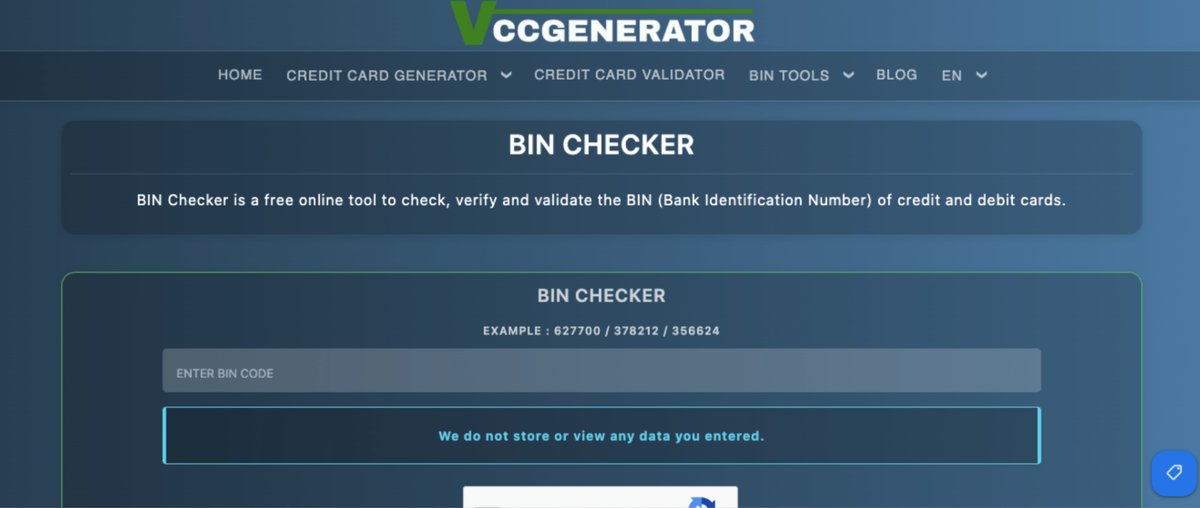
Example: an agency launching campaigns across multiple markets can use this tool to map where payments are originating. That information helps adjust media planning and targeting strategies.
3. Bincheck.io
Bincheck.io is widely used by professionals dealing with international transactions. It provides real-time BIN lookups, with free access and regular updates.
The service holds 365,460 BINs in its database. Its interface is designed for teams managing large transaction volumes.
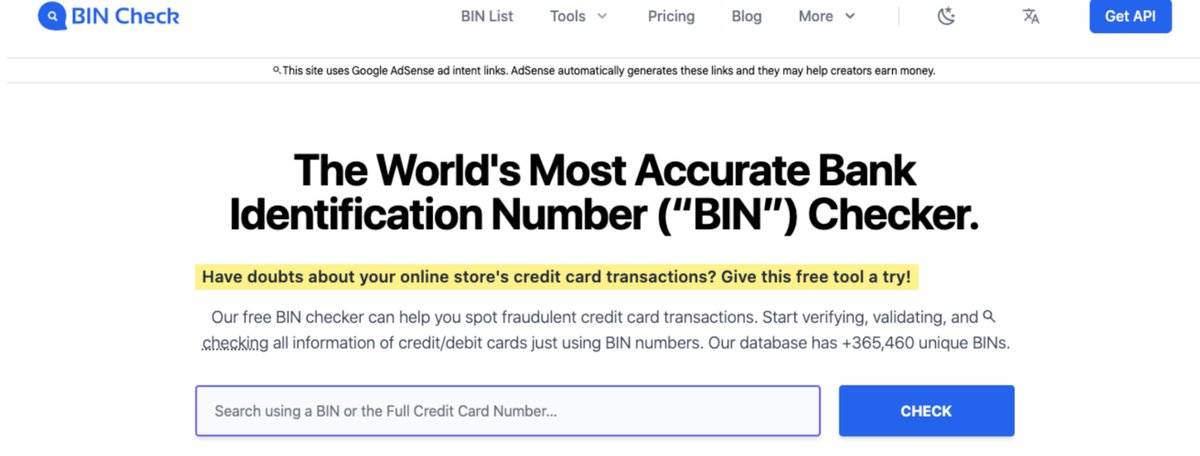
Example: a global digital services platform uses Bincheck.io to track the geographical spread of its customer base. If a surge in new markets appears, the business can plan localised campaigns and product adaptations accordingly.
How BIN Checkers are used in practice
BIN checkers operate as the first filter in the transaction chain. First comes the BIN lookup, then anti-fraud screening, followed by acquiring bank checks. This order reduces pressure on core processing systems while ensuring that high-risk cases are flagged early.
Merchants often use BIN checkers for “soft routing”. If a card is linked to a bank or region with higher dispute levels, the transaction is diverted into a separate flow for further checks. This protects the main customer stream from delays.
Marketing teams also apply BIN data for customer analysis. By examining card origins, they can identify corporate card usage, assess geographical trends, and initiate partnerships with banks whose clients show strong purchasing activity.
Conclusion
BIN checkers are tools for businesses that accept online payments. They help reduce chargebacks, guide transaction routing and support customer analytics. They are not consumer-facing safeguards, but they form an essential part of the payment infrastructure.
Three notable solutions in the market are PSTNET Pulse, VCC Generator BIN Checker and Bincheck.io. Each provides up-to-date data, integration capabilities and capacity to handle significant transaction volumes. While they do not replace anti-fraud systems, they give businesses the early insight required to make better payment decisions in real time.