The shift from asynchronous feeds to synchronous live interaction represents one of the most significant inflection points in consumer technology since the mobile revolution. Where users once passively scrolled through curated content, they now demand instant, unmediated connection, a trend accelerating the rise of social discovery platforms that enable users to chat with strangers on InstaCams and similar services.
For architects building these next-generation applications, the engineering challenges are formidable. The requirements are contradictory: achieving sub-300-millisecond latency across global networks, moderating millions of concurrent video streams in real time, and scaling infrastructure to absorb viral traffic spikes, all while maintaining the safety standards that users expect.
The Engineering Trilemma: Latency, Safety, and Scale
Real-time video discovery platforms operate under constraints that traditional streaming architectures were not designed to handle. Unlike broadcast media (one-to-many), social discovery demands bidirectional, ephemeral connections between participants who expect conversational responsiveness. This creates a "trilemma": latency must be imperceptible, moderation must occur before harm is done, and the cost per stream must be viable for a free-to-use model.
Legacy approaches relied heavily on Peer-to-Peer (P2P) mesh networks. While theoretically elegant, P2P proved catastrophic for user safety. These architectures exposed participant IP addresses, creating vectors for geolocation attacks, and bypassed central servers entirely, making automated moderation impossible.
Developers building a modern platform such as an Omegle or Mirami alternative have discovered that cloud-native architectures solve the fundamental limitations of P2P at the transport layer. By routing all video through managed WebRTC ingestion points rather than establishing direct browser-to-browser connections, platforms gain three critical capabilities: centralized content inspection, consistent quality of service (QoS), and robust user privacy protection.
Moving Beyond Peer-to-Peer: The Managed Transport Layer
Amazon Interactive Video Service (IVS) Real-Time Streaming exemplifies the modern solution to this topology problem. Rather than a direct mesh, the architecture utilizes a "star topology" where client streams are ingested at the nearest Point of Presence (PoP) and routed over the AWS global fiber backbone.
This architectural shift is profound. As illustrated in the Real-Time Video Discovery Safety Architecture (Image 2), the "Managed WebRTC Transport" acts as an air-gap between User A and User B. This intermediary position enables every subsequent innovation in safety and globalization.
Crucially, the 2025 introduction of Multitrack Video support in IVS has revolutionized the economics of this model. Previously, server-side transcoding (converting high-bitrate video into lower qualities) was prohibitively expensive for real-time chat. With Multitrack, the heavy lifting of encoding multiple quality layers (simulcast) is offloaded to the client device's GPU. This allows startups to deliver broadcast-quality video with teleconference-level responsiveness (<300ms glass-to-glass latency) at a fraction of the traditional cost.
The Agentic Moderator: Autonomous Safety at Scale
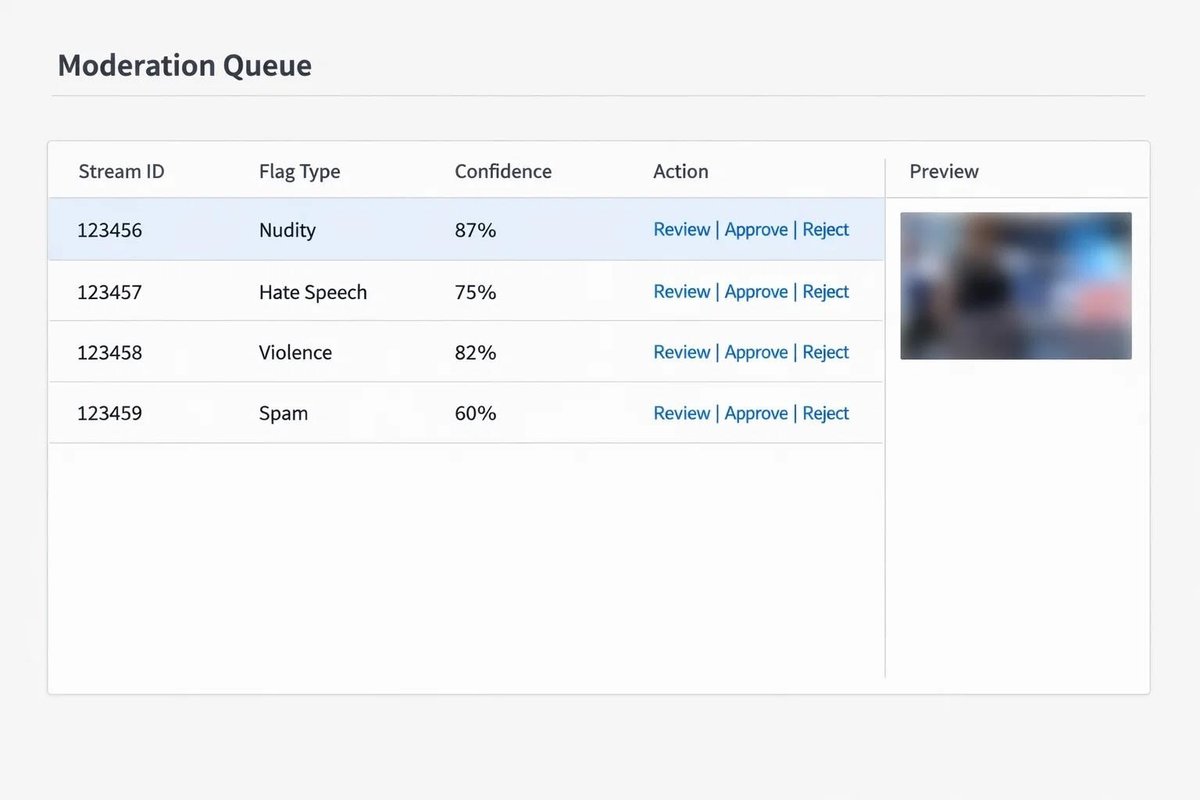
The most compelling application of this centralized architecture is the "Agentic Moderator", an autonomous system that evaluates and acts on live video streams without human intervention. This represents the practical implementation of the Agentic AI principles that dominated AWS re:Invent 2025, moving beyond simple classifiers to context-aware decision engines.
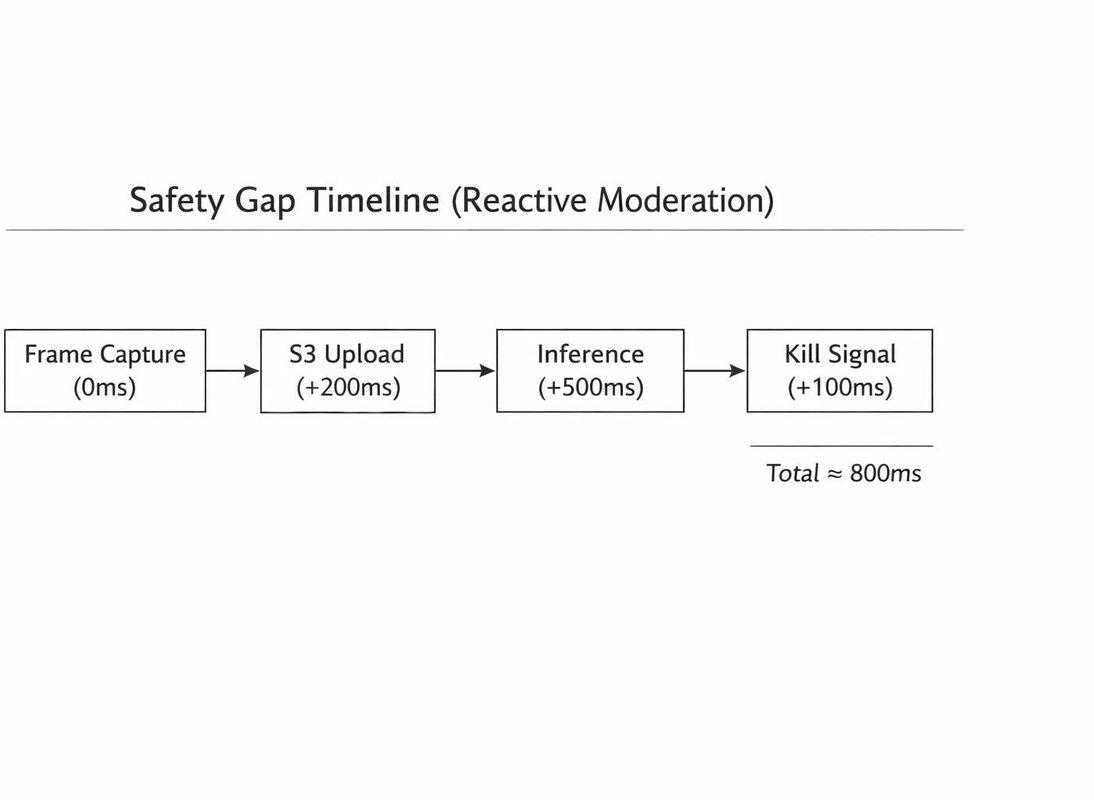
The technical implementation follows the event-driven serverless pattern shown in Image 2:
Ingest: IVS captures thumbnail snapshots from active streams at configurable intervals (e.g., every 5-15 seconds).
Storage & Trigger: Snapshots are stored in Amazon S3, triggering an AWS Lambda function.
Inference: Lambda invokes Amazon Rekognition's content moderation API.
Decision: The AgentCore logic evaluates the confidence score. If it detects prohibited content with high confidence, it immediately issues a StopStream command to the IVS control plane, severing the connection.
Breaking Language Barriers in Real Time
Global social discovery requires more than translation; it demands seamless multilingual communication. The bottom section of Image 2 details this pipeline:
Audio Ingest: Audio is forked from the WebRTC stream.
Transcribe & Translate: The audio flows to Amazon Transcribe (ASR) and then Amazon Translate.
Delivery: Instead of a separate chat socket, the translated text is often embedded directly into the video stream using Supplemental Enhancement Information (SEI) metadata. This ensures that the subtitles are perfectly frame-aligned with the video, eliminating the "lip-sync" drift common in older applications.
The Path Forward
The transformation from legacy random chat platforms to cloud-native social discovery represents a fundamental reimagining of how trust operates in digital spaces. The era of unmoderated, privacy-compromising P2P architectures is ending. What replaces it is
something more ambitious: platforms where safety and spontaneity coexist, built on infrastructure that scales globally while acting locally in milliseconds.