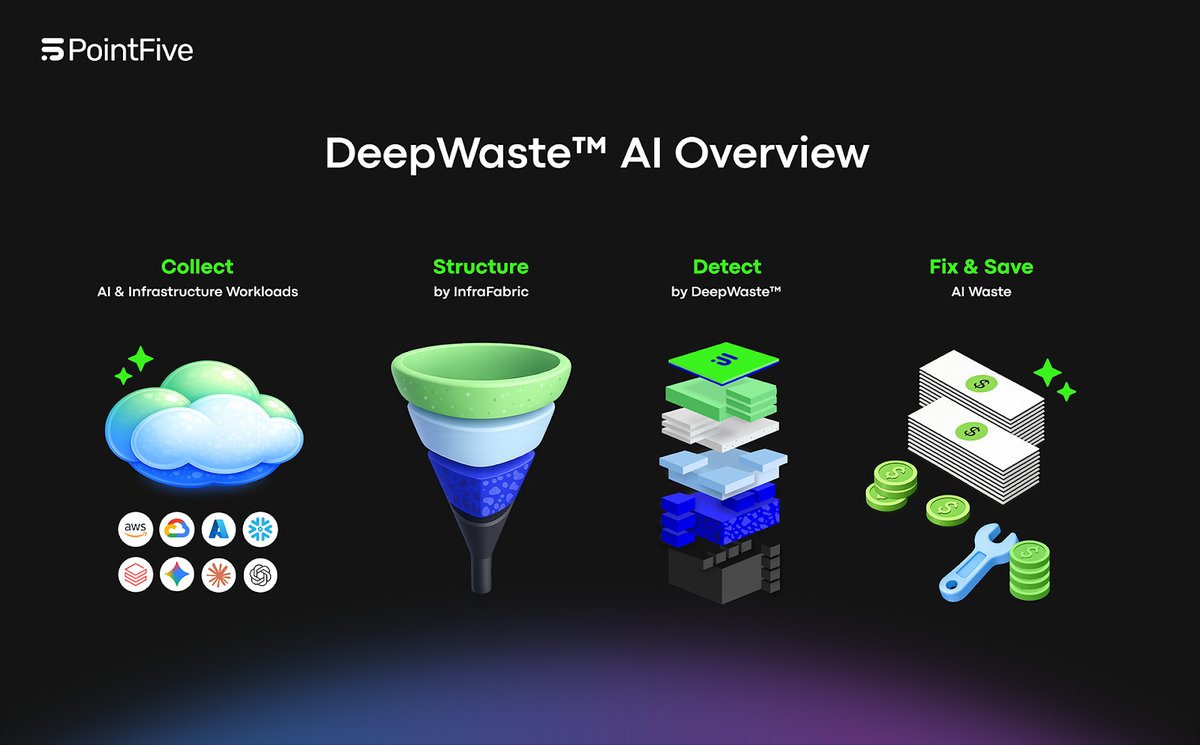
On February 27, 2026, PointFive launched DeepWaste™ AI, positioning it as a full-stack AI cost optimization module aimed at improving AI unit economics across LLM services, GPU infrastructure, and AI data platforms. While the launch is framed as an engineering product, the underlying message is aimed squarely at unit economics: if AI is becoming a production capability, organizations need a repeatable way to align AI execution behavior with business value.
In early AI experiments, spend can be tolerated as the cost of learning. In production, the conversation shifts. AI becomes a system that must be measured, governed, and improved. PointFive argues that cost visibility alone is insufficient because the drivers of cost are multi-layered and behavioral. Model selection, token consumption, routing logic, caching behavior, GPU utilization, retry patterns, and data platform orchestration all influence cost and performance. The outcome is that two systems can produce the same result with very different efficiency profiles depending on how those layers interact.
Why Traditional Optimization Misses AI Behavior
PointFive’s position is that traditional cloud optimization tools were not built to analyze the AI execution stack. Those tools often focus on broad infrastructure usage patterns and billing anomalies, but production AI spend can be driven by how requests are routed, how prompts and context windows are structured, whether repeated work is cached or re-run, and whether retries are occurring in ways that inflate spend.
DeepWaste AI is positioned as the module that links those behaviors to cost attribution and remediation, providing signals that can be mapped to both engineering work and FinOps prioritization.
Coverage for How AI Is Actually Bought and Run
DeepWaste AI provides native, agentless connectivity across cloud AI services and direct model APIs:
AWS (Bedrock, SageMaker, and AI managed services)
Azure (Azure OpenAI, Azure ML, Cognitive Services)
GCP (Vertex AI and AI services)
OpenAI and Anthropic direct APIs
This multi-provider approach supports organizations that run AI across different environments, where cost and performance signals can be fragmented by provider boundaries.
Completing the Stack: GPUs and Data Platforms
PointFive emphasizes that “full-stack” optimization must include more than model calls. DeepWaste AI continuously optimizes GPU infrastructure by identifying underutilized or idle GPUs, instance-type mismatches, OS and driver misconfigurations, and hardware-to-workload misalignment. In a unit-economics context, GPU waste is not just an infrastructure issue; it directly affects the cost basis of AI services delivered to internal teams or external customers.
DeepWaste AI also extends optimization across AI data platforms with native support for Snowflake and Databricks. By covering workflows from data ingestion through inference, PointFive aims to connect upstream orchestration choices with downstream AI execution costs.
Agentless Deployment and Data-Minimizing Defaults
DeepWaste AI connects directly to cloud APIs, LLM service metrics, GPU telemetry, and billing systems without agents, instrumentation, or code changes. By default, optimization runs using metadata, billing signals, performance metrics, and resource configuration data rather than raw inference logs. PointFive positions this as privacy-preserving and designed to minimize data access requirements.
For teams that want deeper insight into how prompts and orchestration logic influence spend, optional inference-level analysis can be enabled. Customers control the depth of analysis, allowing different governance levels depending on policy and risk tolerance.
A Four-Layer Framework for Prioritization
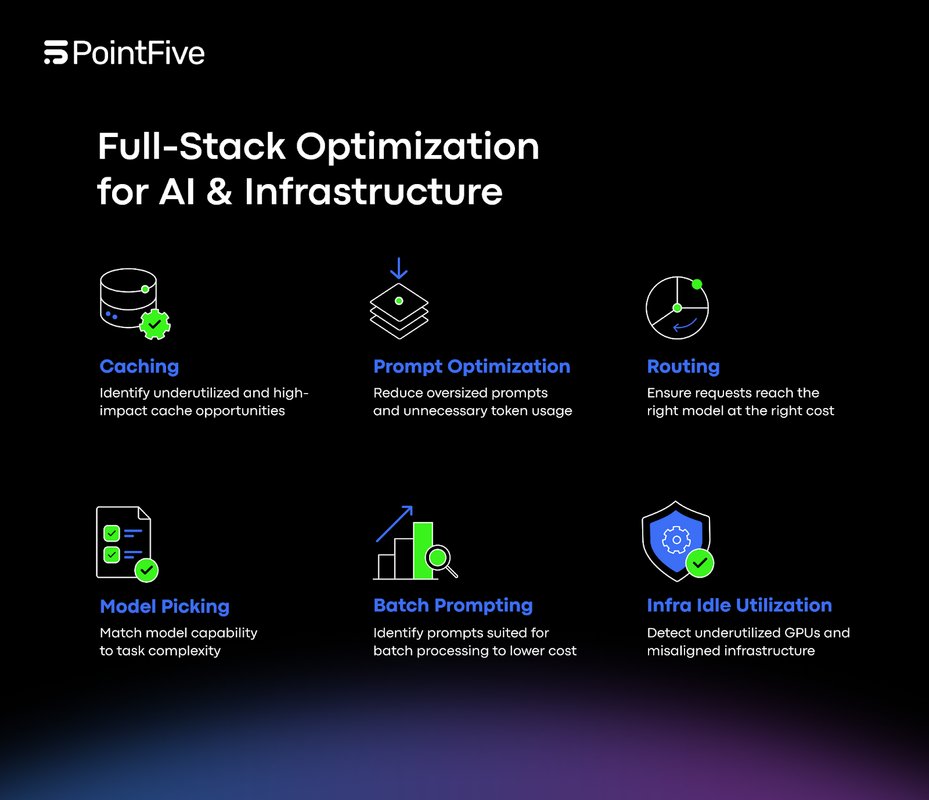
DeepWaste AI detects inefficiency across four layers designed to be actionable:
Model & Routing Intelligence: model-task mismatch, downgrade opportunities, batch vs. real-time misalignment, benchmarking outliers
Token & Prompt Economics: prompt bloat, context window overprovisioning, output inflation from misconfigured max_tokens, parameter-task misalignment, structural token waste
Caching & Reuse Optimization: duplicate inference detection, underused caching capabilities, cache miss rate inefficiencies
Infrastructure & Operational Leakage: idle GPUs, instance mismatch, driver-level throughput limitations, retry-driven cost inflation, latency outliers, provisioning misalignment
PointFive says findings are grounded in unified workload signals rather than surface-level billing anomalies, supporting prioritization based on real operational behavior.
Quantified Savings, Mapped to Workflows
DeepWaste AI attaches a quantified savings estimate and implementation guidance to each finding. Recommendations are prioritized by financial impact and mapped directly to engineering and FinOps workflows. The intent is for teams to evaluate projected savings before committing resources, then track realized improvements over time, turning optimization into a continuous discipline rather than a periodic cost review.
Alon Arvatz on Production AI Complexity
“AI workloads introduce a new category of operational complexity,” said Alon Arvatz, CEO of PointFive. “DeepWaste AI gives organizations the intelligence required to scale AI efficiently, across models, infrastructure, and data platforms, without sacrificing control.”
DeepWaste AI is now available to PointFive customers.