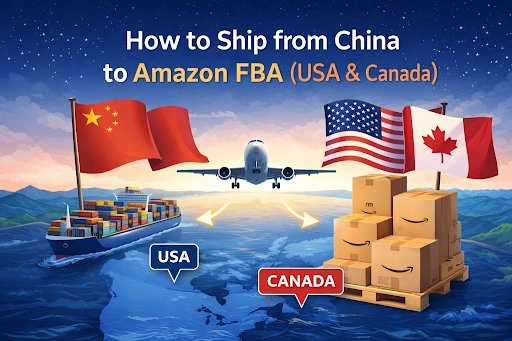
If you sell on Amazon, you already know the real stress isn’t getting your first sale — it’s staying in stock.
A late shipment can cause stockouts, hurt rankings, and push you into expensive “panic shipping.” That’s why shipping from China to Amazon FBA isn’t just logistics. It’s part of your inventory plan.
This guide explains what new sellers should know about shipping from China to Amazon FBA in the United States and Canada — including transit time, routes, and customs basics — in plain language.
If you want a clearer picture early, it helps to review route overviews. Sellers planning U.S. inbound shipments often start by understanding China to USA Amazon routing and delivery flow. Sellers expanding into Canada can compare timelines and import steps through China to Canada Amazon. You don’t need to memorize everything, but realistic expectations help you plan inventory without guessing.
Start with the shipping method: ocean, air, or express
Most Amazon shipments from China use one of these options. The best choice depends on how fast your product sells, how large it is, and how much cash you can have tied up while inventory is in transit.
Ocean freight (sea shipping) is usually the most cost-efficient for larger shipments. It often makes sense for heavy items or high carton counts. The trade-off is time, so you’ll need to plan ahead.
Air freight costs more but moves faster. Sellers often use it for launches, fast sellers, or urgent restocks to prevent stockouts. It can be worth it when the cost of running out is higher than the extra freight cost.
Express (courier) is the fastest option and is common for samples or small, urgent shipments. For bulk inventory, it’s usually too expensive.
A common mistake is choosing freight only by price. A smarter approach is choosing based on inventory risk: how much does a delay cost you in lost sales and ranking?
USA vs Canada: what changes for Amazon FBA sellers
Shipping to the U.S. and Canada can look similar — both require customs clearance and delivery into Amazon’s network — but the details differ.
For the United States, sellers usually focus on balancing cost and speed, then building buffer time for customs and inland delivery. Most shipments move from major export ports in China to U.S. gateways, then into Amazon’s appointment-based receiving system.
For Canada, the shipping method decision is similar, but sellers also need to think about Canadian import rules and taxes (often GST/HST, depending on how your business is set up). Door-to-door delivery time can also vary more by destination city.
In both countries, the biggest planning mistake is assuming “shipping time” means just one number.
Port-to-port vs door-to-door: the timeline trap
New sellers sometimes hear “ocean shipping takes two to three weeks” and assume their inventory will be available at Amazon in that time.
That’s rarely true.
Port-to-port only covers the ocean leg. Door-to-door includes pickup from your supplier, export handling, transit, import customs clearance, inland delivery, and Amazon receiving time after delivery.
Even if the ocean leg is predictable, total delivery time can change due to customs, inland transport, and Amazon check-in speed.
For planning, focus on door-to-door time and add buffer. It’s better to be a little early than painfully late.
Documents that matter (and why small errors cause big delays)
Customs delays often come from paperwork issues. You don’t need to be a customs expert, but the basics must be correct.
Most shipments require:
Commercial invoice (accurate value and product description)
Packing list (carton count, weights, dimensions)
HS code (correct product classification)
Transport document (bill of lading or airway bill)
“Mystery delays” often happen when the HS code is wrong, the invoice description is too vague, or carton counts don’t match. Requirements can also vary by product type, so confirm details with your broker or freight provider before shipping.
Amazon adds its own layer: shipping plans and delivery appointments
Shipping to Amazon isn’t the same as shipping to a normal warehouse.
Before goods leave China, you’ll create a shipment in Seller Central. Amazon assigns an FBA shipment ID, a receiving warehouse (sometimes more than one), and labeling requirements.
Then comes delivery. Amazon warehouses often require scheduled appointments and strict labeling and pallet rules. Even after delivery, Amazon may take time to receive and check in inventory, so build that delay into your timeline.
A lead-time mindset that prevents stockouts
If you only remember one idea from this guide, make it this:
Shipping is an inventory cycle, not a one-time event.
A realistic plan includes production time, door-to-door delivery time (not just ocean or air time), customs buffer, and Amazon receiving time.
Many sellers stabilize their business when they stop asking “How fast can I ship?” and start asking “What’s my repeatable replenishment rhythm?”
That mindset reduces emergency shipments, protects rankings, and makes growth less stressful.
Final thoughts
Shipping from China to Amazon FBA can feel complicated at first, especially when you’re juggling product research, marketing, and cash flow.
But once you understand the basics — shipping options, door-to-door timing, paperwork, and Amazon receiving rules — the process becomes far more predictable.
And for Amazon sellers, predictable systems are what scale.