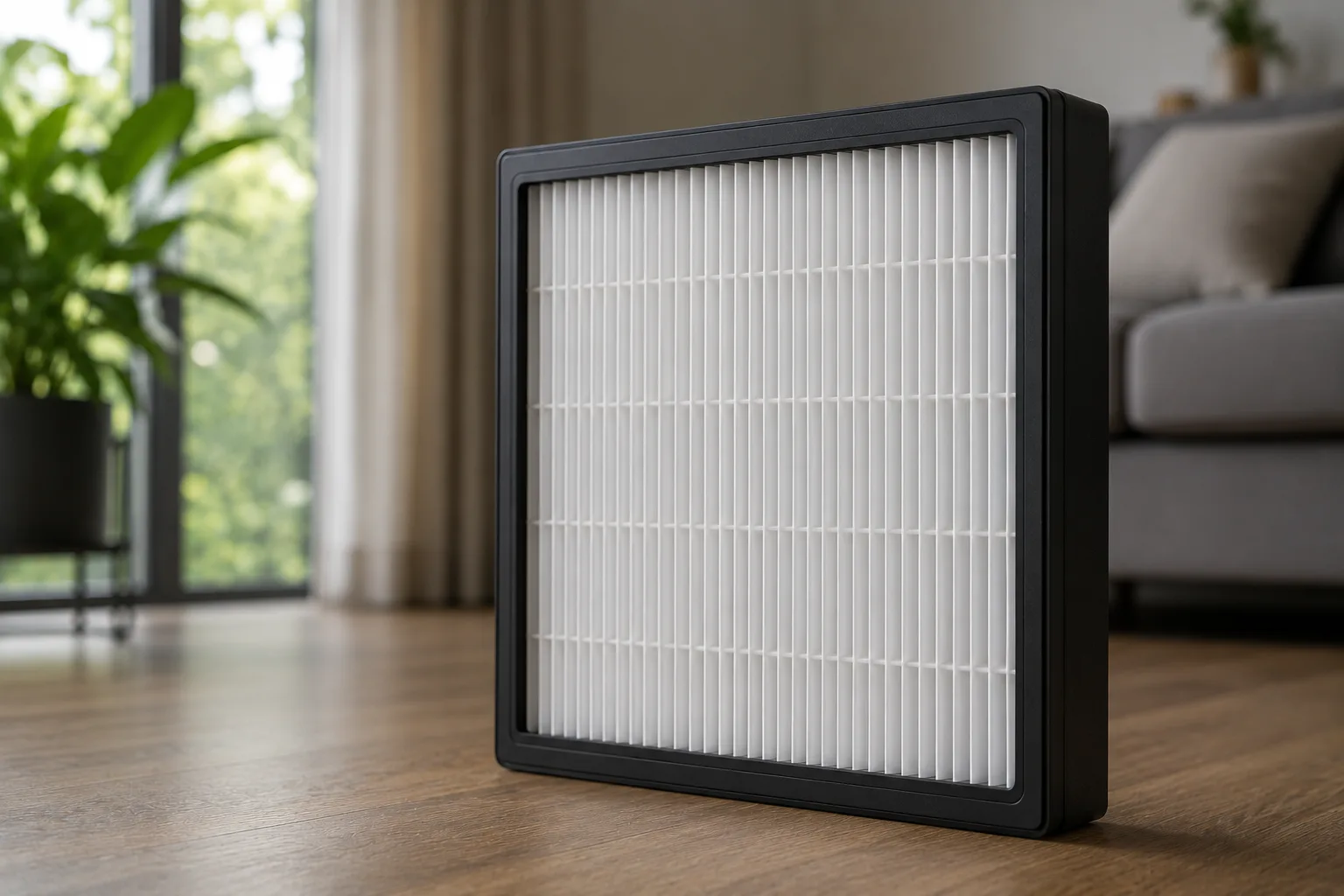
Most explanations of hepa air filters start with what the letters stand for and stop there. What actually happens on a production floor between raw glass and a sealed filter panel gets skipped entirely, which is strange, because that process is the reason one filter captures 99.97 percent of particles and another one, sold under the same three letters, does not.
A HEPA filter is not woven or stamped out of a single material. It moves through five distinct manufacturing disciplines, glass chemistry, papermaking, precision folding, sealant engineering, and metrology, before it earns the right to carry a certified efficiency rating.
Melting Sand Into Fiber Thinner Than a Human Hair
The raw material for most HEPA media is borosilicate glass, melted in a furnace at somewhere between 1,400 and 1,600 degrees Celsius. The molten glass is drawn through a bank of tiny orifices called bushings, stretching it into continuous filaments. Fiber diameter is controlled precisely at this stage, typically down in the range of half a micron to a few microns, because that diameter is what determines how the finished media will trap particles later. Thicker fiber is cheaper to produce and easier to handle. Thinner fiber captures more particles per gram of material but is harder to draw consistently, which is one reason glass fiber HEPA media costs more than ordinary HVAC filter cloth.
Turning Fiber Into a Sheet, Not a Fabric
Once the fibers are chopped into short lengths, they go through a wet-laid process that looks almost identical to ordinary papermaking. The chopped fiber is mixed with water and a binder into a slurry, then pumped onto a moving wire screen. Water drains through the screen, leaving behind a randomly oriented mat of glass fiber. That mat is dried and heat-cured to activate the binder, which locks the fibers into a rigid, porous sheet.
This method is not new. Glass fiber filter paper was developed by the U.S. Naval Research Laboratory in the 1950s specifically to replace asbestos-based filter media, and the wet-laid process it introduced is still the industry standard today. The fibers don't work like a sieve with uniform holes. They form a tangled maze that catches particles three different ways: direct impact, interception as air bends around a fiber, and diffusion, where the smallest particles drift into a fiber through random molecular motion.
Why Every Sheet Gets Folded Into Hundreds of Pleats
A flat sheet of glass fiber media has nowhere near enough surface area to handle real airflow without choking it. That's why every HEPA filter is pleated into a tight accordion shape. A standard 24-by-24-inch panel can hold more than 50 square feet of actual media once it's fully pleated, which is the only reason a filter that size can move meaningful airflow without an enormous pressure drop.
Aluminum Separators or Hot-Melt Beads
Pleats that touch each other block airflow just as badly as no pleats at all, so something has to hold them apart. Traditional deep-pleat filters use thin corrugated aluminum foil strips woven between the folds to keep air channels open. Newer mini-pleat designs skip the metal entirely and run fine beads of hot-melt adhesive along the media in lines instead, which is lighter and allows tighter, more closely packed pleats in the same footprint.
Sealing the Media Into the Frame Is Where Filters Actually Fail
This is the step that gets the least attention from buyers and the most attention from quality engineers, because a filter with flawless media and a bad seal performs like a filter with no media at all. The edges of the pleated pack are embedded in a liquid sealant, most commonly a two-part polyurethane, that cures into a solid bond between the media and the frame. Unlike swapping a heating element on an induction cooker, there is no adjusting this after the fact. Once the potting compound cures, that seal is permanent, for better or worse.
The frame itself varies by application. Particleboard is common in low-cost disposable panels. Galvanized steel or aluminum shows up in industrial and cleanroom filters that need to survive repeated handling. ABS plastic is standard for portable air purifiers and vacuum filters, where weight and corrosion resistance matter more than raw structural strength. A gasket, usually closed-cell sponge rubber or polyurethane foam, is then applied to the mounting face so the filter seals tightly against the housing once it's installed. Skip that gasket step, or use the wrong material for the operating environment, and unfiltered air will bypass the media through the gap.
The Final Step Nobody Should Skip: Testing at the Fiber's Weakest Point
A finished filter isn't legitimately HEPA until it passes a scan test under the EN 1822 protocol. The test targets the Most Penetrating Particle Size, the specific particle diameter, usually between 0.1 and 0.3 microns, that slips through media most easily. H13-grade filters must stop at least 99.95 percent of particles at that size. H14-grade filters have to stop 99.995 percent, roughly ten times fewer particles escaping than H13.
Lower grades can pass on a batch sample. H14 and above require a full-face scan of every single unit, checking for the small gaps in seal or pleat structure that a random sample would miss entirely. A factory that skips this step and simply labels a filter "HEPA" based on the media's rated specification, rather than a test tied to the finished, sealed unit, is making a claim it can't actually back up with paperwork.
What This Means Once You're Looking at a Spec Sheet
None of these five stages happens in isolation, and a weak link in any one of them shows up as a weak number on the test report. Glass chemistry sets the ceiling on how fine the fiber can be drawn. The wet-laid process determines how evenly that fiber is distributed across the sheet. Pleating and separators decide how much of that media actually gets used before airflow resistance becomes a problem. Sealing determines whether any of it matters once the filter is installed. HIFINE runs all five stages for its H13 True HEPA lines in-house, along with the OEM parts and components that go around them, rather than assembling filters from media and frames bought from separate, uncoordinated suppliers.