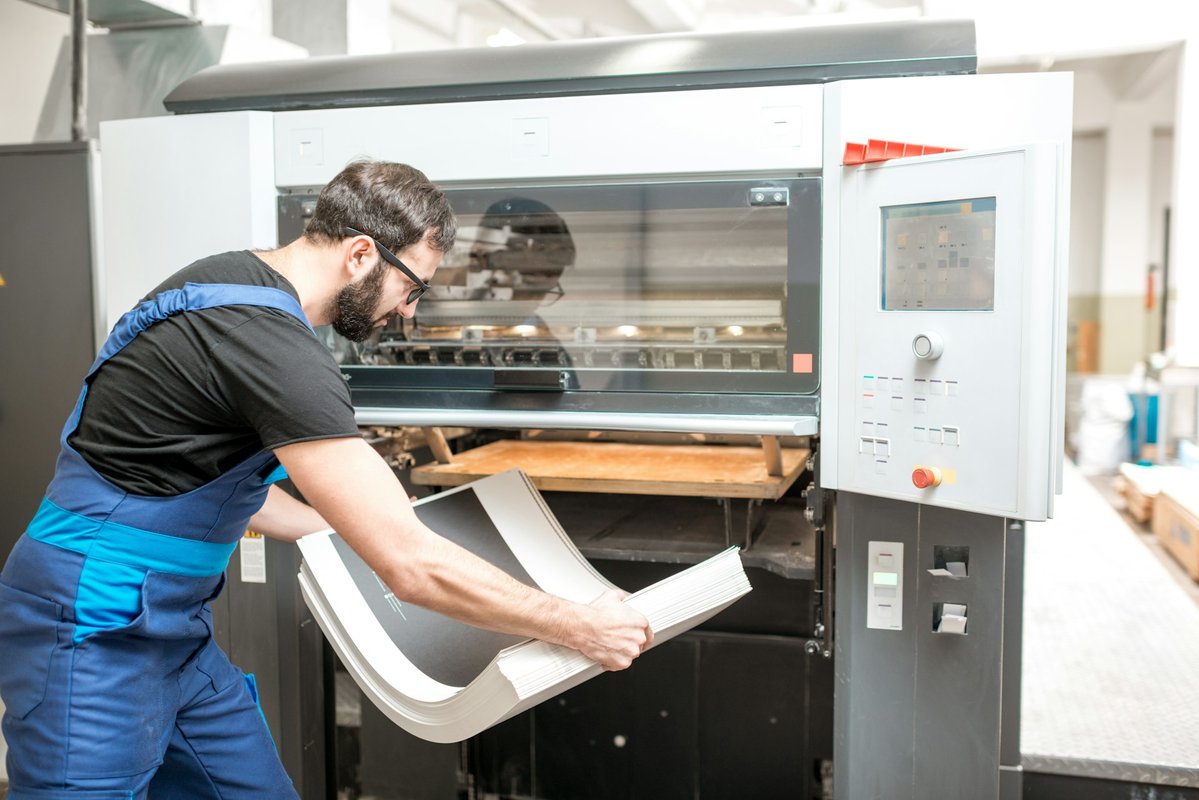
A quiet revolution is taking place in the print sector. Though not as intense, it is just as impactful as tech headlines. Code, software, data, and automation are reengineering print rather than making it obsolete. In 2025, AI-enhanced presses, print-as-a-service simulations, cloud-managed operations, and on-demand APIs are all changing the definition of "printing."
Driven by cloud computing, AI, and automation, the digital transformation market in MENA grew rapidly between 2024 and 2025, reaching roughly USD 55 Billion. It is changing all industries, including print. In other words, print is no longer confined to the analog world. Key innovations to mention are:
Variable data printing (VDP) enables personalized print at scale
Inkjet and laser dominate UAE’s digital tech pie.
The Cloud Has a Press Pass Now
Print is only one of the industries that the cloud has reinvented, including economics and logistics.
Digital print processes are currently controlled by cloud-based print management tools such as Xerox FreeFlow Core, EFI Fiery Command WorkStation, and HP's PrintOS. By centralizing data across numerous print equipment and locations, these platforms allow companies to monitor and regulate operations, track tasks in real-time, and simplify production.
Additionally, by moving to cloud infrastructure, UAE printing companies are:
Cutting down on dependency on hardware.
Accelerating work cycles.
Letting customers place print orders through safe online ordering platforms.
This strategy is particularly important in commercial print settings when coordination and accuracy are required due to version control, user modifications, and decentralized manufacturing centers.
Cloud APIs
Cloud APIs make automated print-on-demand possible. Customized packaging or labels can now be generated by an eCommerce platform such as Shopify using integrated print workflows, eliminating the need for human involvement. Specifically, during busy retail seasons, this degree of automation is crucial for staying on schedule and advancing execution.
Artificial Intelligence in Printing
Artificial intelligence is redefining print quality control and design workflows.
Print businesses in the United Arab Emirates that implemented automated inspection and image correction systems saw cost reductions of 8-12% in 2024 as a result of AI integration.
Prepress
During prepress, AI tools like Adobe Sensei can automate tasks such as:
Image resolution checks
Layout balancing
Color corrections
This can save hours of manual adjustments.
Press Floor
AI-powered vision systems on the press floor keep an eye out for registration mistakes, color drifting, and misprints on every sheet. By spotting even the smallest flaws that the human eye might miss, these technologies can flag prints for revision or initiate real-time corrective actions.
Postpress
AI algorithms that acquire knowledge from production data are now being used to optimize postpress operations like binding, cutting, and folding. AI is contributing directly to improved sustainability and increased profitability by lowering error rates and reprints, two major goals in the MENA print market.
AR, QR, and NFC: Print That Talks Back
Printed materials are active now.
Every page and packaging is becoming more immersive - thanks to technologies like Near-Field Communication (NFC), Quick Response (QR) codes, and Augmented Reality (AR).
These days, a magazine in Dubai might have AR-enhanced content, where a mobile device scan of a page displays a 3D rendering of an item or starts an embedded video.
Restaurants are incorporating QR codes into their menus so that patrons can examine nutritional information or place online orders.
Luxury packaging for electronic goods or beauty products frequently has NFC tags that, when tapped with a phone, confirm authenticity.
In the mobile-first MENA economy, where customers need on-demand accessibility to content and services, this interactive print-digital hybrid is particularly valuable.
IoT and Smart Printers: When Machines Think Ahead
These days, printers are intelligent systems that can diagnose themselves, improve performance, and connect to the cloud. They are no longer merely output devices. Industrial IoT (IIoT) printers are outfitted with sensors that continuously track temperature, humidity, printhead work, nozzle wear out, and ink levels. Predictive maintenance reduces repair expenses and period of inactivity considerably.
IoT-powered automation has made it feasible to run print farms that depend on wide-format or industrial-scale digital printers to sustain large-scale productivity with minimal manual inspection.
Besides, these smart printers are allowing for nearly uninterrupted service with less technical interruptions in sustainability-conscious settings like the UAE, where material efficiency and uptime are crucial for company operations.
3D Printing: Blurring the Line Between Print and Product
Additive manufacturing, typically called 3D printing, is radically extending the possibilities of printing. 3D printing turns computer designs into tangible goods by building objects layer by layer, in contrast to traditional 2D printing.
3D printing is being used for both prototyping and full-scale manufacturing in a number of industries in the United Arab Emirates and the wider MENA area, including consumer goods, dental care, construction, and aerospace. As an illustration, Dubai’s 3D Printing Strategy 2030 seeks to establish the city as a global center for this technology, with a target of having 25% of its buildings 3D printed by that year.
This change creates fresh revenue sources for the printing industry in areas like medical devices, architectural modeling, and packaging design, where only 3D techniques make low-volume or one-off production financially feasible.
API-Driven Print Ecosystems
Printing is becoming an ever-changing networked service with the help of Application Programming Interfaces (APIs). These days, print systems are linked with more comprehensive business systems, such as eCommerce platforms, CRMs, and ERPs.
For instance:
E-commerce: Integrated print-as-a-service for Shopify, WooCommerce.
CRM/ERP: Automated invoice, label, packaging prints triggered by transactions.
Web-to-print: Customers use web-to-print portals (Web2Print) for instant templates and VDP customization via APIs.
In addition to lowering friction and expediting operations, this plug-and-play print structure is compatible with contemporary tech stacks that require automation at all levels.
Future Trends in Print Technology
Looking ahead, several key trends will continue shaping the print landscape:
Automation & Web-to-Print:
Print-as-a-service models are being taken on by businesses, letting customers design and order prints right away, from any location. This is especially handy for international brands, retail chains, and franchisees.
Hybrid Printing:
Hybrid presses, which combine the high quality of offset with the agility of digital, are becoming more popular in commercial print and packaging.
Smart Packaging:
The smart packaging market in the GCC is expanding quickly from USD 0.74 Billion in 2024 to USD 0.82 Billion in 2025 (CAGR 9.2%) with computerized labels, temperature-sensitive tags, and NFC-enabled packs.
Regional Scale & Government Momentum
Print is one aspect of the digital-first plans being pushed by governments around the MENA. From 2025 to 2031, the UAE's commercial print market is expected to increase at a 5.5% CAGR driven mostly by public-private investments in smart manufacturing and technological advancements.
While lowering traditional print volumes, projects like the UAE Smart Government program and the Dubai Paperless Strategy are creating fresh prospects in smart signage, safe digital document printing, and on-demand government service materials.
Conclusion
Print has not been destroyed by technology; rather, it has been revived. Print is developing into an active pillar of the MENA region's digital economy because of AI, IoT, cloud, 3D printing, and API ecosystems.
At this crossroads, where print and technology professionals take the stage together, Half Price Print is influencing the future of printing services - from press to pixel - in powerful, novel ways.