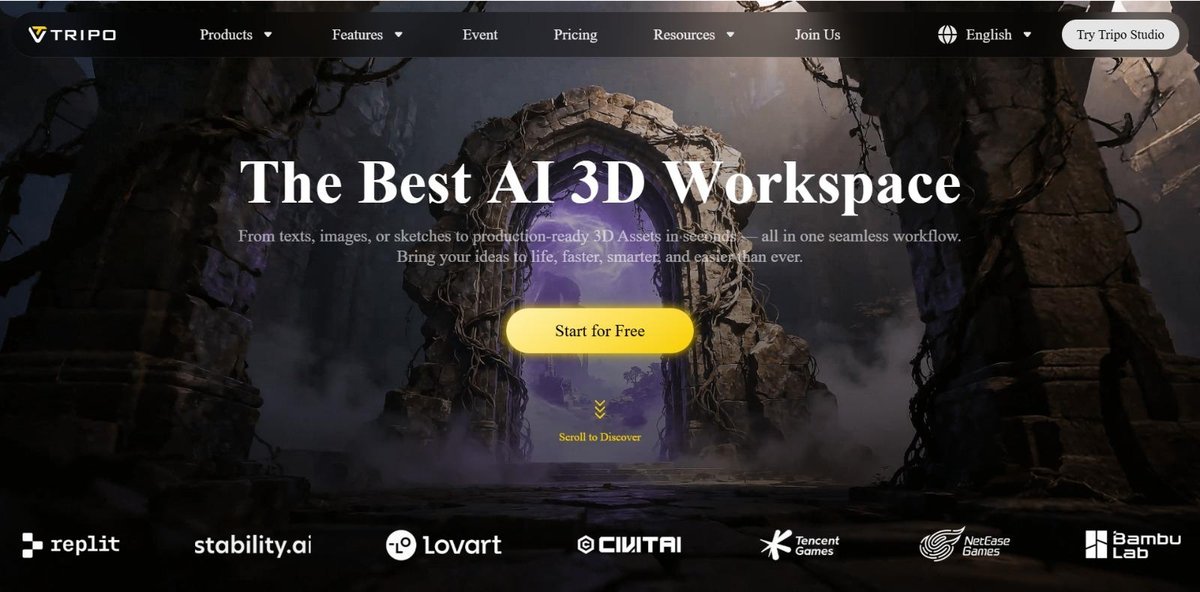
"The hardest part of 3D creation isn't imagination—it's everything that comes after." For many creators, the journey from an initial idea to a usable 3D asset has long been defined by technical barriers, fragmented tools, and time-consuming iteration. Designers and developers often spend more effort navigating software complexity than exploring creative possibilities.
This dynamic is beginning to shift with the rise of the AI 3D model generator. By automating foundational steps in asset creation, these tools are changing how quickly and intuitively concepts can be transformed into structured 3D models. Among them, Tripo AI stands out as the technology powering Tripo Studio—an integrated, AI-driven platform built to streamline the entire 3D workflow. By bringing generation, refinement, and preparation into a single environment, Tripo Studio enables creators to move from idea to production-ready assets with far greater efficiency.
A Centralized Approach to 3D Creation
Tripo Studio brings previously fragmented stages of 3D production into a single, cohesive environment. As an AI 3D model generator, it allows creators to move from initial ideas—whether expressed through text, visual references, or rough sketches—directly to usable 3D assets, all within one workspace.
Instead of relying on multiple disconnected tools, users can generate, adjust, and prepare models in a continuous workflow. This consolidation minimizes context switching and manual overhead, making the overall creation process more efficient and easier to manage, especially for teams and creators working across different stages of production.
Key Capabilities
This AI 3D model generator is designed to reduce technical friction and speed up creative iteration.
1. Text to 3D Model
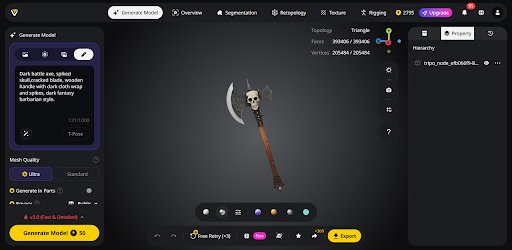
Tripo allows creators to turn written descriptions into structured 3D assets with minimal effort. By describing form, materials, and style in natural language, users can quickly generate models complete with PBR-compatible textures. A visual preview is created alongside the model, making it easier to evaluate ideas before moving forward.
This text to 3D model workflow is particularly useful for rapid prototyping and early-stage concept development across fields such as game design, visualization, and product exploration. Once generated, models can be exported in standard formats like GLB or FBX for use in common 3D engines, or prepared for 3D printing when physical output is required.
2. Image to 3D Model
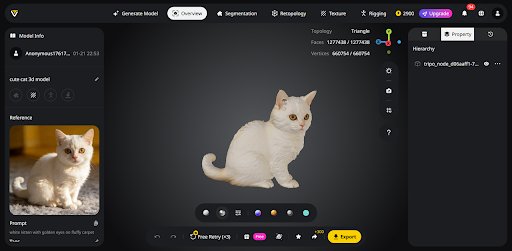
For projects that begin with visual material, Tripo provides an efficient image to 3D model workflow that simplifies the traditional 2D to 3D conversion process. By uploading reference images—such as concept art and product photos—creators can generate detailed 3D models without manually rebuilding forms from scratch.
To improve reconstruction quality, Tripo supports multi-view image input. Supplying multiple angles helps the system interpret depth and proportions more accurately, resulting in more consistent geometry and surface detail. For larger-scale tasks, batch processing enables multiple images to be converted in a single session, making it easier to explore variations, populate scenes, or assemble reusable asset libraries.
3. AI Model Segmentation
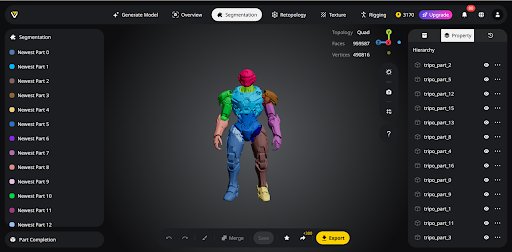
Working with dense, unified meshes often limits how efficiently a 3D asset can be refined. Tripo Studio addresses this challenge through its intelligent model segmentation system, which automatically identifies and organizes a model into meaningful, editable sections based on structure and form.
By breaking an asset into modular components, creators can focus on adjusting individual elements without disturbing the rest of the model. Parts can be replaced, refined, or recombined as needed, supporting rapid experimentation and variation. This approach is particularly effective when developing multiple asset versions, preparing models for downstream production, or adapting designs for different use cases, including physical fabrication and assembly.
4. Smart Retopology
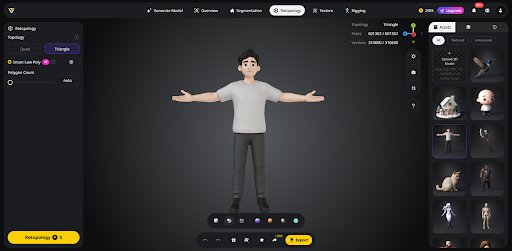
AI-generated meshes can vary widely in density and structure, which often creates challenges when assets are prepared for animation or real-time use. Tripo's automated topology refinement process evaluates a model's form and redistributes geometry in a more balanced and efficient way.
Instead of manual cleanup, the system produces streamlined meshes that retain essential visual detail while reducing unnecessary polygon load. Creators can adapt the resulting topology to match their intended use—whether favoring cleaner edge flow for deformation or more rigid layouts for technical assets. The outcome is a set of optimized models that integrate smoothly into interactive pipelines, supporting applications such as games, immersive experiences, and performance-sensitive environments.
5. Advanced AI Texturing with Magic Brush
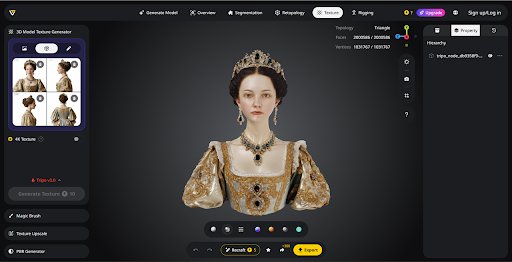
Applying materials to a 3D model is often one of the most time-intensive stages of production. This 3D AI generator simplifies this step through an AI-assisted texturing workflow that generates complete, render-ready materials based on simple descriptions or visual references.
Creators can establish an overall surface look in seconds, then fine-tune specific areas directly on the model using interactive brush-based adjustments. This balance between automation and manual refinement allows artists to maintain creative intent while avoiding repetitive setup work. To ensure visual consistency, textures are generated at high resolution and enhanced through built-in upscaling, preserving surface detail and material realism across different assets and rendering contexts.
6. Auto-Rigging
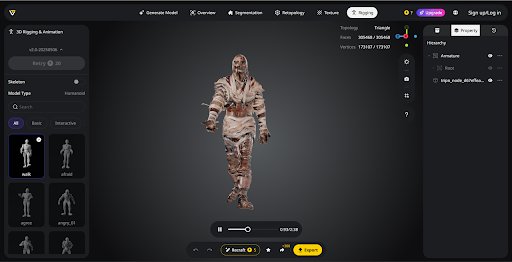
Preparing a model for animation often introduces a major technical hurdle in the 3D workflow. Tripo Studio removes much of this complexity by automating the rig setup process, allowing static meshes to be transformed into animation-ready assets with minimal effort.
By evaluating a model's structure and proportions, the system generates appropriate skeletal frameworks and applies balanced deformation data, resulting in natural movement across a wide range of asset types. Built-in motion previews make it possible to test articulation immediately, helping creators assess movement and make adjustments without additional setup. Tripo also includes a collection of ready-made animations for quick validation, and supports capturing specific poses for export as standalone models—useful for pose variations or physical production scenarios without repeating the rigging process.
Industry Applications of Tripo Studio
Tripo Studio, an AI 3D model generator, is reshaping how industries that rely on 3D content approach design, visualization, and production. By combining generation, editing, and preparation tools into a single platform, it enables faster workflows, greater flexibility, and higher-quality results across multiple sectors.
Game Development
For game studios, particularly small or indie teams, Tripo Studio accelerates asset creation dramatically. Features such as instant generation, modular segmentation, automatic topology optimization, and integrated rigging allow developers to produce ready-to-use assets quickly.
"With Tripo, our small team can create and implement game assets in days rather than weeks, giving us creative freedom we never had before," shared a game developer.
Product Design and Visualization
Product designers can quickly convert concepts into editable, high-detail 3D models. Intelligent segmentation and rapid iteration make it easy to explore design variations before committing to prototypes.
"We can test multiple component ideas in a fraction of the time it used to take, helping us finalize designs faster," said a product visualization specialist.
Architectural Visualization
Architects and interior designers benefit from the platform’s ability to quickly generate, refine, and stylize 3D environments. This enables immersive presentations and more effective communication with clients.
"Tripo lets us transform floor plans into interactive 3D scenes almost instantly, making client feedback much more actionable," explained an architect.
Shaping the Next Era of 3D Creation
Tripo AI has evolved into a powerful AI 3D model generator, providing creators with a unified platform that combines automated model generation with intelligent editing and preparation tools. This integration allows users to realize their creative ideas quickly while producing assets that meet professional standards.
For newcomers, Tripo offers a free plan with a limited set of credits, enabling experimentation and learning without upfront investment. By generating 3D models directly from text descriptions or reference images, the platform streamlines workflows and opens new possibilities for both personal projects and professional production. Now is the moment to explore AI-assisted 3D design and discover how Tripo can accelerate creativity, iteration, and output quality.