
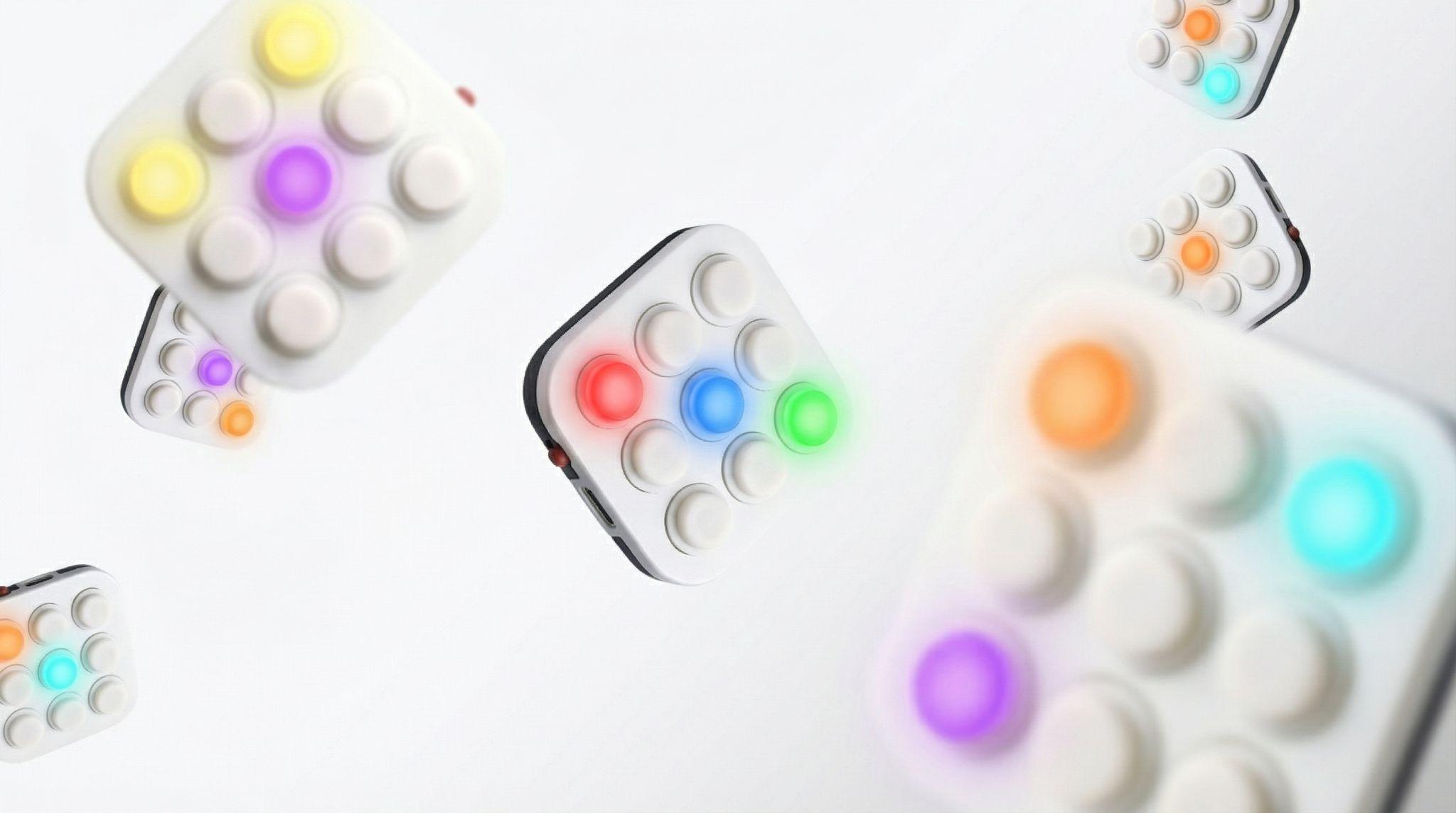
What is BrainBlink? The Pocket-Sized Brain Game Designed for Focus and Competitive Play
BrainBlink is a handheld mental fitness console, a pocket-sized arcade designed to train focus through competitive gameplay. The product launched on Kickstarter in 2025 and hit 100 percent funding in under eight hours, finishing the campaign at over 1,500 percent of its goal. The device features eight game modes including memory recall, speed rounds, pattern bursts, and color swaps. Players can track progress through a companion app, compete against friends one-on-one, join global tournaments, and climb leaderboards.
The product was designed by Nicolas Aagaard, one of the founders of LastObject, a company that has already proven it can deliver on crowdfunded promises. BrainBlink was manufactured by Morpho, a product design and manufacturing company based in China with 14 years of experience helping founders bring hardware products to market.
The Problem BrainBlink Solves: Why Focus Has Become a Rare Skill
The average person checks their phone 96 times per day. That is once every ten minutes. Research shows it takes an average of 23 minutes to regain focus after an interruption. Most people never get those 23 minutes.
The result is a generation of people who are busy but not productive, connected but not present, and exhausted by the constant demand to be available. Smartphones have made distraction the default state. Focus has become the exception.
Neuroscience has established that focus is not fixed. It is trainable. Like any muscle, it grows stronger with use and atrophies without it. People who practice focused attention show measurable improvements in their ability to concentrate. They perform better on complex tasks. They make better decisions. They report higher levels of satisfaction with their work.
But knowing that focus is trainable and actually training it are two different things. Most people do not have a system for it. They do not have a way to practice that feels rewarding rather than punitive.
BrainBlink was designed to fill that gap. It is a game, but it is also a training tool. The eight game modes are designed to challenge different aspects of focus. Each mode requires sustained attention. Each mode rewards improvement.
How BrainBlink Works: Game Modes, Gameplay, and Competitive Features
BrainBlink comes with eight game modes designed to train different aspects of focus and cognitive performance:
Call & Response: The device lights up a sequence of buttons. Repeat the sequence in the same order, then select and press one additional button of your choice to add it to the end of the sequence. Designed for memory expansion practice.
Classic Sequence Recall: Buttons in the same order. After each successful round, the sequence becomes longer and the light speed increases.
Whack-A-Mole: A randomly positioned LED turns on, representing a “mole.” Press the corresponding button within the time limit to score. Each successful hit earns points.
Stamina Challenge: The sequence is randomly generated and gradually becomes longer as the light speed increases. Once the sequence is complete, press the buttons in the same order as the lights were shown.
Pattern Burst: The device lights up multiple buttons simultaneously (randomly selecting 3-7 buttons). Press all the illuminated buttons in any order.
Speed Challenge: Repeat as many sequences correctly as possible within 60 seconds.
Reverse Call: Repeat the sequence in reverse order to test your reverse memory ability.
Color Swap: After the device demonstrates the sequence, the lights cycle through 7 colors. Press the corresponding button only when the correct color is displayed. A response is counted as correct only when both the button position and color match.
The experience is tactile and immediate. You play a round. You see your score. You try again. The feedback loop is tight and satisfying.
The device connects to a companion app on your phone to track progress, unlock new challenges, and compete against friends. Players can play one-on-one matches, join global tournaments, win challenges, climb leaderboards, and face the world's best players all through the same pocket console.
The competitive element transforms focus training from a solitary activity into a shared experience. The social dimension adds motivation and accountability.
The Design Philosophy: Why Simplicity Required Enormous Iteration
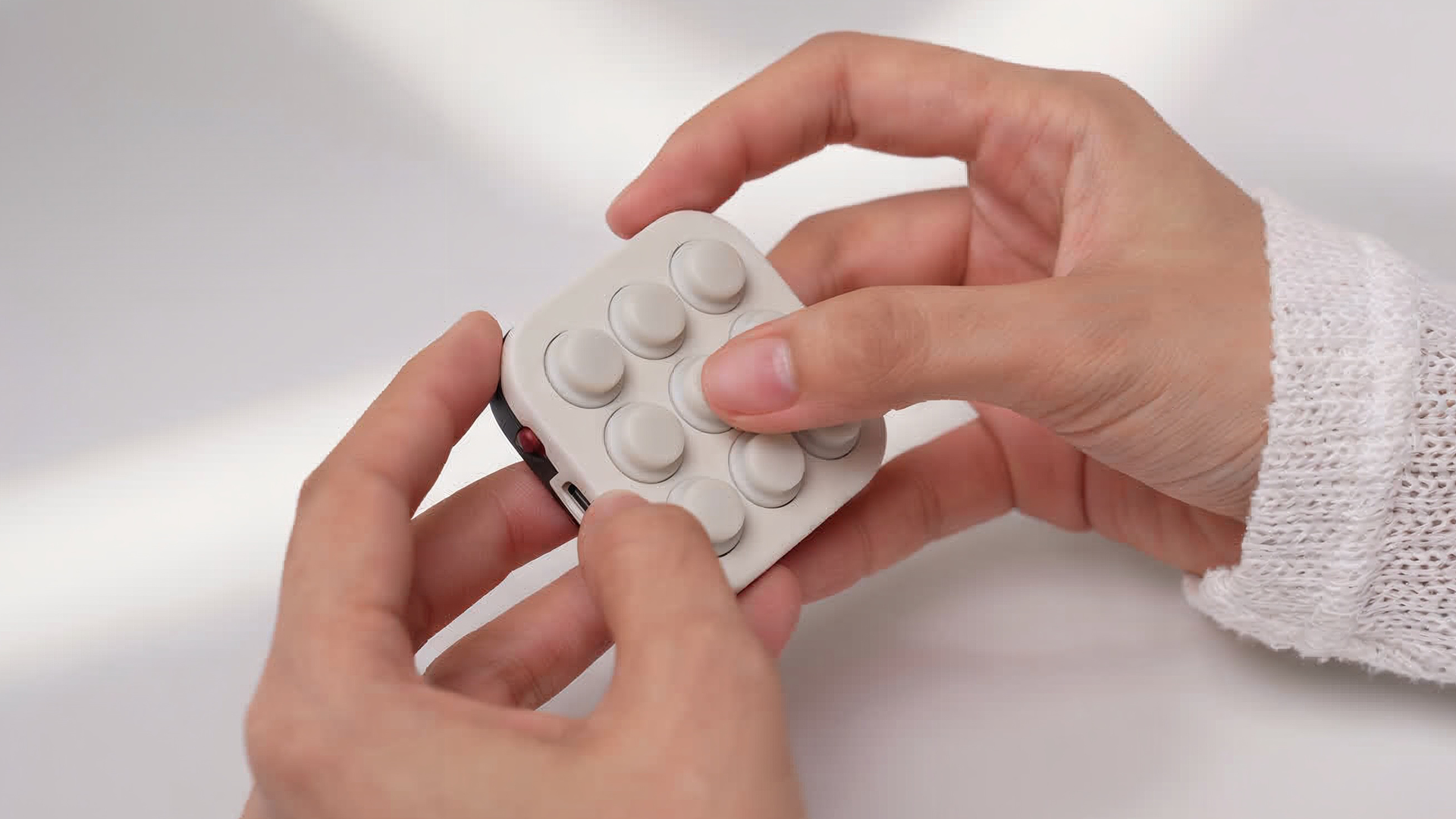
BrainBlink looks simple. A pocket-sized arcade. Eight game modes. Lights, buttons, a screen. The effortless experience is exactly what the design team wanted you to feel.
The problem is that effortless products are almost never simple to build.
"The products that feel the simplest are often the hardest to design well," says Josh Fairbairn, founder of Morpho. "You look at it and think 'it's just a game.' And then you realize the iteration behind that simplicity was enormous. That's true of almost every product we've built. The effortless ones are the most work."
The engineering behind BrainBlink's simplicity started with a single principle: every component had to serve the experience. Nothing decorative. Nothing that looked good in a render but created problems on the assembly line.
The tactile feedback. The button response. The way the screen illuminates. Each of these required iteration. Not because they were difficult in isolation, but because they had to work together at scale, across thousands of units, without variation.
Morpho's approach to manufacturing begins long before production starts. Each project receives a comprehensive quality standard document that establishes tolerances, inspection methods, and defect categories before tooling begins. For BrainBlink, that meant defining exactly how the buttons should feel, how much resistance they should have, and what constituted an acceptable variance.
Critical components are sourced directly from qualified suppliers. These relationships are built over years, which means Morpho knows the quality of work, the reliability of timelines, and the pricing structure before a project starts. Components are individually inspected before they reach the assembly line.
The company places particular emphasis on Design for Manufacturability, or DFM. This is the discipline that identifies production problems before they become expensive ones. For BrainBlink, DFM happened before tooling was committed. Once a mold is cut, design changes become structural and expensive to revisit.
How Morpho Built BrainBlink
Morpho is a product design and manufacturing company based in Guangzhou, China. Founded in 2012, the company has helped over 1,100 founders bring 2,000+ products from concept to mass production. The company has worked on products ranging from consumer electronics to durable goods, with successful campaigns including BullseyeBore Core and Écoute Headphones.
Nicolas Aagaard, the designer of BrainBlink, is a long-time Morpho client and one of the founders of LastObject, a company that has already proven it can deliver on crowdfunded promises. Aagaard understood from the start that the hardest part of a crowdfunded product is not the campaign. It is the months that follow, when you have to deliver on what you promised.
The partnership between Aagaard and Morpho was built on a shared understanding: that simplicity in the final product requires discipline in the design and manufacturing process. That a pocket-sized brain game that feels effortless to use requires enormous iteration to build.
Morpho's manufacturing process for BrainBlink included:
Comprehensive quality standard documentation before tooling
Direct sourcing from qualified suppliers with established relationships
Individual component inspection before assembly
Design for Manufacturability review before tooling commitment
Systematic quality control at every stage of production
BrainBlink Kickstarter Success: 1,500% Funding and What It Means
BrainBlink hit 100 percent funding in under eight hours. The campaign finished at over 1,500 percent of its goal. The numbers reflect something deeper than just product interest. They reflect a hunger for a solution to the attention crisis.
The Kickstarter success is particularly significant because it came from a product designed with manufacturing reality in mind from the start. Most crowdfunded hardware products face delays, quality issues, or delivery failures. BrainBlink was designed to avoid those pitfalls.
The success also reflects the credibility of the team behind it. Nicolas Aagaard has already proven he can deliver on a crowdfunded promise. Morpho has already proven it can manufacture at scale. The combination of proven designers and proven manufacturers created confidence in backers.