
Health Sample
Respiration is another word for breathing; thus, the respiratory system consists of the organs involved in breathing: the nose, trachea, larynx, and the lungs. In order to function, every cell in the human body needs oxygen. The respiratory system brings oxygen from the air into the body for cells to use. Air comes in through the nose (sometimes the mouth) and moves through the pharynx (part of the throat) to the trachea, also known as the windpipe, and then down into the lungs.
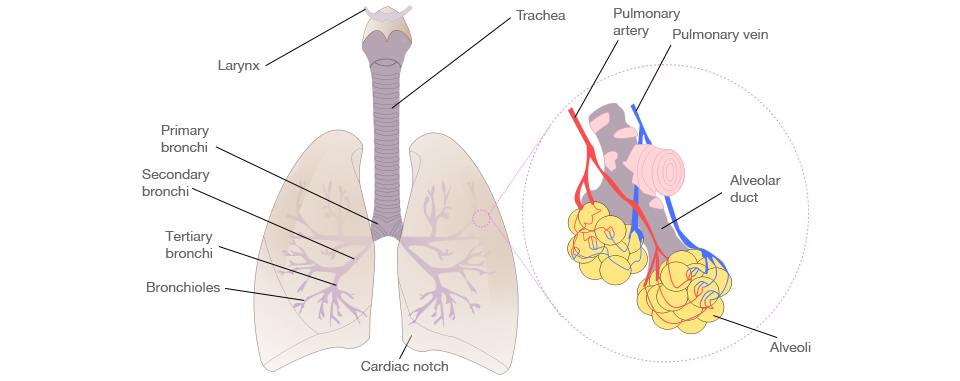 Dronchi, Bronchial Tree and Lungs. Adapted from source image courtesy Wikimedia Commons/Rastrojo. (Click for larger view)
Click through the tabs below to learn more about the respiratory system and how it functions.
The lungs are large organs made up of a system of airways that branch out from the trachea into smaller and smaller passages. These passages resemble the roots of a tree. With each breath in, oxygen is pulled into the bloodstream through the narrowest ends of each branch. Cells use the oxygen and produce carbon dioxide as a waste product. Carbon dioxide is pushed back into the lungs and is exhaled with each breath out.
The larynx sits between the pharynx and the trachea. Sometimes called the voice box, the larynx produces sound - a person’s voice. Inside the larynx are bands of tissue called the vocal cords.
When a person is quiet, there is a space between the vocal cords, but when the vocal cords are brought together, they vibrate as air passes between them. This vibration creates noise. The more tightly the vocal cords are brought together, the higher the pitch of the sound. So, the vocal chords of a man speaking in a deep voice are looser than those of a female opera singer hitting the high notes in an aria.