Creating income for today, wealth for tomorrow | Issue 61, April 2018

Diversifying Into Natural Resources

And the Booming Demand and Tight Supply That Will Grow This Dividend for Years


Marc Lichtenfeld

Dear Member,

This April 2018 edition is a special one. It marks the five-year anniversary of The Oxford Income Letter. I’ll have more on this big milestone later in the issue.

The traditional gift for a five-year anniversary is wood.

And though this month’s recommendation is not a gift (you paid for a subscription, after all), it will keep on giving. The stock yields 3.6% and should continue boosting the dividend by double digits for many years.

It’s the Wood That Makes It Good

Demand is surging for timber.

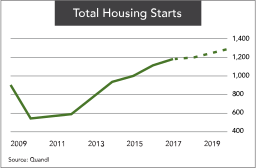
An improving economy and maturing millennials are leading to another housing boom. In fact, housing starts are at their highest levels since records started being kept more than 100 years ago. That number is expected to go even higher in 2019, 2020 and 2021.

Last year in California – one of the country’s strongest economies (which would be the world’s sixth largest if it were a country) – housing starts grew 18%.

Millennials have been notoriously slow to enter the housing market. But as the economy has improved and this generation has started pairing off and raising families, they’ve increasingly been buying homes.

In fact, last year, millennials bought 36% of the homes that were sold, more than any other demographic group. They likely would have bought even more houses if real estate values hadn’t been so high.

In addition to an American housing boom, demand for logs is strong. Chinese imports from the U.S. increased 10% last year.
Meanwhile, supply that can be turned into wood for constructing houses is very tight. Last December, the United States imposed a 21% tariff on Canadian lumber.

And fewer Canadian logs are even available to be imported into the U.S. Canadian forests have been devastated by the mountain pine beetle, which has destroyed 29% of the harvestable forests. And that may just be the beginning.

Another pest, the spruce beetle, destroys trees at twice the rate of the mountain pine beetle and its damage is growing 50% per year.

Industry experts are calling it a “lumber supply crisis.”

So it makes sense that a top operator that can meet demand stands to make a lot of money for shareholders over the coming years.

Weyerhaeuser (NYSE: WY) is the largest private owner of timberland in the U.S., with 12.4 million acres. One hundred percent of its holdings are classified as sustainable.

The company was started in 1900 with 900,000 acres of timberland and three people on the payroll. One hundred and eighteen years later, with 9,300 employees, Weyerhaeuser is the best in class in the industry, with a keen eye on its margins and bottom line.

In 2014, management said it would eliminate $500 million in costs. It reached its goal last year.

In 2017, Weyerhaeuser’s cash flow from operations grew 63%. And there’s more where that came from...

Earnings and cash flow should skyrocket in 2018 and beyond as the price of logs rises due to increased demand and limited supply.

Additionally, the new corporate tax rate lowers Weyerhaeuser’s rate from 21% to between 11% and 13%. Earnings are forecast to grow 13% annually through next year.
The Dividend

Management has stated that returning cash to shareholders is a priority.

Weyerhaeuser is set up as a real estate investment trust. That means it must pay out 90% of its net income in the form of dividends.

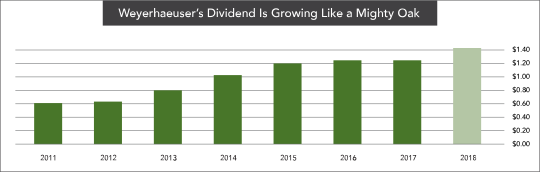
With the company’s earnings expected to grow double digits, it shouldn’t be a problem for Weyerhaeuser to continue to raise the dividend every year by an average of 11.4% as it has for the past eight years.

If Weyerhaeuser raises the dividend by an average of double digits every year, it shouldn’t have any trouble generating the 12% average annual total return necessary to qualify for the 10-11-12 System and the Compound Income Portfolio.

Additionally, there is still $500 million left in its current share repurchase authorization. Should the company use the full $500 million at today’s price, that would reduce the share count by about 2%.

Weyerhaeuser adds a natural resource to our portfolio that has strong demand and tight supply. The company has a long, solid history and a commitment to raising dividends. It should enable your portfolio’s income to grow like a mighty oak.

Action to Take: Buy Weyerhaeuser (NYSE: WY) at the market, and add it to the Compound Income Portfolio. Keep the position in a tax-deferred account if possible.

The Oxford Club’s 2018 Private Wealth Seminars

Fairmont Chateau Whistler | British Columbia, Canada | July 23-24, 2018

Sanctuary Resort | Kiawah Island, South Carolina | October 1-2, 2018

Are you free this coming July 23-24 or October 1-2?

If so, you’re invited to join our Oxford Income Letter team at one of The Oxford Club’s upcoming seminars, taking place July 23-24 at the beautiful Fairmont Chateau Whistler in British Columbia, Canada, and October 1-2 at the renowned Sanctuary Resort on Kiawah Island, South Carolina.

This is a wonderful opportunity for you to get up close to some of the world’s most accomplished investing minds… discover their best ideas for generating serious money in uncertain markets… and mingle with like-minded attendees, forging profitable, lifelong friendships.

You’ll hear from your favorite Oxford Club editors, including Chief Income Strategist Marc Lichtenfeld, Bond Strategist Steve McDonald, Options Strategist Karim Rahemtulla and many others!

To view all the details on these highly anticipated meetings, simply click here.

P.S. Act fast – our July meeting is nearly sold out!

To reserve your spot today, simply click here or contact our conference team at 443.708.9411.

STEVE’S BOND INSIGHTS

Moving America

The Growing Company That Is Innovating America’s Railway System


The U.S. has one of the largest freight rail systems in the world – 140,000 miles of track. It carries 40% of all goods consumed in the U.S. And the amount carried by the freight rail system is expected to increase 88% by 2035. That’s just 17 years!

Every ounce of the 54 tons of goods consumed by the average American each year has to be shipped. And at some point in the shipping process, 40% of those goods are in or on a rail car.

Transportation by rail is three to four times more fuel efficient than transportation by truck. It’s cheaper, it’s faster, and – because rail is not affected by highway congestion – deliveries are more predictable.

Ninety-one percent of rail freight is bulk commodities: agriculture and energy products, automobiles, construction products, food, metals, minerals, and paper.

The other 9% is intermodal – truck and rail combined. This area is expected to show the biggest growth going forward.

Intermodal is the best of both worlds – the efficiency of long-distance rail and the flexibility of trucks to deliver smaller, shorter-distance loads.

Trains are best suited for the heavy, long-haul portion of shipping. Trucks fill the void in urban and rural areas where there are no tracks.

But by 2050, 75% of the U.S. will live in one of the megaregions. And 80% of the population growth will occur there.

These areas already have huge traffic problems. As a partial solution, trucking is expected to decline and rail is expected to take more market share in densely populated areas.

Rail has already shortened its haul distances to as little as 500 miles. That’s less than the average of 750 miles that trucks serviced in the past.

So while intermodal is the most efficient model for the existing rail system, over the next 30 years rail is expected to increase its share of total intermodal freight miles.

And from a technology and safety perspective, there have been huge improvements in freight rail service:

  • A freight train recently hauled a load from China to Germany, 6,000 miles, in less than half the time it takes for sea transport.
  • Many trains can be computer controlled remotely and stopped if they miss a slowdown zone.
  • And the advent of high-speed trains in the U.S. opens up all kinds of possibilities.

The future of shipping will continue to be a combination of truck, water and rail. But rail is definitely on a roll (pun intended). And every mile of rail shipping is in or on a rail car, carried on axles and held together by coupling devices.

So let’s buy a rail car, train axle and coupler manufac-turer’s bond.

Moving America

Trinity Industries (NYSE: TRN) is North America’s leading manufacturer and provider of rail cars, train axles, coupling devices, rail car leasing services, and comprehensive rail services.

And it has the inland waterway shipping covered as well... It is the leading manufacturer of inland barges and barge covers.

Its customers range from energy and chemicals companies to agricultural, automotive and construction firms. There isn’t much that doesn’t ride in a Trinity rail car or on one of its axles, or isn’t connected to a rail car by one of its couplers.

Trinity also operates a wholly owned leasing division valued at $1 billion and a Railcar Investment Vehicle (RIV) division. RIVs are sold to institutional investors who lease them to end users. It’s similar to how planes are leased to airlines.

The company has a 50-year history of paying a dividend. It has also repurchased $35 million of stock via its current repurchase program and – over the last decade – has returned $781 million to its shareholders.

That said, the dividend is only 1.5% and is subject to change. And the bond gives you reliability, predictability and stability you won’t get from any stock.

Trinity currently has an infrastructure division the company plans to spin off to shareholders. The result will be two separate companies, each with a single focus.

Trinity Rails will operate the industry-leading integrated rail leasing, manufacturing and services business. And the infrastructure division will focus on just infrastructure in North America.

The spinoff is expected to generate stable cash flow and more growth opportunities.

This is an investor-friendly, solid company with a very bright future.

The Proof Is in the Numbers

The rail car industry has been facing an oversupply situation, which put pressure on last quarter’s numbers. But this is a temporary hitch, and it’s the only reason we are able to buy this bond slightly below par.

In its most recent quarter, Trinity posted a year-over-year increase in earnings of 696%. And it expects to grow those earnings, between this year and next, by 20% to 40%.

Its five-year earnings growth estimate is 10% per year.

Trinity is estimating a 6% increase in revenues this year, with a profit margin of 19% and a return on equity of 15.5%. All excellent numbers!

And its ratio of debt to cash and cash flow is exceptional... $3.2 billion in debt with $1.1 billion in cash and $0.7 billion in cash flow. That might be the best cash-to-debt ratio we own.

This is a solid company in a growing industry that holds the top position in rail cars in North America. It will make an excellent addition to the Blue Chip Bond Portfolio.

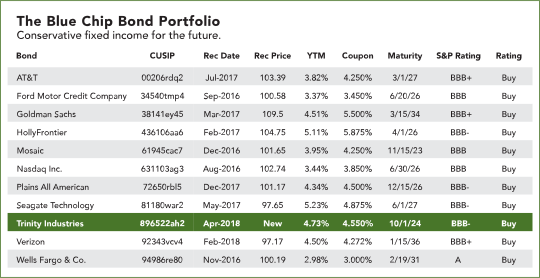
Action to Take: Buy the Trinity Industries 4.55% bond (CUSIP 896522ah2) that matures on October 1, 2024, at 98 to par, or $980 to $1,000 per bond, and add it to the Blue Chip Bond Portfolio. The yield to maturity is 4.73%.

five years in review

Pearls of Wisdom – and Wealth

Reflections on five Years of Camaraderie and Income Generation


It’s late at night here in Las Vegas and I’m thinking about the past five years of The Oxford Income Letter – fully aware that’s probably the lamest sentence ever written that started with “It’s late at night here in Las Vegas and I’m thinking...”

I’m in Vegas for The Oxford Club’s 20th Annual Investment U Conference. I’ve talked with lots of subscribers here. And I’m very grateful for all of the very nice things that were said about me and The Oxford Income Letter.

However, one Member said something that I was extremely proud to hear. It made my whole week.

He said, “The picks have been great, and that’s really nice. But what I really appreciate is that now I have a specific strategy for how to build my portfolio and it makes so much sense.”

You see, when I launched The Oxford Income Letter five years ago this month, my goal was, of course, to make you money. And I’ve done that.

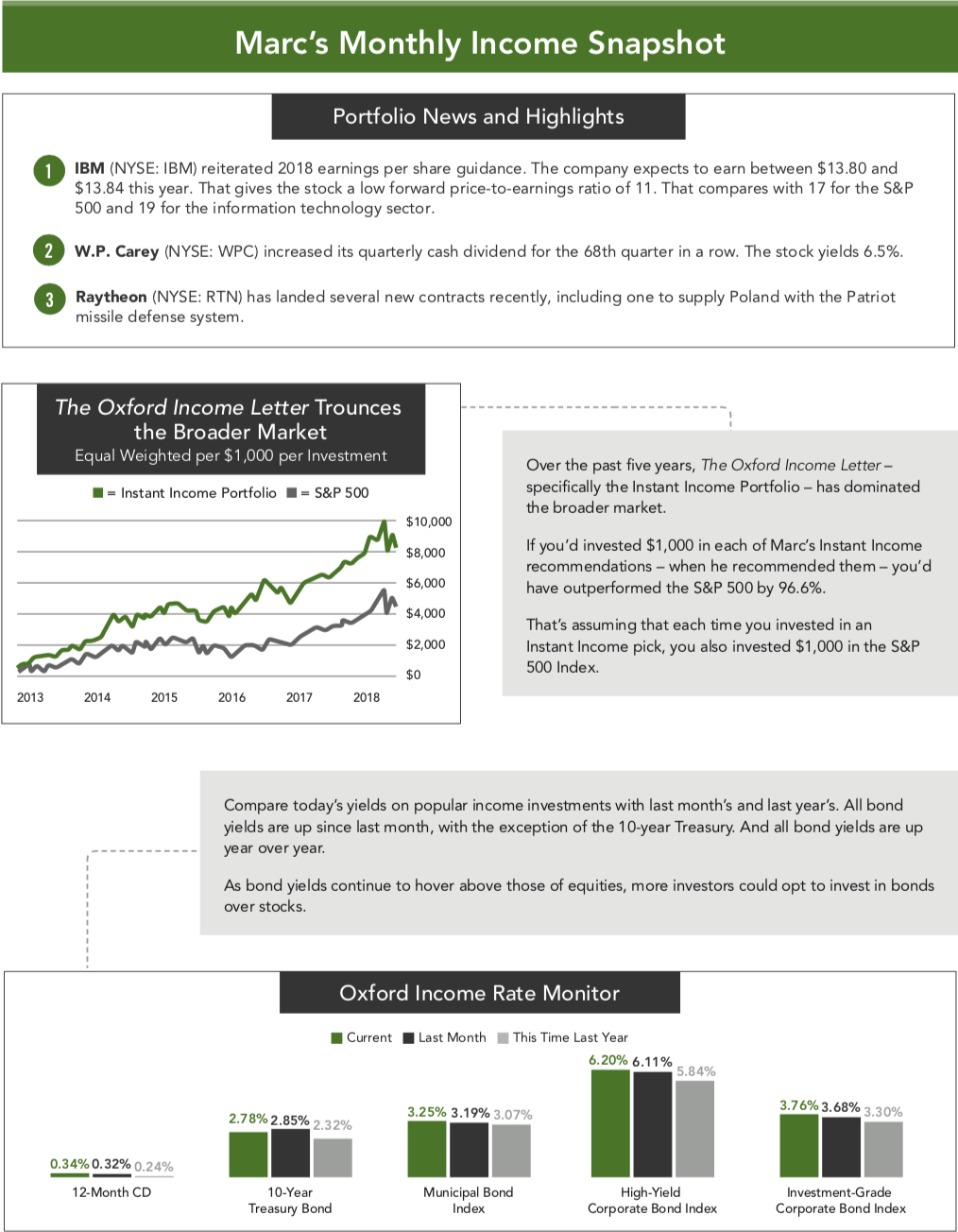
We have five triple-digit winners, including our largest, Raytheon (NYSE: RTN), up 283%, followed closely by Texas Instruments (Nasdaq: TXN) with a total return of 241%. We also have some stocks that have greatly outperformed the market, like Apollo Global Management (NYSE: APO) and Lazard (NYSE: LAZ), which are up 40% and 37%, respectively, in just over a year.

Of course, I’m not batting a thousand. No one does. We’ve had some losers too. Mattel (Nasdaq: MAT) and Teva Pharmaceutical (NYSE: TEVA) left particularly bad tastes in our mouths. And Omega Healthcare Investors (NYSE: OHI) – though up 28% since I recommended it – is the current problem child.

But The Oxford Income Letter wasn’t created simply to give out stock recommendations. It was built to show readers the benefits of investing in Perpetual Dividend Raisers so that they would understand what a powerful wealth creation tool these stocks are and how much income can be generated investing in them.

I created my 10-11-12 System for my first book, Get Rich with Dividends, in 2012. Shortly after it was published, we launched The Oxford Income Letter.

The strategy that the Member in Las Vegas praised is designed to generate 11% yields within 10 years or, if dividends are reinvested, 12% average annual total returns over 10 years.

Month after month since 2013, I’ve recommended stocks that pay healthy dividends. Most of them raise the dividend every year, with the exception of the stocks in the Retirement Catch-Up/High Yield Portfolio, which pay high yields and are for investors who can tolerate a higher degree of risk.

I’m extremely proud of The Oxford Income Letter and the entire team that puts it together. Again, not just because of winning stock picks but because of the breadth and depth of information that we’ve been able to provide for you. That includes Steve McDonald’s column on bonds and Karim Rahemtulla’s articles on selling options as an income strategy.

Karim gave me my start with The Oxford Club, so I’m honored that he believes The Oxford Income Letter is worthy of his time and effort.

What I’m also especially proud of is that we’ve innovated along the way – adding Steve’s Blue Chip Bond Portfolio, the SafetyNet Pro database, and the Retirement Cash Calendar where you can see the ex-dividend and payable dates for all of the stocks in our portfolios.

Those are three major new features in just a short five-year span.

Based on your suggestions, I also added recommendations on which type of account to hold the various stocks in so you can maximize tax efficiency.

If you have other suggestions for features or additional information you’d like to see in The Oxford Income Letter, please email me at mailbag@oxfordclub.com.

And I’m very pleased to report we get more reader feedback than any other product or service in The Oxford Club. That tells me you are engaged, hungry for information and excited about the strategy.

As a result, last June we added a new Oxford Income Mailbag column on Tuesdays to address all of your questions and feedback in a more timely manner.

And of course Oxford Income Weekly every Thursday is where I issue updates on the positions in the portfolio.

It’s a lot of work – one of the reasons I’m in my hotel room in Vegas rather than out there getting into trouble. But I love it, especially when I hear from Members about how much it has impacted their lives.

Phillip R., a healthcare worker from Eugene, Oregon, recently emailed in to tell me “I’m collecting $7,000 to $8,000 per year, and that will improve.” It’s not a fortune, but who couldn’t use an extra $600 or so every month? Phillip adds, “The possibility of a worth-while retirement for both my wife and me now looks more secure.”

One of my readers, Holly M., spent her career in the petroleum industry. But she just sent me a happy note saying she’s been able to retire thanks to the extra cash generated by the recommendations in The Oxford Income Letter. “I’m making about $20,000 a year, and I expect more as payouts increase, and as I buy more.”

And Shawn D. from Michigan emailed me with big news, literally... He said he’s “just bought a 42-foot Carver motor yacht” and that he “looks forward to cruising the Great Lakes.”

Shawn also happily reported his retirement income has now hit the $90,000-per-year mark.

I’m very glad that you find The Oxford Income Letter valuable and feel that the 10-11-12 System is a useful strategy in helping you achieve financial freedom.

In April 2013, I couldn’t have imagined that The Oxford Income Letter would be so well-loved by so many.

Thank you for an incredible five years. I look forward to many more.

4,800 Diseases... 1 Potential Cure...

and THIS Company has 19 Patents on It

Instead of just treating one disease at a time... this under-the-radar company is targeting the SOURCE of thousands of debilitating diseases.

The MIT Technology Review calls it “the biggest biotech discovery of the past century.”

We’ve created a special presentation to show you why we believe you can collect as much as 2,907% or MORE over time when this company skyrockets starting on February 1.

Click here to watch NOW.


Mailbag

The Oxford Income Mailbag


We believe it’s helpful to share questions and clarifications on dividend-investment strategies with all of our subscribers. Keep in mind, Marc can answer your general strategy and service questions, but he cannot give personalized advice. As always, feel free to send us your questions at mailbag@oxfordclub.com.

Marc,

Quick question on W.P. Carey (NYSE: WPC). You rate it “Buy.” However, it’s a REIT and sensitive to interest rate growth.

That was one of the reasons you recently moved Hannon Armstrong Sustainable Infrastructure Capital (NYSE: HASI) to “Hold” from “Buy.” If so, what is the difference between it and W.P. Carey?

Does it make sense to buy, or am I better off waiting (I don’t have it yet in my portfolio)?

Same question about Annaly Capital Management (NYSE: NLY).

– Leo

My downgrade on Hannon Armstrong was not only because of interest rates. As I explained in the February 8 Oxford Income Weekly, there’s a new tariff on imported solar cells. That means the company’s costs are going higher.

W.P. Carey and Annaly Capital Management remain “Buys.”

Though rising interest rates are a headwind for the stocks, they have other things going for them that should enable them to continue generating cash flow and funding their dividends.

In fact, W.P. Carey raised its dividend just last month.

And that’s the 34th consecutive quarter that the company has boosted its dividend.

More important than the direction of interest rates, Annaly Capital Management makes money on the difference between short- and long-term rates.

Annaly borrows money at cheaper short-term rates and lends it out at higher long-term rates. Those two rates can move at different speeds.

So if longer-term rates rise faster than shorter-term rates, Annaly makes more money.

The opposite is true if short-term rates rise faster.

How many days prior to ex-date do you recommend buying the stocks on the calendar to obtain the dividend?

I can’t buy all the stocks and continue to hold them through the next quarter.

What is the best process for collecting the dividend besides buy and hold?

– Glenn

You need to buy the stock at least one day before the ex-dividend date in order to collect the dividend.

If you can’t buy all of the stocks and hold them, I strongly suggest you buy only a few.

Buy and hold is the best way to collect dividends.

Otherwise, you’re taking on too much risk by purchasing a stock simply for the dividend and selling it right after.

What good would buying a stock at $50 and collecting a $0.50 dividend be if the stock dipped to $49.25 when you needed to sell it?

You’re too susceptible to market noise if you try to play the dividend capture game.

How do I calculate my return on entry price like you do?

I suspect you factor in the dividends and the reinvestment of them. I’m having a hard time figuring out how well my stocks are doing and think this calculation might be my answer.

If I’m wrong, please show me the calculation I should be using.

– Wally

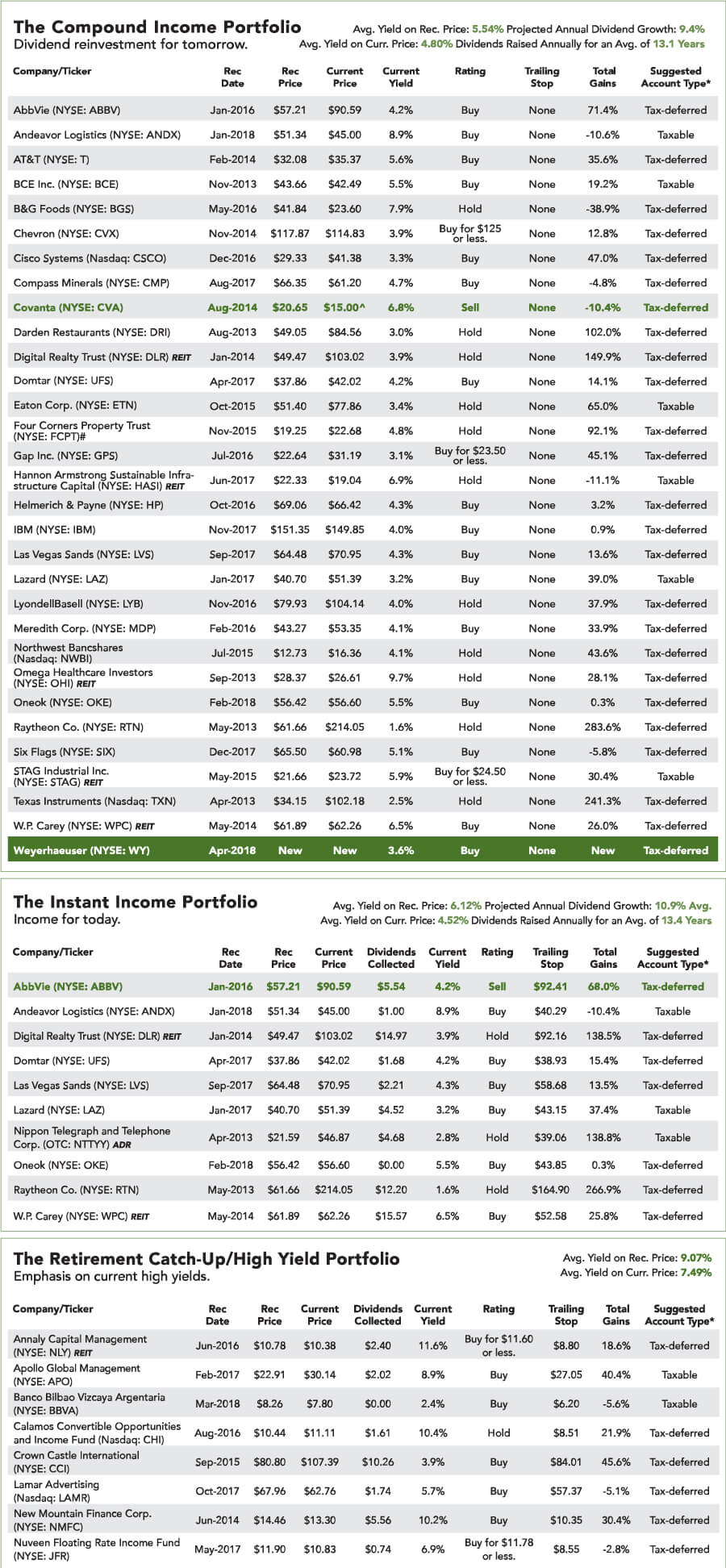
We do include dividend reinvestment in the total return calculation for the Compound Income Portfolio.

We do not in the Instant Income and Retirement Catch-Up/High Yield portfolios.

A simple way of figuring out your total return is to...

  1. Determine your original cost.
  2. Determine the current value of your portfolio (this will include additional shares that have been reinvested).
  3. Subtract the original cost from the current value.
  4. Divide Step 3 by Step 1.

For example, let’s say you bought 100 shares of stock at $50 for $5,000.

Today, your investment is worth $7,327 because the stock price has gone up and you own more shares.

7,327 - 5,000 = 2,327

2,327 / 5,000 = 0.465, or 46.5%

Your total return would be 46.5%.

I was surprised to learn that your most recent Instant Income and Compound Income portfolios contain Las Vegas Sands (NYSE: LVS) since SafetyNet Pro rates it an “F” and W.P. Carey, which is a “D.”

Is this a problem with SafetyNet Pro or just an oversight?

Thanks for your response. I enjoy your research and articles.

– Norm

Since your email hit our inbox, Las Vegas Sands was upgraded to a “C” thanks to free cash flow estimates being raised by Wall Street for this year.

W.P. Carey was also raised to a much safer “B” as its funds from operations estimates increased as well.

But it’s important to keep in mind that not every stock in our portfolios will be rated “A.”

While most of the stocks will have high ratings from SafetyNet Pro, not all of them do.

I often look for opportunities where a company’s fundamentals aren’t the greatest at the moment but are improving. That can lead to a low rating by SafetyNet Pro.

Some of our contrarian stocks, like Gap (NYSE: GPS), Darden (NYSE: DRI) and Meredith (NYSE: MDP), were struggling at the time I recommended them.

But ample cash flow to cover the dividend and what I expected to be an improving business turned them into big winners.

So if a stock I recommend isn’t rated highly by SafetyNet Pro, that is likely the reason why.


The Compound Income Portfolio Prices as of 4/3/2018. Trailing stops are adjusted to reflect dividends collected. # Spinoff from Darden Resturants. ADR – American Depositary Receipt. MLP – Master Limited Partnership. REIT – Real Estate Investment Trust.
*We created the “Suggested Account Type” column in the spirit of The Oxford Club’s fourth Pillar of Wealth – to cut expenses and stiff-arm the taxman. This column denotes the suggested account type in which to hold each position for tax purposes. Please note, stocks that are suggested for tax-deferred accounts may go into taxable accounts if necessary. Stocks suggested for taxable accounts should generally not be put in tax-deferred accounts. Everyone’s situation varies, so please consult your tax professional or financial advisor before you invest.

The Oxford Income Letter portfolios fit into the Blue Chip Outperformers level of the Oxford Wealth Pyramid. For more information, go here: www.oxfordclub.com/wealth-pyramid.