Creating income for today, wealth for tomorrow | Issue 59, February 2018

A Turnaround in the Energy Sector With a 5.2% and Growing Yield


Marc Lichtenfeld

Dear Member,

I love a good turnaround story.

The Golden State Warriors were mediocre, at best, for decades until their recent dominance of the NBA.

John Travolta, one of the biggest movie stars of the 1970s, was all but forgotten in the 1980s. Then, his role in Pulp Fiction brought his career back from the dead.

Heck, even Tonya Harding, who famously orchestrated the kneecapping of a figure skating rival, is now seen as a somewhat sympathetic character.

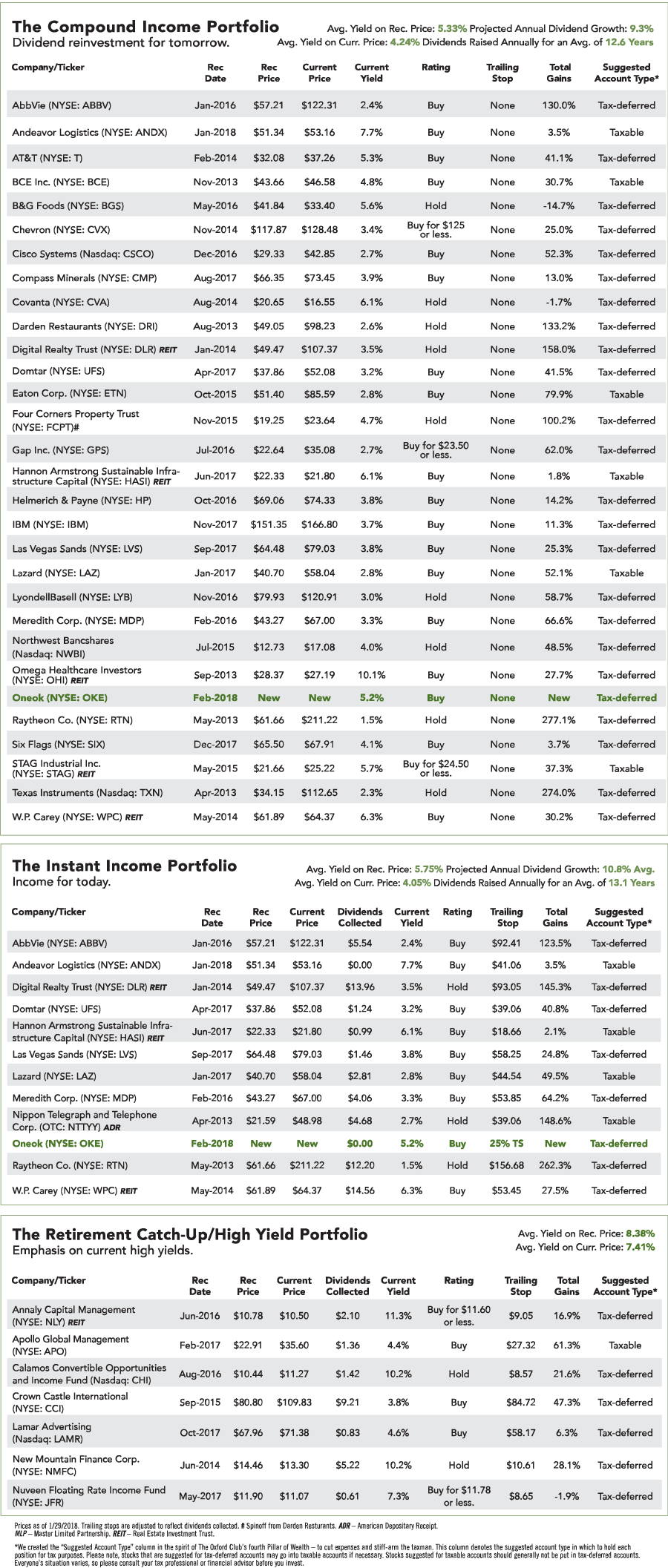
And our portfolio is filled with turnaround stories – Gap (NYSE: GPS), Chevron (NYSE: CVX), IBM (NYSE: IBM) and several others.

Today I have another for you, and it’s in a space that I’m particularly bullish on for 2018.

In the January issue of The Oxford Income Letter, I mentioned that I liked the energy sector – including master limited partnerships, or MLPs.

This month, I’m sticking with the business model of most MLPs – pipelines – but not the corporate structure.

Pipeline companies generate tons of cash as they don’t have large operating expenses. This particular pipeline company pays a 5.2% dividend yield that is rising by double digits each year.

But this company is a bit different from our other energy plays, such as Chevron. It doesn’t focus on oil. Its main business is transporting natural gas.

Demand for natural gas is huge thanks to this winter’s brutally cold temperatures. It’s in the 40s here in South Florida as I write this. I know I may not get much sympathy from those of you in the north, but I had to put on a jacket this morning.

Power plants have never burned as much natural gas as they do today. In fact, this winter we’re using 14% more gas than we did during the polar vortex of 2014.

And it’s not just the frigid Northeast and Midwest (and South Florida) that need gas.

Over the past five years, U.S. producers have more than doubled the amount of natural gas they export.

Oneok (NYSE: OKE) is positioned perfectly to take advantage of the growing demand for natural gas.

The 112-year-old company gathers, stores and transports natural gas liquids. It has 38,000 miles of pipelines in the United States and can store 58 billion cubic feet of natural gas.
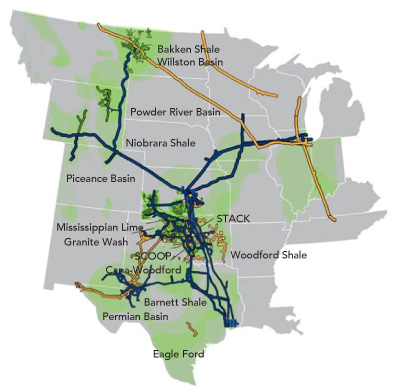
Its assets are located in some of the country’s most active gas fields, including the Permian Basin.

Additionally, Oneok dominates the Bakken region, with two-thirds of gas rigs on Oneok’s footprint.

And in the states where Oneok operates, rig counts are up 70% in the past year. All that gas will need to be gathered, transported along pipelines and stored.

Oneok is in a perfect position for massive growth.

The company has invested heavily for the future, and it is starting to pay off.

In the third quarter of 2018, Oneok will complete a 120-mile pipeline expansion in West Texas.

Two more pipeline expansions will come online in Oklahoma in the fourth quarter. And a massive 900-mile pipeline from Montana to Colorado will be finished at the end of next year.

These and other projects should fuel growth in the near future as well as the long term.

A Game Changer

What I like about the pipeline business is that it’s not tied to the price of the commodity. If a gas company needs to get gas from point A to point B, it pays a set fee to the owner of the pipeline regardless of the price of gas.

Those fees are usually set months or even years earlier, so a fluctuation in the price of gas doesn’t change the fees collected by the pipeline.

Five years ago, 63% of Oneok’s revenue was fee-based. Today, 90% is.

Last year, the company took an important step in improving its financials. It absorbed its MLP, Oneok Partners.

Here’s why that’s a big deal:

  • The acquisition of Oneok Partners immediately adds to earnings and free cash flow.
  • It will result in Oneok owing no taxes through at least 2021.
  • Oneok will have a lower cost of capital, making it cheaper to make future investments.

In fact, this year free cash flow is forecast to be more than double what it was in 2016, and it should jump another 22% in 2019.

Additionally, the company is paying down debt. It repaid $1 billion in July. Oneok plans to bring its debt-to-EBITDA ratio (a simple measure of cash flow) below 4.0. It was 4.6 at the end of the third quarter and 5.1 in 2016.

Impressive Dividend

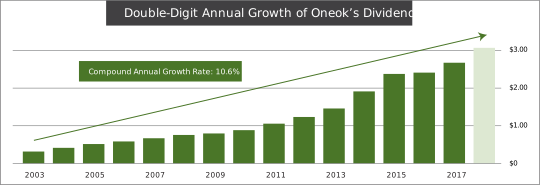
Oneok has paid a dividend since 1972. It has raised the dividend every year since 2003. That includes the Great Recession from 2008 to 2009 and the collapse in energy prices from 2015 to 2016.

The dividend’s compound annual growth rate over that time has been an impressive 10.6%. The current quarterly dividend is up 25% year over year.

The company generates plenty of cash flow to pay the dividend. Through the first nine months of 2017, Oneok’s free cash flow totaled $1.02 billion. It paid out $747 million in dividends. And with free cash flow expected to rise to $1.9 billion next year, the dividend should increase sharply over the coming years.
There are many ways to invest in a rebound in natural gas, but Oneok is one of the only pure plays. With a yield of 5.2% and double-digit dividend growth expected, this stock fits perfectly into the 10-11-12 System.

Action to Take: Buy Oneok (NYSE: OKE) at the market, and add it to the Instant Income Portfolio and Compound Income Portfolio. Place a 25% trailing stop if you’re holding it in the Instant Income Portfolio (collecting the dividend income). Do not place the stop if you’re holding it in the Compound Income Portfolio (reinvesting the dividend). The stock should be held in a tax-deferred account if possible.

Marc’s New Best-Seller...
You Don’t Have to Drive an Uber in Retirement
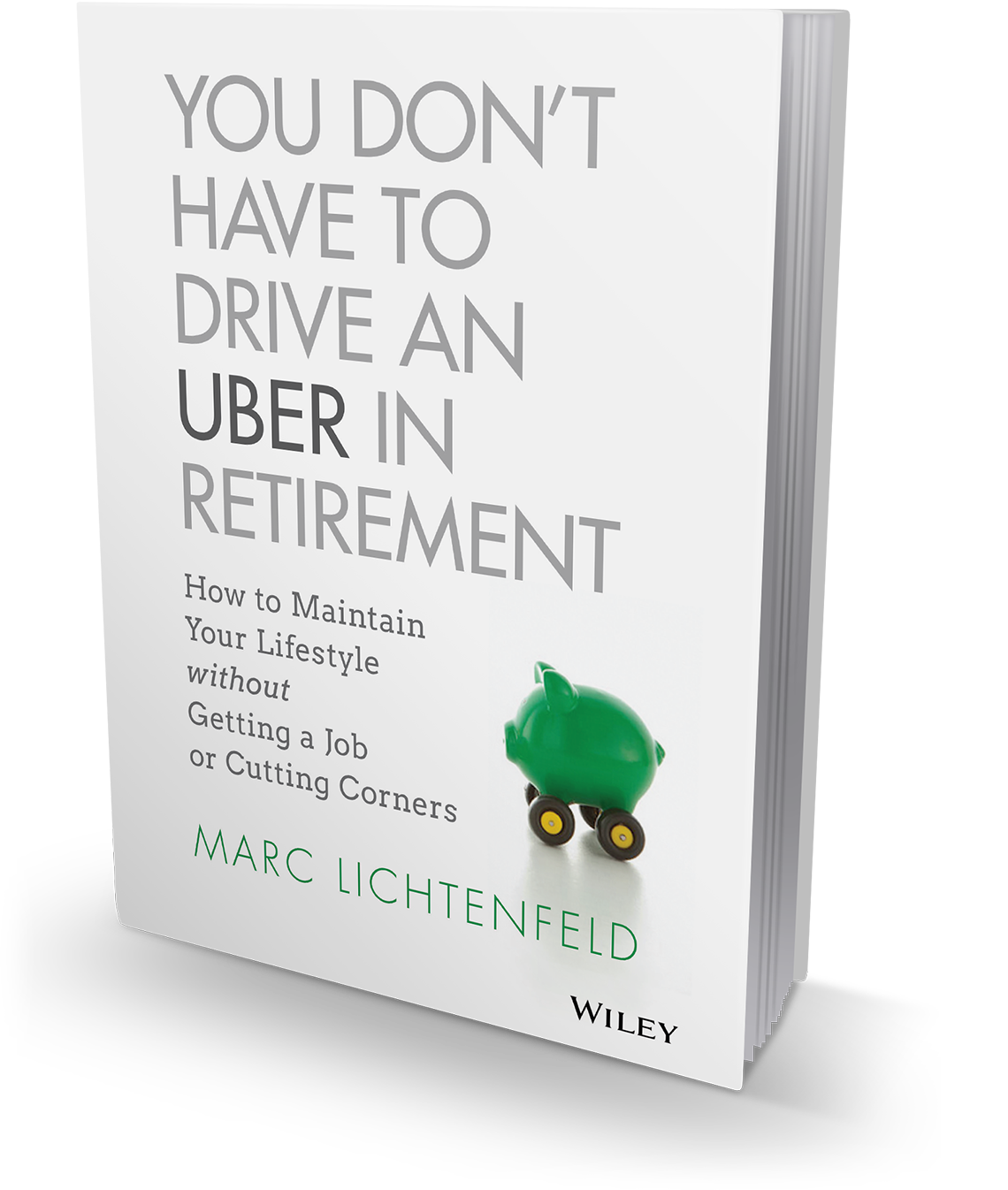
Planning for retirement does not mean holding off on fun today; there are many simple ways the average American can boost their income and reduce everyday costs without living like a pauper or clipping coupons. Marc’s new book, You Don’t Have to Drive an Uber in Retirement, will help you take stock of what you have and what you’ll need, and will show you how to bridge the gap.

  • Discover unique ways of generating a meaningful amount of income – without having to get a job.
  • Adopt new everyday strategies that will help you increase your funds.
  • Maximize your savings while minimizing the impact on your lifestyle.
  • Learn just how much you’ll need for a comfortable retirement.

Add new income streams, optimize your portfolio and learn to spend less without living less – these are the factors key to making your golden years truly golden. You Don’t Have to Drive an Uber in Retirement is an important resource and insightful guide for those who want to maintain their comfortable lifestyle in retirement – without getting a job.

Pre-order your copy today, and receive a free bonus chapter: “How to Save Money Every Time You Visit the Doctor.” For all the details, click here.

STEVE’S BOND INSIGHTS

A $40 Billion Industry and the Reliable Company That’s Staking a Big Claim in It


In bonds, boring is beautiful.

Week after week, nothing exciting happens with bonds except that they make their interest payments. And just when things get so dull you think you’ll die of boredom, they mature and return your $1,000 in principal.

These boring, predictable, safe and stable investments pay month after month, year after year, with no excitement, no rush and, except in very rare cases, no losses.

How rare are losses in bonds?

The default rate for speculative corporate bonds, the highest-risk bonds on the market, has dropped to a stunning 3.2%. And investment-grade bonds default less than 1% of the time. That’s a 96.8% success ratio for the highest-risk bonds and a 99%-plus success rate for the bonds we hold in our Blue Chip Bond Portfolio.

And most people avoid them like the plague because… they’re too “risky.” I wish I was kidding.

But if you’ve matured enough as an investor to appreciate what consistent returns and no losses, year after year, from the sleeping pills of the money world can do for your finances, then you’ll love this month’s pick.

They don’t get any snoozier or safer than this one!

Verizon Communications (NYSE: VZ) is a grandchild of the old Bell System. It has developed into one of the two dominant players in the wireless world – AT&T (NYSE: T) of course is the other.

Despite tough competition, Verizon is a standout performer in both cellular and fiber networks. But, as with most sleepy, long-term growth and income stories, Verizon’s numbers are far from exciting... stable and growing, but not exciting.

Earnings between this year and next are expected to increase by 5% to 6%. On top of that, revenues are expected to grow by about 1.6% over the same period.

And the five-year average growth estimate is 2.16% per year. The companies backing most of the other bonds in our portfolio have higher growth rates.

These are not the gangbuster numbers most investors look for in a company, but we aren’t investing in Verizon because of its growth. We’re investing in it for its consistency.

This is a company that has grown its top and bottom lines for decades. That kind of reliability is a nice thing to have in an income source. And in other fundamentals, Verizon outperforms.

It has a return on equity of 64% – a huge number that is a measure of management effectiveness. And it has excellent management that delivers consistent returns.

Despite a tough competitive environment and massive amounts of money being invested in network improvements, the telecom giant still boasts a profit margin of 12.8%.

The company’s current network has been ranked No. 1 in the U.S. for seven years, and it experienced usage increases of 47% last year.

Going forward, Verizon’s new 5G network will deliver speeds of 1 gigabyte per second. That’s 100 times faster than its current technology. And it is expected to deliver $12.3 trillion in market opportunity by 2035.

One hundred times faster means friends could receive your texts before you type them! (Just kidding, but you get the idea.)

Verizon is also investing $300 million per year for the next six years to continue the development of its fiber network in Boston.

It currently has fiber assets in 45 of the 50 largest markets and will deliver broadband to residential and business customers.

Digital advertising is expected to be a $900 billion industry by 2020. That’s just two years from now. And the purchase of AOL and Yahoo (and the 1.3 billion users who came with them) will make Verizon a force in that area.

Verizon’s acquisition of Fleetmatics and Telogis has made it the No. 1 player in telematics, or connected transportation solutions, in the U.S. That division had a 21% increase in revenues in the fourth quarter and is approaching $1 billion per year in revenues.

By 2020, the global market for telematics is expected to grow to $40 billion. And Verizon has the assets and expertise in place to capture a big part of that market.

I could go on indefinitely about all the opportunities Verizon is exploring and developing.

But suffice it to say this is a company that is much more than just wireless or fiber networks. Its commitment to growth and expansion in the digital world will make it a force to be reckoned with for decades.

And with that long-term potential in mind, I am recommending a Verizon bond this month that has an 18-year maturity.

As most of you know, that breaks one of my rules about short maturities. I typically hold bonds with shorter maturities, but this one is an exception.

I am so confident in this company’s long-term growth and stability that I know its bonds can serve as an income source for most of anyone’s retirement. There’s a lot to be said for an investment you can rely on for that long, especially when it pays 71% more than the benchmark 10-year Treasury with almost the same risk level.

And while I don’t usually recommend a bond with the expectation of selling it before maturity for a capital gain, Verizon may be an exception, again. If its expansion in the digital world continues as it has, we could be out of this one with a gain long before maturity.

This is one of the best and most reliable long-term income buys on the market.

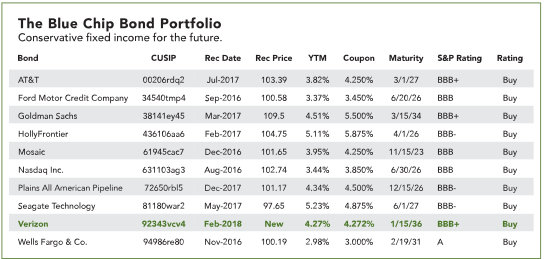
Let’s buy the Verizon bond with the 4.272% coupon that matures on January 15, 2036, at par, or $1,000 per bond. The CUSIP is 92343vcv4, and it is rated BBB+.

Since we are paying par for the bond, the yield to maturity is the same as the coupon: 4.272%. If the bond is trading above par, wait for it to drop to 100 or less.

Action to Take: Buy the Verizon 4.272% bond (CUSIP 92343vcv4) that matures on January 15, 2036, at par, or $1,000 per bond, and add it to the Blue Chip Bond Portfolio.

Infinite Income Strategies

Are You Going to Be Forced Back to Work?


You should congratulate yourself.

You’re in the small minority who are actively taking control of their finances. Most people are unable or unwilling to do so.

The numbers are scary. According to the Federal Reserve’s Survey of Household Economics and Decisionmaking, almost 25% of non-retirees aged 45 and older have nothing saved for retirement.

Zero. Nada. Bupkus.

Nearly half of the respondents to the survey said they would not be able to meet an unexpected $400 cost such as a car repair or medical emergency.

Those who are in their retirement years aren’t doing any better. According to a study by AARP, 35% of respondents aged 65 to 74 said they need to work. Not to be self-fulfilled or to give back to society, but to have the income. After 40 or 50 years in the workforce, they still need a job to get by.

And don’t think you’ve got it made in the shade with pink lemonade just because you have a pension. Low interest rates have left pensions woefully underfunded. For example, Kentucky’s pension fund has $16 billion in it. That’s $27 billion less than what’s needed to pay the state’s public workers, including police officers. S&P 500 companies have a pension shortfall of $500 billion, and federal, state and local pensions are underfunded by an estimated $2 trillion to $5 trillion.

Whether you’re expecting money from a pension or from the government in the form of Social Security, you need to take control of your retirement. Otherwise it will be in someone else’s control, and you definitely don’t want that.

Even if you’re not wealthy or are still building your nest egg, the fact that you are reading The Oxford Income Letter and (hopefully) investing along with it means you are unlikely to be one of those millions of Americans who can’t pay for a new set of tires when they unexpectedly need them.

I’m a big believer in the power of investing in Perpetual Dividend Raisers. That’s evident. And I assume you are too or you wouldn’t be reading The Oxford Income Letter. But there are additional ways to generate income and make sure you live the lifestyle you desire in retirement.

Invest in bonds, sell options and maximize your Social Security to ensure you’re getting every dollar you’re entitled to.

For example, based on the average benefit, by waiting to collect Social Security until age 70, you’ll collect nearly $28,000 more than you would by taking benefits at full retirement age. That’s if you live to 84.3 years old – the average life expectancy of someone who is 65 today. And you’ll receive $52,000 more than you would if you collected early starting at age 62. If you live longer than that, the difference widens even more.

Additionally, a wife or husband can claim spousal benefits of 50% of their beloved’s payment even if they are already claiming their own.

For example, let’s say you received $500 per month in Social Security while your spouse was not yet claiming benefits. Now your spouse begins collecting $2,000 per month. You can file for spousal benefits and receive $1,000 per month as long as you forgo your own $500 per month payments. So your spouse gets $2,000 and you get $1,000.

Additionally, ex-spouses can claim spousal benefits if they are 62 years or older, are unmarried and were married for 10 years or longer.

There are a lot of retirement guides out there to help you navigate this period of your life when many costs, such as healthcare, increase but income may decline. These books recommend drastic changes – downsizing your house and getting a job. Those things are fine if they’re what you want. But my goal has always been to give you control of your life.

It’s the reason I wrote my new book, You Don’t Have to Drive an Uber in Retirement. It took me more than two years to complete and is jam-packed with income-producing ideas and ways you can lower your expenses without changing your lifestyle.

For example, on Page 23, I go into detail on how you can “be the bank” and lend to people trying to consolidate debt, real estate investors and even family members – and how to best protect yourself from losses while earnings big yields on your money.

On Page 81, I talk about how you can easily save hundreds or even thousands of dollars on your prescription medicines. And it has nothing to do with buying generic drugs.

And on Page 153, I show you why a popular investment is likely never going to pay off for you and will cost you thousands (maybe tens of thousands) of dollars in fees.

As a special gift to Oxford Income Letter subscribers, if you pre-order You Don’t Have to Drive an Uber in Retirement, I’ll send you a bonus chapter – “How to Save Money Every Time You Visit the Doctor” – absolutely free.

This chapter does not appear in the book, which launches in March. “How to Save Money Every Time You Visit the Doctor” is my way of thanking you for pre-ordering my new book.

Once you pre-order You Don’t Have to Drive an Uber in Retirement, receive your bonus chapter by going to uberretirementbook.com and entering your confirmation number from Amazon. You’ll be able to access the bonus chapter moments later. We recommend printing a copy of the chapter for safekeeping.

I’d love to hear what you think of the book after you’ve read it. Please leave a review on Amazon as it really helps me as well as other readers.

There’s a real retirement crisis out there. With the average retiree expected to spend $150,000 out of pocket for healthcare costs alone, everyone should learn these techniques for creating more income, receiving every dollar they’re entitled to and slashing costs when they need to most.

Private Wealth Seminars 2018

Fairmont Chateau Whistler | British Columbia, Canada | July 23-24

The Sanctuary Resort | Kiawah Island, South Carolina | September 1-2

The Oxford Club invites you to join us as our experts dissect the strongest sectors for your portfolio in 2018.

They’ll reveal their personal strategies that you can use to slingshot your investments by 10x... 100x... or a possible rare 1,000x over time.

You’ll have the opportunity to hear from Chief Income Strategist Marc Lichtenfeld, Bond Strategist Steve McDonald, Options Strategist Karim Rahemtulla and many more!

Please join us in July or September for an unforgettable experience that will enrich your mind and bolster your portfolio.

Our Whistler event is nearly sold out... so don’t delay!

For details – and to save an additional $300 on registration –click here now.


Mailbag

The Oxford Income Mailbag


We believe it’s helpful to share questions and clarifications on dividend-investment strategies with all of our subscribers. Keep in mind, Marc can answer your general strategy and service questions, but he cannot give personalized advice. As always, feel free to send us your questions at mailbag@oxfordclub.com.

Thanks for your work on all your investment services. I am a Chairman’s Circle Member and bought B&G Foods (NYSE: BGS) at about the time you recommended it a little over a year ago. Love the dividend but am down 13.9% (-9.26% with dividends). The stock price is falling again for no reason I can find. You rate its dividend safety as a D, the short ratio is >20%, I heard a rumor that Walmart just stopped buying Green Giant beans, and on and on. I am thinking about biting the bullet on this one and deploying the money elsewhere.

Do you see anything about this stock that makes it worth holding?

I met you at the Investment U Conference in Florida and am looking forward to meeting you again in Las Vegas.

– Richard M.

Looking forward to seeing you in Las Vegas too. For anyone not yet aware, The Oxford Club’s Investment U Conference is being held in Las Vegas next month. It’s not too late to sign up. If you’re interested in seeing Steve McDonald, me and others speak at this terrific conference, visit investmentuconference.com.

B&G Foods is one of only two stocks that are down in the Compound Income Portfolio. It sports a 5.6% yield, and I do not recommend selling it.

Revenue, earnings and cash flow are all projected to grow in 2018. In fact, free cash flow is forecast to increase by 50% in 2018. Should that occur, we’ll likely see the stock get an upgrade from SafetyNet Pro.

No insiders have sold stock in nearly two years.Additionally, I couldn’t find any evidence that rumors about Walmart cutting ties with Green Giant (one of B&G’s brands) are true. In fact, if you go to Walmart’s website, you’ll find plenty of Green Giant products for sale.

I have a chunk of money that I want to invest with companies that will be taking advantage of the lower rate provided in Trump’s tax plan for companies to bring cash back into the U.S.

  1. Do you think companies will take advantage of this provision?
  2. If so, what would a good strategy be and around which companies? I know, for example, you have Cisco Systems (Nasdaq: CSCO) as a company that could benefit.
  3. Is it too late to get into this now?
  4. How long term should this strategy be?

– Henry N.

  1. Yes, because they basically don’t have a choice. As far as the IRS is concerned, the money is considered repatriated, whether the company brings the cash back to the U.S. or leaves it in a bank in Brussels (or anywhere else). Companies will pay a 15.5% tax on foreign income held as cash. After paying the tax, many companies will likely bring the funds back, though others have said they will deploy cash where needed. So not every company is bringing every dollar back home. But there will be a significant amount that returns to the U.S.
  2. Many large cap tech and healthcare companies have a lot of money stashed overseas.
  3. It’s probably too late for a trade but not for a long-term investment if it’s a solid company.
  4. I don’t recommend using this strategy at this point as a primary reason to get involved in a stock. If you find a great company like Cisco that may repatriate the cash, invest in it for the long term.

You recommend Andeavor Logistics (NYSE: ANDX) for a taxable account, and I recall a recent mailbag question about the reasons why. Does this stock have the complicated tax issues referred to in that mailbag post? If it is just a question of losing the tax benefit, I am not too concerned. All of our liquid funds are in various retirement accounts, and since this is the first new recommendation since I have become a disciple so to speak, I would prefer to take advantage.

Note, I have sold most of my other stock investments and purchased a selection of those stocks in your Compound Income Portfolio.

I have changed investment philosophies several times over the years but am now locked into following your recommendations as you do so well explaining the whys and wherefores. You are also not afraid to discuss the ones that did not work out.

Thanks for the transparency. Wish Washington, D.C., would follow your example!

– Tim

Thanks for the kind words, Tim. I’m not going to hold my breath about our politicians being transparent. Maybe it’s time for Mr. Lichtenfeld to go to Washington!

Andeavor Logistics is a limited partnership, so it does have more complex tax issues. It releases K-1 statements rather than 1099-DIV forms like you’d get with a regular corporation.

The reason I typically recommend MLPs for taxable accounts is twofold:

  1. The distribution is already tax-deferred, so the investment may take up space in a tax-deferred account that has contribution limits. I’d rather see a taxable dividend in the tax-deferred account so that you save on taxes.
  2. Some partnerships’ distributions consist of unrelated business taxable income (UBTI). If you receive $1,000 in UBTI in a tax-deferred account, you will owe taxes on that income and may have to pay other penalties or fees. If there is any UBTI in the distribution, it is stated on the K-1.

Is this system and your suggested plays worth doing if you can only afford to buy five to 25 shares of each play? With limited funds, that’s the best I can do each month. Am I wasting my time and money?

– Kevin H.

This is a great question and one that many investors likely have. One of the key factors in making the 10-11-12 System work is time. You want to be invested for as long as possible. So starting small today is more important than starting bigger in a year or two when there are more funds available.

Let’s say you can invest $5,000 per year and your average yield is 4%, with 8% annual dividend growth, and the market goes up by the historical average of just over 7.5% per year.

After 10 years of reinvesting dividends, you’ll have $103,405. If you waited two years to accumulate $10,000 to start and everything else stayed the same, your account would be worth $86,269. That’s a meaningful difference.

Every year that you can stay invested in Perpetual Dividend Raisers adds fuel to the compounding machine. Compounding is the easiest and most reliable way to build wealth, but it needs time to work. The more time you give it, the better the results will be. So start investing early, even if you don’t think the amount is very large.


The Compound Income Portfolio

The Oxford Income Letter portfolios fit into the Blue Chip Outperformers level of the Oxford Wealth Pyramid. For more information, go here: www.oxfordclub.com/wealth-pyramid.