Creating income for today, wealth for tomorrow | Issue 58, January 2018

Annual Forecast Issue

The Prediction So Nice I’m Making It Twice

And a Company That Could Quadruple Your Money in the Next 10 Years and Pays You While You Wait


Marc Lichtenfeld

Dear Member,

In last January’s prediction issue, I said I liked financials and healthcare for 2017. And the stocks in those sectors in our portfolio have done very well.

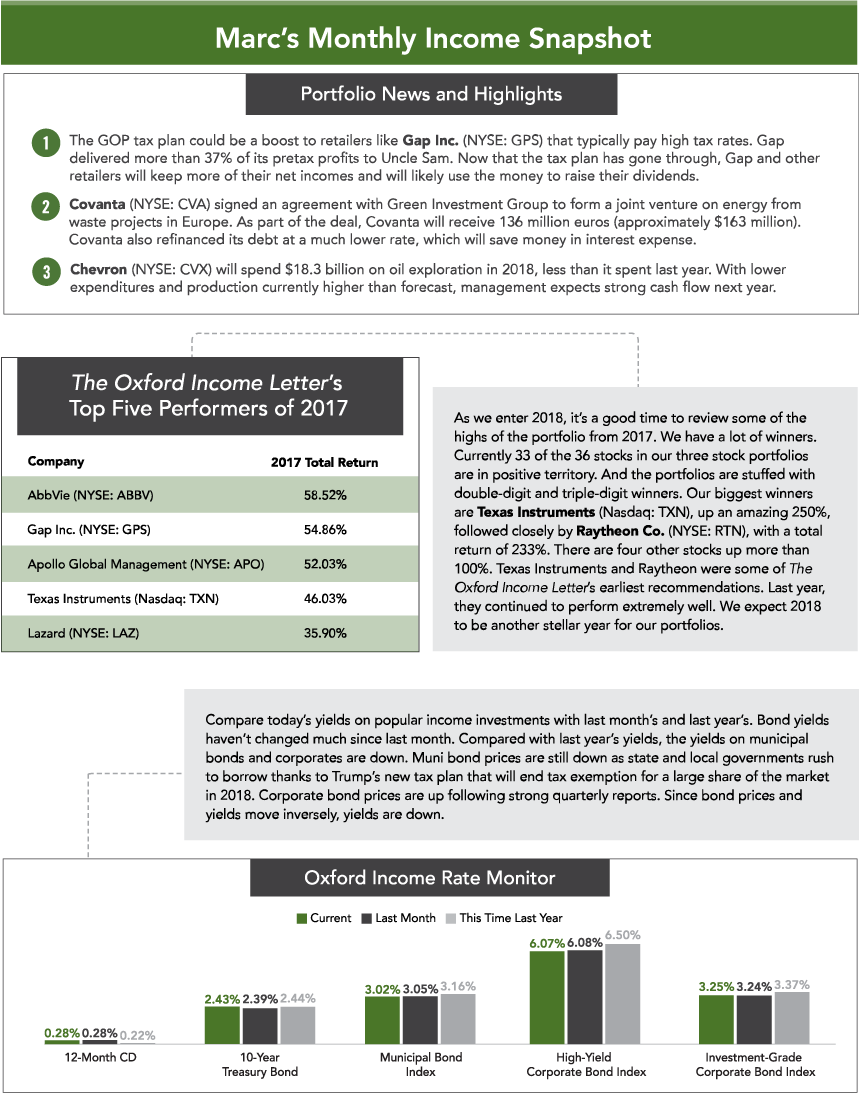
In that issue, I recommended investment bank and asset manager Lazard (NYSE: LAZ). Since then, it has returned 38% versus a 22% gain in the S&P 500. Apollo Global Management (NYSE: APO) is up 53% since it was recommended in February. Our lone bank stock, Northwest Bancshares (Nasdaq: NWBI), didn’t fare as well. Though we’re still up 43% on it, it had a slightly negative return in 2017.

Our lone healthcare stock, AbbVie (NYSE: ABBV), had a terrific year, climbing 59%.

In 2018, I once again expect financials and healthcare to outperform. And this year I’m adding another sector to my favorites.

The Yield Curve... and Financials

Financials should continue to perform well. Higher interest rates will generally help banks and other financial institutions as they’ll make more money on the capital they lend.

Additionally, the yield curve is very flat right now. The yield curve is the difference in interest rates between the two- and 10-year Treasurys. A small difference is seen as a flat yield curve. A growing difference is a widening curve.

When the yield curve is flat, it’s tougher for financial institutions to make money. As the economy heats up and interest rates rise, the yield curve should widen, which will be positive for the financial sector.

Additionally, the Trump administration’s removal of costly and burdensome regulations will give banks and other financial companies the flexibility to take on business they may not have been able to in the recent past.

I’ll be looking for new financial companies to add in 2018.

Big Government Won’t Slow Healthcare Down

Despite the tax reform bill recently signed into law, which is expected to cause 13 million more people to be uninsured, the demand for healthcare will continue to be strong.

As of 2015, there were nearly 48 million seniors in the United States, with 10,000 people turning 65 every day.

And we know that the older we get, the more healthcare products and services we consume.

So regardless of government policy, a demographic tidal wave is upon us, and it will continue to increase demand for healthcare for the next several decades.

In 2018, I’ll be looking to add some quality healthcare companies. In fact, as you read this, I’m at the J.P. Morgan Healthcare Conference meeting with CEOs, looking for the next great company in the sector.

My New Favorite Sector for 2018

Those two predictions – that financials and healthcare will outperform – are the same ones I made for 2017. This year I’m adding another group to the list: master limited partnerships (MLPs).

MLPs are pass-through entities that generally avoid federal and state corporate income taxes because they are classified as partnerships. The income is “passed through” to unit holders (MLP investors are called unit holders).

Most MLPs operate in the energy industry. That’s because, to maintain their tax benefits, they have to generate 90% of their income from “qualified activities,” i.e., exploration and development of natural resources.

As a result, if the energy sector does well, so do MLPs. And I expect the energy sector to outperform in 2018 for several reasons:

  • The economy is heating up. Third quarter GDP growth in the U.S. was 3.3%, the highest it’s been since 2014. A stronger economy should increase the demand for oil and gas.
  • OPEC recently agreed to reduce output. That puts pressure on the supply side of the supply-and-demand equation.
  • Saudi Aramco is going public. The largest oil-producing company in the world is expected to IPO this year. You can be sure that the Saudis are going to do everything in their power to make this an extremely lucrative offering to refill their coffers after the oil price collapse of a few years ago. Some believe the recent arrests of senior government officials and royal family members were made to ensure that the IPO would be as big as it could be. Don’t be shocked by more volatility in Saudi Arabia.

So oil should do well... but MLPs should do even better.

When the price of oil crashed in 2015, all types of energy stocks, including MLPs, tanked with it. In theory, MLPs shouldn’t have because they are not dependent on the price of oil.

The majority of MLPs are pipeline companies that get paid contracted fees for allowing oil to flow through their pipelines.

The price of oil has to be at or above a certain level for an exploration company to make money extracting it from the ground. That’s not the case for a pipeline company. It doesn’t matter if oil is at $30 or $100 – those companies’ fees will be the same.

As long as an oil company is transporting its oil through a pipeline, the MLP gets paid.

When oil rebounded, the stocks of oil companies followed. MLPs did not, creating an opportunity.

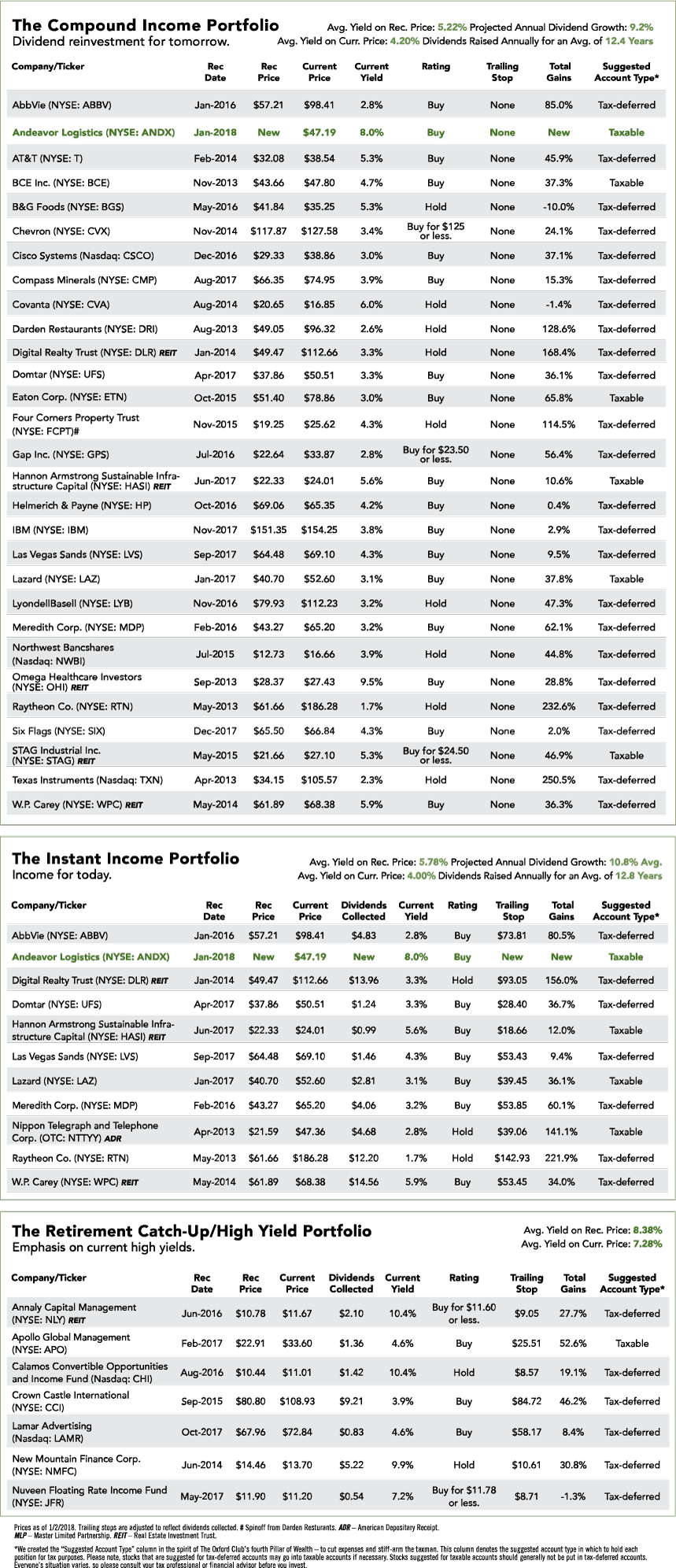
The one I want you to buy today is Andeavor Logistics (NYSE: ANDX).

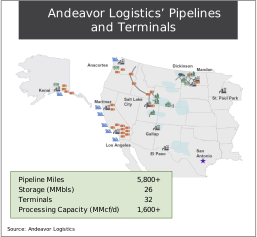
The company has 5,800 miles of pipeline and 32 terminals, mostly in the western U.S.

Distributable cash flow (DCF) – a measure of cash flow used by MLPs – grew 19% in 2017, but growth should be even stronger in 2018 as the company acquired Western Refining Logistics in October.
At the same time, Andeavor Logistics issued 78 million units to its general partner, Andeavor (NYSE: ANDV), in exchange for eliminating distribution rights. In 2016, Andeavor Logistics paid Andeavor $148 million. It will no longer have to make those payouts.

One of the goals of that deal was to improve Andeavor Logistics’ financials in order to obtain an investment-grade rating from the credit rating agencies. That goal was achieved on October 31, and it should lower the partnership’s borrowing costs.

The Distribution

The stock pays around an 8% yield. Andeavor Logistics has raised the distribution (MLPs pay distributions, not dividends) for 26 straight quarters.

Management expects annual distribution growth of 6% per year with plenty of cash flow to cover it.

If the company can achieve that kind of growth, it should richly reward unit holders. Assuming Andeavor Logistics has an 8% starting yield and 6% distribution growth, and the stock matches the historical average return of the stock market, the investment should more than quadruple over 10 years.

If DCF continues to grow and the stock price mirrors that growth, the returns could be even higher.

Action to Take: Buy Andeavor Logistics (NYSE: ANDX) at the market, and add it to the Compound Income Portfolio and Instant Income Portfolio. Because this is an MLP, some or all of the distribution will be tax-deferred, so I recommend holding the stock in your taxable account.

The Oxford Club’s 2018 Private Wealth Seminar

Fairmont Chateau Whistler, British Columbia, Canada | July 23-24

You’re cordially invited to join us at our 2018 Private Wealth Seminar next July 23-24 at the beautiful Fairmont Chateau Whistler in British Columbia, Canada.

This is a wonderful opportunity for you to get up close to some of the world’s most accomplished investing minds... discover their best ideas for generating serious money in uncertain markets... and mingle with other like-minded Members, forging profitable, lifelong friendships.

You’ll hear from your favorite Oxford Club editors, including Chief Investment Strategist Alexander Green, Chief Income Strategist Marc Lichtenfeld, Bond Strategist Steve McDonald and our guest speaker, Sprott U.S. Holdings Chairman Rick Rule.

We’ve spent months preparing this exclusive event for you. And while we’re still putting together some of the final touches, we don’t want to keep you waiting. Registration for our July meeting is now open. Simply click here for more information.

P.S. Our second Private Wealth Seminar will be held October 1-2, 2018, at the Sanctuary Resort on Kiawah Island, South Carolina. If you’d like to join us at this meeting, please email conferences@oxfordclub.com to be added to our interest list. You’ll be the first to know when registration becomes available.

STEVE’S BOND INSIGHTS

The Bond Guru’s Unexpected Predictions for 2018

And a New Year’s Resolution You Should Start Working On Today


It’s that time again... when The Oxford Club’s strategists are asked to do the impossible: predict what the markets will do in the coming year.

That said, last year I predicted an inflation bump and a rally in corporate bond prices. Both shook out, so I might just be on a roll!

As the bond guy here at the Club, I’m expected to stick to the debt markets, bonds and interest rates. But if you know anything about me, you know I rarely do what is expected of me. So here are my expected and unexpected predictions for 2018. I’ll also give you a New Year’s resolution that can help you build and preserve your wealth today.

Higher-Than-Expected Inflation

My first call is that inflation will be higher than the experts are expecting.

Everything in 2018, as I also said would be the case in 2017, will hinge on taxes and changes to the tax code.

But in 2018, we’ll also have to account for the trillions of dollars that are expected to hit balance sheets – and eventually the Street – from the reduction in corporate and repatriation tax rates.

I haven’t seen any estimates as to how much money the new lower corporate rate will flush out, but a 14 percentage point reduction in the rate – from 35% to 21% – is a huge number. Look for $1.35 to be added to S&P earnings for every one point the corporate tax rate is lowered.

That means the S&P 500 price-to-earnings ratio should drop to about 17.

A lower repatriation tax could pump as much as $2.6 trillion into the system. That’s how much cash U.S. companies have stashed outside the U.S. to avoid paying taxes on it.

And there’s a third source of money out there that could unleash an inordinate amount of pressure on inflation – the new wealth created by the run-up in the stock market.

Since the election, the stock market has created an estimated $5.2 trillion of new wealth. Obviously not all of that can make it out of brokerage accounts and into the system, but let’s assume half – or $2.6 trillion – makes it into spendable form.

That’s $2.6 trillion from the market, $1 trillion or so from outside the U.S. and whatever money we see from lower corporate rates on domestic earnings. That adds up to a mountain of money that no one expected to be here.

Let’s make a lowball estimate and say we’ll have several trillion dollars’ worth of new money.

Now, this money isn’t going to just gush out of banks’ doors. This flow process could drag on into 2019.

But eventually it will make its way to the Street, and no one has taken any of it into consideration.

The new money will finally give the Fed its higher (3%-plus) inflation rate in 2018.

Multiple Interest Rate Hikes

As inflationary pressures build, the Fed will have to get serious about interest rates.

The only question that remains on the issue is when it will happen.

Look for as many as four quarter-point increases next year from the Fed.

As I said before, all that new money will take time to hit the Street. Some analysts say it could take several years. But, as any market watcher knows, markets anticipate, they don’t wait for outcomes.

Look for the money flow and its effects to start in 2018.

And the new higher rates will finally translate into higher yields in Treasurys by the end of 2018. I’m expecting the 10-year Treasury to yield more than 3% by the end of the new year.

More Strong Growth in Corporates

As the corporate bond guy here at the Club, I wish I could tell my readers that yields will be heading back to the more normal range of 7% to 10%. They aren’t.

They won’t move up appreciably because corporates are tied to the financials of a business more than rates.

And if I am certain of one prediction for 2018, it is that the health of this economy and individual companies will continue to improve.

As Chief Investment Strategist Alexander Green said, “We have low inflation, low interest rates, cheap energy and improving earnings. You can’t ask for a better environment for economic growth.”

Look for a year of strong, mid-3% GDP growth.

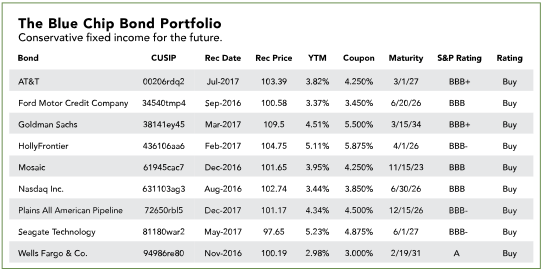
And the improving balance sheets and strong demand for corporates will keep yields in the 5% to 7% range for another year.

Another Good Year in Equities

And then there’s everyone’s favorite guessing game, the stock market.

Despite my request that investors show restraint and hunker down in our safety zones, I am looking for another good year in equities.

I don’t expect anything like the huge run-up since the election, but the market should follow macroeconomic improvements.

The Resolution You Should Make Today

That said, the world is not getting any nicer and our friends in Russia, Iran, North Korea and a host of other sovereign annoyances could all be sources of black swan events.

And none of these threats would need to materialize into military aggression or a terrorist act to short-circuit the stock party here at home.

Despite my confidence in a solid and healthy 2018, there is always the possibility of a shock to the system from non-economic pressures.

And that brings me to my resolution for you for the new year...

The one goal I would recommend you set in 2018 is to train yourself to see all sell-offs as buying opportunities. It’s the mark of an experienced investor.

You’ll know you’ve achieved this level of development when, in a market like we had in 2017, you find yourself building a stock wish list and praying for a sell-off so you can buy them at better prices.

Believe me, it works a lot better than paying too much for them. Keep your powder dry and your eyes on the horizon. Here’s to a great 2018.

Infinite Income Strategies

My Thoughts on Bitcoin


“What do you think of bitcoin?” my friend asked.

It’s the question everyone is asking these days. It’s not surprising.

The price of bitcoin soared from $6,500 in mid-November 2017 to more than $17,400 in mid-December – a gain of more than 165% in just one month. And a lot of people know others who have seen even bigger gains.

I know several people, including Oxford Income Letter Managing Editor Rachel Gearhart, who have made five times their money on a small investment.

I told my friend what I thought. “It’s a mania right now.”

He replied, “But it can go higher, right?”

Can It Go Higher?

It absolutely can go higher. It also can go lower (thanks for the prophecy, Nostradamus).

There are many experts, including Pillar One Advisor and founder of Early Investing LLC Adam Sharp, who believe bitcoin will eventually hit $100,000.

They expect other cryptocurrencies to rise as well.

You may be wondering why I’m even talking about bitcoin. Very few cryptocurrencies pay dividends or generate any income.

I’m writing about it today because so many of you are interested, have requested my opinion and want to know how bitcoin fits into your overall portfolio.

As I mentioned to my friend, it is a mania. Many have equated it to the 17th-century tulip bubble in the Netherlands.

Nearly 400 years ago, people bid up the prices of tulips to ridiculous levels and flipped them like day traders.

Bitcoin shouldn’t be compared to tulip mania. A more accurate parallel is the dot-com boom.

After that bubble burst, there were still quality companies left that went on to become giant successes – like Amazon (Nasdaq: AMZN) and eBay (Nasdaq: EBAY).

Sure, their stock prices came down, but they eventually rallied and made long-term shareholders rich.

The companies that were junk (and there were many of them) collapsed.

I suspect that’s what will happen in cryptocurrencies. The prices of bitcoin and other cryptos could still go considerably higher.

But I believe they will eventually correct in a major way, shaking out traders who had no business holding these assets to begin with. It could get ugly and painful – just like all mania reversals.

But if you’re in the right currencies for the right time frame, you could do well.

If you’re interested in getting in on the action, here’s what I suggest.

1. Decide how much you’re willing to lose.

If you’ve ever gone to a casino and were smart about it, you had a set amount of money that you were willing to kiss goodbye if lady luck did not pick you as her dance partner that evening.

The same should be true in cryptos. Knowing what your total risk is will make it easier to hold on when things get volatile or to handle a potential loss.

2. Allocate a tiny portion of your portfolio to cryptocurrency.

The Oxford Club’s Wealth Pyramid recommends only a small portion of your assets be designated for the riskiest investments. The good news is it doesn’t take much to move the needle.

Let’s say you have a $100,000 portfolio and are willing to risk 2%, or $2,000, on crypto. If you had success similar to Rachel’s and made 500%, your $2,000 would have turned into $12,000 and your portfolio would have gained 10% just on the crypto alone.

That’s a decent year for a balanced portfolio.

If things go horribly wrong and you lose the entire $2,000, it’s not an insurmountable loss. You can come back from it even with more traditional investments.

3. Understand what cryptocurrency is and how it works.

Don’t just buy it because it’s going up. If you don’t know what crypto is, learn about it before you buy it. There are many great resources from Early Investing LLC, including “Why Bitcoin Should Be in Your Retirement,” “Why Was Bitcoin Created?” and “Bitcoin Hits $18,000 – What’s Driving It Higher?” (To access these and other articles from Early Investing, go click here now.)

The people who got burned the worst in the dot-com boom and bust didn’t know or didn’t care about the companies they bought and why their stock prices were moving in the direction they were.

I avoided a lot of heartache by looking at companies’ financial statements and business plans, and by understanding that management teams had no idea how they would ever make money. They were just cashing in on a mania.

So many times I was told I was crazy for not buying certain stocks during that time. When they crashed, I had no stress because I didn’t have exposure to the riskiest names.

Cryptocurrency is an exciting and potentially lucrative investment. Just be sure you understand the opportunity... and especially the risk.


Mailbag

The Oxford Income Mailbag


We believe it’s helpful to share questions and clarifications on dividend-investment strategies with all of our subscribers. Keep in mind, Marc can answer your general strategy and service questions, but he cannot give personalized advice. As always, feel free to send us your questions at mailbag@oxfordclub.com.

Do you know of a book for children – ages 14 and 15 – that would hopefully spark an interest in investing for the future? Better yet, would you know of an app or game that teaches investing on the lowest level? I have an account for each of them at Schwab, but would like them to get involved in investing.

– Linda M.

I don’t know of any books written specifically for teens that teach about investing. Most of the kids books that I’ve seen aren’t too engaging.

My book Get Rich With Dividends is not necessarily geared toward teenagers, but it’s easily understood by novices.

Understanding Wall Street by Jeffrey Little is the first book I read on investing, though it’s also geared toward novices, not teens. The Richest Man in Babylon by George Clason offers great lifelong lessons for how to handle money. It is my favorite finance book.

If your kids like Monopoly, they may want to try Cashflow. It’s a similar game, but the goal is to invest in order to generate passive income. It’s not stock market focused, though stocks are part of the game. It was created by Robert Kiyosaki, the author of Rich Dad Poor Dad.

It’s not cheap, and it takes a long time to play (like Monopoly), so make sure your kids have the patience and temperament to play it. It’s also good for adults.

There are some apps that help rookies learn about investing while they do it.

Robinhood, Acorns and Stash are apps that all suggest different types of investments based on the user’s risk profile. They are easy to use and are geared toward getting customers up, running and investing very quickly.

I’d prefer that investors know something about investing before using these apps to put money to work.

Marc,

Our daughter is in grad school, and it’s time to get her set up in perhaps a Roth IRA. What would you and the other editors do for your children?

Karim had an article on how he tricked his girls into an account. But he did not say what he set up for them or what he put the money into.

Self-directed? And since you go for the long vision, what manner of stocks would you put into it?

I can’t be the only one who would love to have guidance from all of you on this very important start for a child or grandchild. What would you do for your own children?

– Kelly D.

I have a 16-year-old son and 13-year-old daughter. About three or four years ago, I started talking to my son about investing. If he was interested, I told him, I’d open an account for him and we’d pick the stocks together.

He was excited about the prospects (plus the free money I was giving him).

I discussed my strategy of long-term investing in dividend growth companies but also talked about speculation.

I ultimately left the decision on which stocks to buy to him, though I helped guide him. He chose a few stocks for the long term and hasn’t touched them since.

But before you think he’s a chip off the ol’ block, he also hasn’t looked at his account or asked about it in a long time.

A few months ago, I made the same offer to my daughter. She just wanted me to invest the money for her, which I refused to do. I told her she had to be an active participant in the process. She wasn’t interested, so I never opened the account for her.

I believe parents and grandparents should expose kids to investing and do everything they can to encourage them to learn about the market, but you can’t force them. That will surely backfire.

A question about the lack of stock splits in the recent past. I haven’t seen many.

Valuations are up there. Many small investors can’t afford to buy at current prices.

Why are we not seeing splits and therefore lower prices?

Enjoy your work, I’ve profited from it.

– Gene D.

Price obviously matters when it comes to valuation, but it shouldn’t when it comes to how much you can afford.

For example, let’s say you were planning to invest $1,500 in International Business Machines (NYSE: IBM). It doesn’t matter whether the stock is trading at $150 and you buy 10 shares, or the stock splits and you buy 20 shares at $75. You’re still investing $1,500, and the stock’s valuation is the same (after the split, valuation metrics like P/E ratio and book value per share are also cut in half).

Hi Marc,

I noted, with interest, your very useful comments regarding AT&T. I am a senior with a very short time horizon (10 years max). Could you make a general comment about the implications and risk of such a short horizon with companies like AT&T – or even a hypothetical stock?

Your mailbag comments are invaluable. I am sure that most small investors do not have the knowledge, tools or access to the info necessary to make sound decisions about such important assets.

– Frank B.

I’m glad you’re enjoying the mailbag. I agree that it’s valuable, and I encourage subscribers who have questions to send them in. If you have a question, chances are someone else is wondering the same thing. And don’t be embarrassed if you think your question is too basic. Everyone starts somewhere, and you should be commended for trying to increase your knowledge.

If your investing time horizon is 10 years, the risk of stocks like AT&T or others in the portfolios is low. Going back to 1927, stocks have lost money over 10-year periods only seven times. And all seven were tied to the Great Depression or Great Recession.

And you had to have sold in the depths of the Great Recession to have lost money. Even if you bought and held during the so-called Lost Decade of 2001 to 2010, you made money.

Perpetual Dividend Raisers perform even better. Using the S&P Dividend Aristocrats Index, which began in 1990, as a proxy, Perpetual Dividend Raisers have never lost money over 10 years.

Shorter term, anything can happen. I always recommend that funds you need in the next three years not be in the market and exposed to risk. With a 10-year plan, stocks are definitely the way to go.


The Compound Income Portfolio

The Oxford Income Letter portfolios fit into the Blue Chip Outperformers level of the Oxford Wealth Pyramid. For more information, go here: www.oxfordclub.com/wealth-pyramid.