
This One’s Personal: The Controversial Secret to Taming the Beast That Threatens Us All
Everybody remembers the first time they saw a dead body.
I still get chills when I run into somebody wearing his cologne.
And I’ll never forget the noise that erupted from his lungs as we cut the noose from his neck.
The poor guy hanged himself from an elm tree.
Working for the local rescue squad while in college, I saw plenty of dead bodies. I cut a man out of his dash, helped pull a lifeless infant from his charred crib and dragged drowning victims ashore.
My training taught me to leave those memories at the scene.
But the young man hanging from a bright, white nylon rope (the receipt was on the front seat of his car)... well, that memory isn’t ever going away.
I don’t want it to.
The Beast That Gets Us All
You see, when we cut that man from the tree, I was going through hell of my own.
I suffered from depression. There were days I wouldn’t get out of bed. It was pure misery, and it controlled my life.
I couldn’t help but wonder whether I was staring at my own fate in those lifeless, bloodshot eyes hanging from that tree.
Thank God it never got that bad. And thank God that hell is so far behind me.
Sure, that beast comes roaring back every once in a while. I think he takes charge of all of our lives at some point. But it’s nothing like it once was.
That’s why I’m so eager to get this issue in front of you today.
Not only does the first essay from Dr. Phil Roberts tackle a hugely important issue that too many folks are too embarrassed or too afraid to talk about... but it does it from a unique and thoughtful angle.
In fact, his essay could be the most powerful thing we ever publish.
What It Takes to Heal
I say that because it reminds me of a conversation I had with a man who turned out to be a hero’s hero. He was with me on many of those deadly scenes. I saw him single-handedly (and quite bravely) save a family’s entire house.
I trusted him with my life... and he handed it back to me.
He knew what I was going through. He’d been through it, too.
So one day he sat me down, and we talked at the doorway to his barn... for hours.
He told me what worked for him. He told me what he thought I was missing. And, most of all, he encouraged me to be strong and never stop fighting.
I haven’t yet.
He taught me that I wasn’t alone... that I wasn’t crazy. And that all of us have to fight the “beast” at some point.
If you find a really good doctor (like Dr. Roberts), he’ll tell you all the same things. But most doctors don’t have hours to “get real” with you. They have minutes... and a prescription pad.
Dr. Roberts eloquently does just that.
And when you read Dr. Sanjay Jain’s contribution, you may think he wrote a piece on an entirely different subject. But he hasn’t.
Sure, at first glance, his essay on artificial intelligence and what it’s doing for patients feels high-tech and not all that related to the oh-so-emotional realm of depression... but I beg to differ.
Check out these lines from Sanjay’s fascinating piece. You’ll notice a theme...
“On average,” Dr. Jain writes below, “radiologists need to review an image every three to four seconds to meet workload demands.”
And then he writes, “This ‘standard’ in healthcare is hopelessly outdated.”
In other words, whether we’re talking about our minds or our bodies, so-called modern medicine has some work to do. Our healthcare system needs to focus less on getting patients in and out in the cheapest, most profitable way... and more on the patient.
Again, that’s why this issue and everything we publish are so important.
These are “underground” ideas... thoughts you won’t hear on your next visit to the doctor.
That’s why my team and I are so passionate about bringing them to you.
We know that lives are on the line. And all it takes is one good idea to make a very big difference.
Enjoy the issue.
Be well,
Andy
P.S. When you’re done reading, be sure to send us your thoughts on the issue... and what questions you have for the doctors or what topics you’d like to learn more about. Email us at mailbag@manwardpress.com.
No Relief in Sight for This Troubling Trend... Unless We Look to Nature

I remember clear as day driving by my friend’s home and seeing an ambulance parked out front.
Normally, I would have stopped by to see if there were anything I could do to help. But this time I didn’t. I was on a schedule... en route to see my daughter.
I assumed it couldn’t be anything too serious though. He was as healthy as an ox.
I’d known him for years. Heck, I’d sold my home to him.
But a couple days later, I found out my friend had killed himself. He hanged himself on his birthday.
When I learned what happened, my heart was broken.
I knew he had suffered from depression in the past. And like so many others, he was prescribed antidepressants.
He’d managed to wean himself off these drugs. But I later found out that not long before his death, he had started taking them again.
A Sobering Trend
The use of antidepressants among seniors has more than doubled over the last 20 years.1
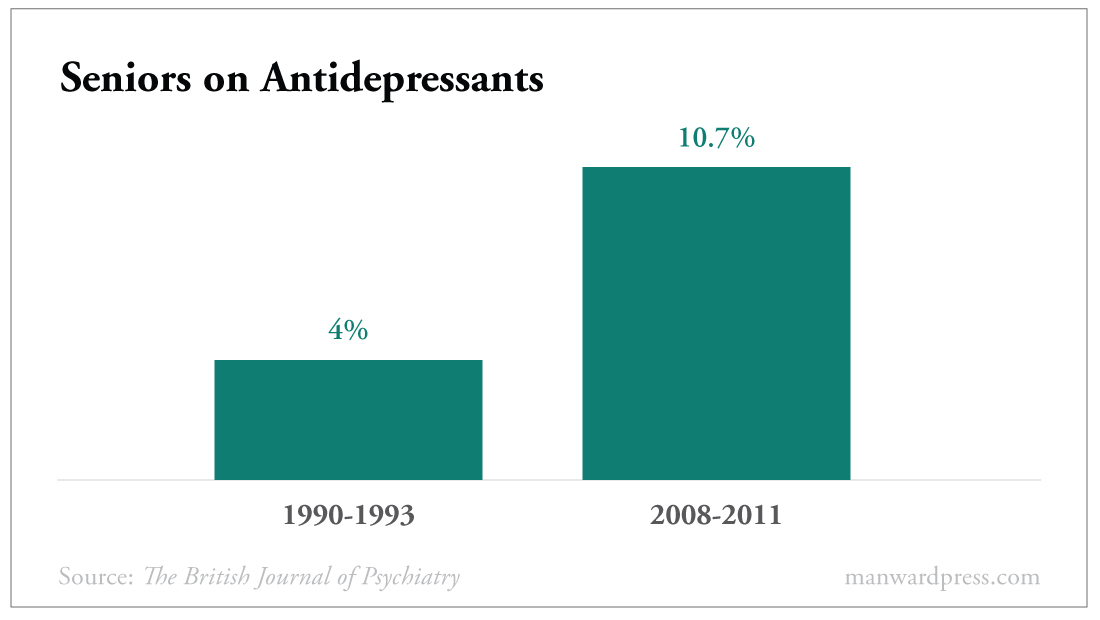
At the same time, the number of seniors actually diagnosed with depression hasn’t changed.
Access to these dangerous pills has been getting easier. Doctors are seemingly giving out prescriptions like candy.
But the stats below indicate these drugs aren’t making any headway in treating depression. It’s like applying a dirty Band-Aid to an open wound.
- Between 1996 and 2013, the rate of overdose deaths from antidepressants skyrocketed by more than 500%.2
- Depression is still the leading cause of disability worldwide.3
- Suicide among the elderly has reached epidemic proportions.4
And it’s not just seniors who are being targeted with these drugs.
One out of every 6 Americans are on psychiatric drugs – most of which are antidepressants.5
This Is Serious
Depression is a very dangerous mood disorder that can cause an unrelenting feeling of sadness and a general loss of interest in things you enjoy.
But it’s not just about “feeling sad.” It can affect how you think, how you act, and how you behave and react to all sorts of emotional and physical problems.
Depression can lead to...
- Angry outbursts
- Irritability
- Loss of sleep
- Reduced appetite
- Slower thinking and reaction time
- Trouble concentrating
- Back pain and headaches
- Reclusiveness
- Suicidal thoughts.
One of the major challenges in treating depression is that it can stem from any number of causes.
Stressful life events, like the loss of a job, illness or trouble in a close relationship, can bring on bouts of depression.
Genetics can also play a major role.
So can chemical imbalances in the brain or even a breakdown in communication between the brain’s nerve cells.
And worse still, more than a third of Americans are currently taking medications that list depression as a potential side effect.6
Finding No Relief
When dealing with depression, the conventional wisdom in conventional medicine is that antidepressants are better than nothing... and maybe they’ll work.
Even when it comes to the most enlightened forms of prescription treatments, there is a lot of trial and error required. Figuring out the right dosage or treatment can take years.
All the while patients risk dealing with a slew of very dangerous side effects...
Antidepressants have been found to double the likelihood of violence and suicide in healthy adults.7 And women on antidepressants are twice as likely to encounter a psychotic event.8
Antidepressants have also been known to make depression worse and result in nausea and insomnia.9 And antidepressant users have an increased risk of developing Type 2 diabetes.10
These pills are also habit-forming...
Trying to get off them can lead to months of withdrawal symptoms.
And the longer you’re on them, the stronger the withdrawal symptoms can be.
Adding addiction to the already serious nature of depression is not a recipe for success.
As all the evidence suggests, these pills just aren’t curing people’s depression... In fact, they’re about as effective as a placebo.11
But the drug companies aren’t going to tell us this... In fact, the British Medical Journal released a report that investigated pharmaceutical-sponsored studies... and found that the industry literally hid the results from nearly half of the trials it conducted that proved its products provided no valid relief from depression.12
There’s a Better Outcome
There’s no miracle cure for depression.
But there are drug-free remedies that can do wonders for improving mood and your outlook that are free from the terrible side effects of antidepressants...
Starting with an important pillar of Manward... Connections.
This one’s simple... yet incredibly powerful. Talk to someone.
No doubt there’s a social stigma attached to depression. But feeling depressed isn’t a sign of weakness. And it’s not something you just snap out of. Not seeking help when you need it could take a toll far worse than the alternative.
A licensed professional trained in mental health conditions will be able to help you navigate your feelings and symptoms... and will understand what you’re going through. Having an ally is a powerful remedy.
But don’t flip open the Yellow Pages and pick the first one you can find. There’s no vetting process to get a listing there, and the high cost leaves many well-qualified resources unlisted.
Start by talking to people you trust.
This can be a friend, your doctor, your dentist or a co-worker.
And you don’t have to go into the details as to why you’re looking into it.
You can just casually mention, “I’m having some problems, and I’d like to discuss them with a therapist. Do you recommend anyone?”
The important part is that it’s someone you know who will be supportive and not overly intrusive.
Another valuable resource is the website Psychology Today. This website mandates a legitimate advanced degree in the discipline and up-to-date licensing and certification by all who are listed.
And connecting with others is just the start.
A Little Know-How Goes a Long Way
We all know exercise has far-reaching benefits... but just a few months of regular exercise has proven to lead to a whopping 28.3% remission in depression symptoms.13
An analysis published in the Journal of Clinical Psychology concluded that doctors should start prescribing exercise to patients dealing with depression.14
Exercise is known to raise serotonin levels, and it inhibits the conversion of the neurotoxic stress chemical kynurenine.
It also dramatically increases levels of the endocannabinoid anandamide produced by the body. This triggers more receptive endorphin receptors. In short, the more anandamide you have circulating, the better you feel.
And any exercise you can do outside will give you even more benefit...
Because a major player in the fight against depression is sunshine.
Get Outside
Those suffering from depression have almost universally been found to have lower-than-average levels of vitamin D.
And naturally, a steady dose of vitamin D (be it from sunshine or a supplement) has an important impact in the fight against depression.15
Vitamin D plays a crucial role in brain function... and those with a deficiency are much more prone to fall into depression.16
A study out of VU University Medical Center Amsterdam showed that a vitamin D deficiency increased the likelihood of depression by as much as 85%.17
"Underlying causes of vitamin D deficiency such as less sun exposure as a result of decreased outdoor activity, different housing or clothing habits and decreased vitamin intake may be secondary to depression, but depression may also be the consequence of poor vitamin D status."
– Witte J.G. Hoogendijk, M.D., Ph.D., lead author
So get outside whenever you can.
And while you’re out there, don’t worry about getting a little dirty.
Seriously, nature’s Prozac is right at our feet.

There’s a nonpathogenic bacteria called Mycobacterium vaccae found in soil. And exposure to it has proven time and time again to boost mood and induce a renewed sense of vitality.
It’s worked in labs. It’s worked on patients with tuberculosis. It’s worked on patients with cancer.
So getting your hands dirty or traipsing around in the woods for a little while could work for you.18
Just getting outdoors and breathing in what nature has provided us with is like taking a double shot of a natural, depression-fighting vaccine.
This mycobacterium has been found to stimulate neurons and pathways in the prefrontal cortex and hippocampus, which directly affect cognition and mood regulation.
As an added bonus, the bacteria is known to thrive in backyard garden environments. And every time you inhale or eat small particles of this mycobacteria (from foods in your garden), your nervous system boosts the production of serotonin, which is known to keep depression at bay.
And while you’re enjoying the fruits of your garden, limit your intake of ultra-processed foods. They trigger inflammation, which has also been linked to depression.
In a sweeping 12-year study of more than 40,000 women, published in the journal Brain, Behavior, and Immunity, it was found that those who had a diet high in soda, refined grains and processed meats were much more likely to develop depression, while those who had a plant-focused diet had much lower levels of inflammatory markers known to lead to depression.19
While you don’t need to cut meat out of your diet altogether, this study shows the dangerous connection between an unhealthy diet and mental health.
A Success Story
I’ve spent some time explaining the benefits of some natural Know-How that could have a big impact on your health. But what I’m about to share could be the most important information you read today.
Some years ago, I had a young patient who had been battling depression most of her life.
It was heartbreaking to see this 15-year-old girl so listless.
She’d been dosed up on all sorts of things for a big chunk of her short life. Stimulants since she was 12 and on and off selective serotonin reuptake inhibitors... Doctors had been red-lining the engine that was her brain for years, and it had burned up her neurotransmitters.
I ordered a battery of typical functional medicine tests, including six different tests on the thyroid, hormone level readings and genetic testing.
And what we discovered was clear as day once we had results from the correct tests.
She was suffering from hypothyroidism. Her thyroid gland wasn’t producing enough of the thyroid hormone...
Her progesterone levels were out of whack (which can lead to anxiety and insomnia)...
And her vitamin D levels were extremely low.
Conventional medicine often overlooks these culprits.
By evaluating her vitamin and hormone levels and getting them back to normal, we were able to work with her psychiatrist to get her off these dangerous medications...
In follow-up tests, she clearly showed signs of improvement.
While it’s relatively unusual for a young person to be dealing with hormone levels so off-kilter, for older adults, this is often the norm.
Hormone production naturally decreases with age. And many prescription medications can speed up this decline in production, leading to a whole host of problems... not the least of which is depression.
That’s why it’s imperative to have your hormone levels checked.
Restoring them to where they need to be could be a much simpler and safer way to combat depression than any of those dangerous, brightly colored pills that get passed out so easily.
The Cures Are All Around Us
When faced with illness of any kind, we all want to find the miracle cure... and we want it to be as easy as possible.
While it doesn’t get much easier than taking a “magic pill,” antidepressants are proof that easier isn’t always better.
As the writer Samuel Johnson noted a couple hundred years ago, “What is easy is seldom excellent.”
That’s why a multipronged approach to tackling depression can be far more effective.
Tapping your Connections, exploring drug-free alternatives that are all around us and understanding what your hormone levels are telling you could have a major impact in the battle against depression.
Taking a Cue From Professional Sports for More Personalized Care

In his day, “Mean” Joe Greene was the centerpiece of one of the most dominant defensive units the NFL ever saw.
Fast-forward to today and it’s unlikely he’d make anywhere near the impact he did... if he were to make the NFL at all.
Check this out...
“Mean” Joe measured in at 6-foot-4 and 275 pounds.
But today, the average defensive lineman in the NFL weighs a whopping 310 pounds.
There’s been an evolution in “optimal body type” for pretty much every position on the field.
Running backs are shorter and wilier than they used to be (all the better to hide behind giant offensive linemen). And wide receivers in the league are taller and faster than ever before.
But bigger, stronger, faster and more specialized athletes didn’t just happen accidentally.
New levels of peak performance are being achieved by embracing technology as a willing and able health partner.
And the same can be said when talking about the healthcare industry.
Some technologies are streamlining the patient experience.
And others may transform the healthcare industry as a whole, revolutionizing the way diagnoses are made and – somewhat ironically – bringing personal care to a level we’ve never seen.
The Waiting Game
This may sound familiar...
A guy walks into his doctor’s office. His back has been stiff and sore for a couple of weeks, but he’d put off doing anything about it.
After a particularly painful tweak lifting a heavy box, he finally made an appointment to get checked out.
When he shows up a few minutes early for his appointment, he’s greeted by a friendly but busy receptionist who hands him a clipboard with paperwork to fill out.
He’s filled out the same paperwork at least a dozen times... the only difference being the new symptoms. “Just part of the process,” he says to himself.
He fills out all the appropriate forms, checks all the boxes that apply, signs off on it and waits.
Then he waits some more.
Forty-five minutes in the waiting room is about the norm these days.1
Then he’s ushered into a small room where a nurse takes his vitals and hands him a rather revealing hospital gown to slip into.
Then some more waiting...
Finally, the doctor comes in and listens to what the problem is (all of which sounds brand-new to him). He feels around and presses on problematic areas of the back and suggests an X-ray.
If there’s a radiology department in the same building where he sees his doctor, it might be able to squeeze him in the same day. If not, who knows.
But either way, there’s going to be some more waiting.
Eventually, he straps on the lead vest, gets his X-ray taken and then a radiologist briefly analyzes it...
On average, radiologists need to review an image every three to four seconds to meet workload demands, according to a study published in Academic Radiology.2 But needless to say, the patient’s wait is a good bit longer than this.
Eventually the patient patient learns there doesn’t seem to be cause for alarm. It just looks like a pinched nerve, according to the radiologist.
Hours (if not days) later, he’s given a prescription for a muscle relaxer to reduce muscle spasms and told to alternate between applying ice and heat packs to the affected area... And he hopes that a more serious condition like a spinal infection wasn’t missed.
Eventually, all of that information logged along the way is compiled and sent through a gauntlet of administrators who tag and code it for billing purposes.
Who Has the Time?
This “standard” in healthcare is hopelessly outdated.
It costs us time... It costs us money (and not just bloated insurance bills – how about lost productivity?).
Administrative healthcare workers and insurance employees – which have no impact on actual patient care – ring up an average cost of $2,497 per year for every man, woman and child in the country.3 (Check out the Appendix for even more wasteful spending.)
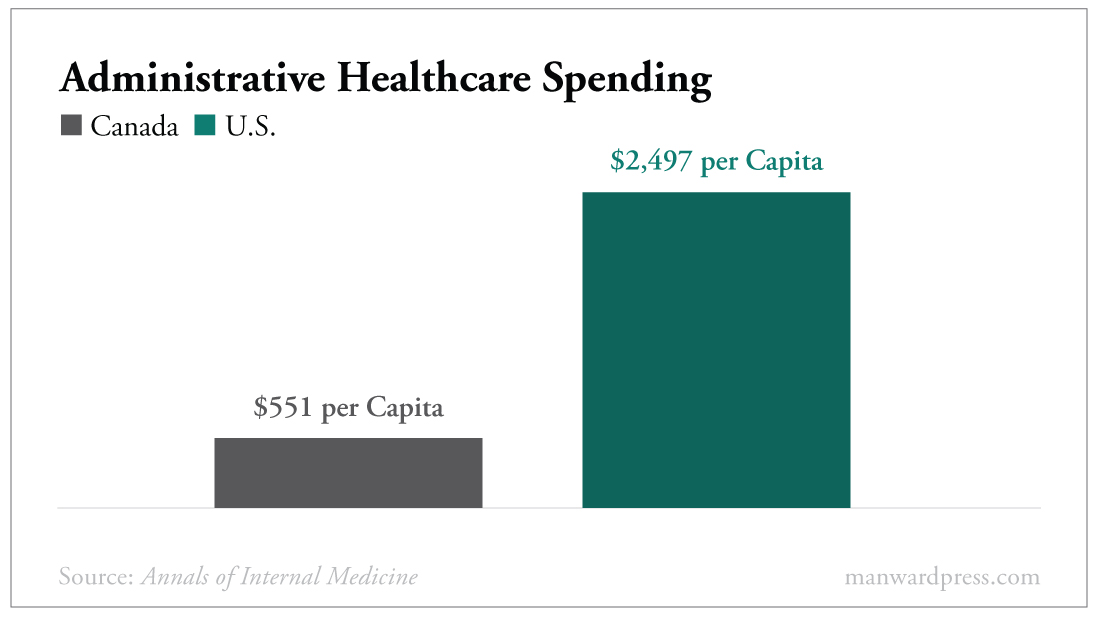
That’s about four times more than Canada. And the gap is widening due to inefficiencies in our system.4
Add it all up and it’s no wonder Americans are so reluctant to visit the doctor. Who has the time and money for all of this?
But there’s more to it than that.
Let’s go back to our theoretical patient...
What if that radiologist missed something in the X-ray and his back pain wasn’t due to a pinched nerve?
Let’s say in the three or four seconds allotted, the tiny spinal tumor that was actually causing his pain was missed.
That little error quickly turns into a delay in appropriate treatment. Now, even though misdiagnosis isn’t the norm, it still happens far too frequently. And the result often leads to serious harm.
Studies have found that as much as 28% of diagnostic errors either are life-threatening or resulted in death or permanent disability.5
And the stats don’t get much better from there.
Around 12 million people in the U.S. alone who are seeking outpatient medical care experience some form of diagnostic error.
A study out of Johns Hopkins found that 1 out of every 71 cancer cases were misdiagnosed.6
So how can technology help?
The (Near) Future of Medicine
Artificial intelligence has the potential to completely transform the way doctors approach clinical problem-solving.
And when some of the diagnostic process is being driven by AI, doctors will have more time to spend with patients and listen more closely to their medical concerns... making patient care far more personal...
The way it should be.
And that’s just the start.
Basic advancements in the sheer magnitude of computer power combined with the enormous amount of data that comes from healthcare systems render diagnostics a perfect application for AI.
And it’s already being employed with outstanding results.
Researchers out of Seoul National University Hospital College of Medicine developed something called deep learning-based automatic detection (DLAD) to detect abnormal cell growth.
This algorithm-based form of AI outperformed 17 out of 18 doctors at detecting potential cancerous cell growth.7
Another example comes from the Google Health team.
Say what you will about the company, but it’s revolutionized its fair share of industries in a remarkably short period of time. And healthcare is on the short list for its next target.
All signs show that to be a good thing.
The team has created an AI algorithm to identify metastatic breast cancer tumors from lymph node biopsies.
The Lymph Node Assistant (LYNA) was able to identify suspicious regions undistinguishable to the human eye. And it did so with remarkable accuracy, successfully classifying samples as cancerous or noncancerous 99% of the time.8
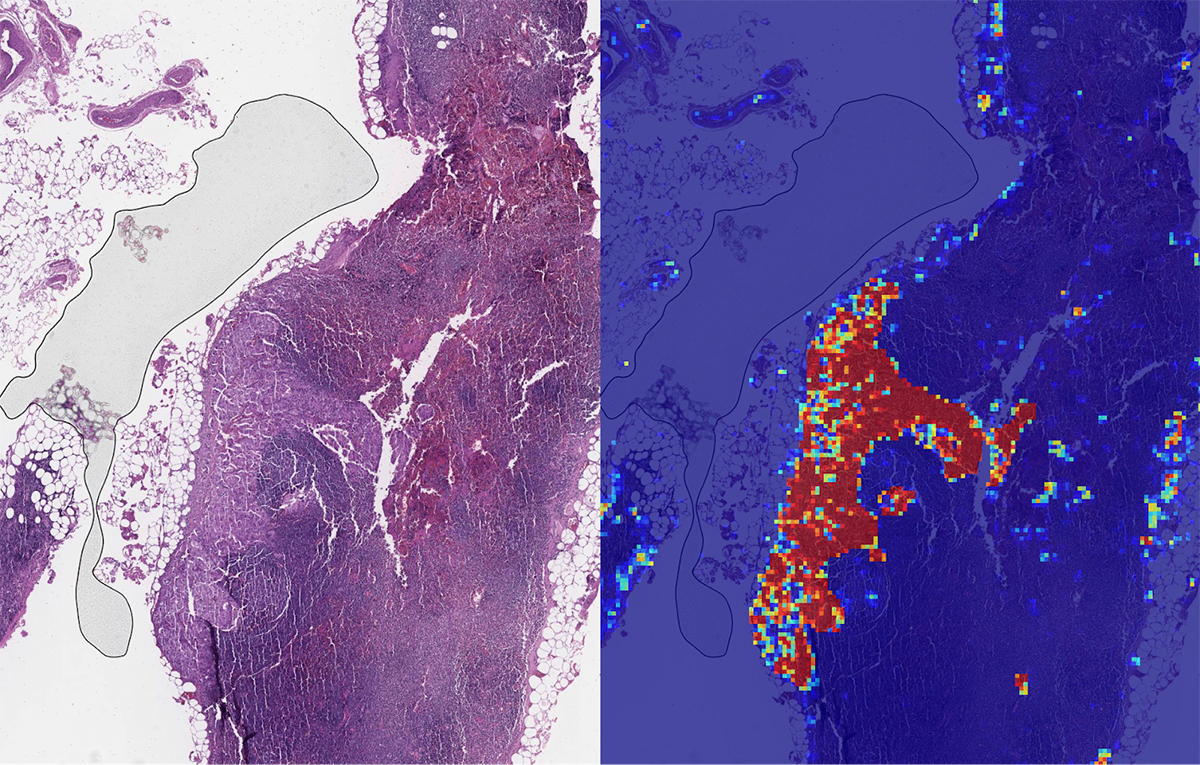
LYNA was not only better than doctors but also faster... halving the average review time of slides.
The Next Stage
Now that we know we can teach machines to be better at detecting problems than humans, the next stage is to put the data collected in medical records to good use.
This is where things start to get very exciting.
Electronic medical records have been an important first step in keeping accurate and detailed health histories...
And the volume of data being collected by doctors is better than ever before at showing what makes each of their patients unique.
Combine that with the ability to plug a patient’s info into a massive database facilitated by AI, and doctors will quickly be able to compare and contrast what has proven to work for a particular ailment and what hasn’t on a larger scale than ever before... effectively allowing them to better prescribe the best cure possible.
These advancements have the potential to make misdiagnosis a thing of the past.
And with this comes the ability to provide more predictive and preventive care... with the opportunity to properly treat the root cause of a disease instead of its symptoms.
Imagine an algorithm trained to look for the similarities in every patient with Alzheimer’s disease. We’ll be able to better understand its cause in no time...
Or imagine being able to analyze and compare the genetic code of those with multiple sclerosis. Learning the similarities could certainly lead to breakthrough treatments.
And that hypothetical patient above with the back pain could rest assured that his diagnosis is spot-on without worrying about the possibility of an undetected spinal tumor.
It’s true that much of this technology already exists... but has yet to be able to have a meaningful impact in day-to-day medical practices.
On one side of the coin, that’s very frustrating.
But on the other, it’s a good sign because the wide array of regulatory concerns is being addressed before the technology is rolled out.
There are some big questions. And there are a lot of privacy and security concerns that need to be sussed out before we experience all of the benefits AI can have on medicine.
The need to embrace these new tools is apparent though. And the clinical test examples of DLAD and LYNA are proof that good people are still doing important things with cutting-edge technology.
We’re on the cusp of doctors knowing everything they need to know about us in order to make an informed prognosis.
They’ll know exactly what our bodies will respond positively to and what will cause nasty side effects.
They’ll be able to optimize treatments and, in turn, optimize every single patient that comes through their door.
Think of it as the “sportification” of medicine.
Professional athletes have some of the best doctors available. But there’s more to it than that...
These doctors are intimately familiar with their patients.
They know their patients’ exercise routines, diet, medical history, sleep schedule, blood type, etc.
With all of that information comes the ability to offer specialized solutions on an individualized level.
When next generation’s “Mean” Joe Greene comes onto the scene, he won’t look the same.
But that’s only because a whole team of medical specialists will have developed a regimen perfectly suited to turn him into the greatest tackling machine he can be.
And that’s where medicine as a whole is heading.
It may not turn you into a perfect tackling machine... but it will be better armed to optimize the health of an aging population.
Appendix
| Average Annual Cost of Healthcare Waste | |
|---|---|
| Failure of care delivery | $134.1 billion |
| Failure of care coordination | $52.7 billion |
| Overtreatment or low-value care | $88.5 billion |
| Pricing failure | $235.6 billion |
| Fraud and abuse | $71.2 billion |
| Administrative complexity | $265.6 billion |
References
Troubling Trend
- https://www.cambridge.org/core/journals/the-british-journal-of-psychiatry/article/changing-prevalence-and-treatment-of-depression-among-older-people-over-two-decades/902EC0C4539FB3E159A18873701C1EF2
- https://today.oregonstate.edu/archives/2009/sep/zinc-deficiencies-global-concern
- https://www.who.int/news-room/fact-sheets/detail/depression
- https://www.tandfonline.com/doi/abs/10.1080/08998280.2008.11928430
- https://jamanetwork.com/journals/jamainternalmedicine/fullarticle/2592697
- https://khn.org/morning-breakout/more-than-one-third-of-americans-take-a-medication-that-has-depression-as-potential-side-effect/
- https://www.ncbi.nlm.nih.gov/pubmed/27729596
- https://www.ncbi.nlm.nih.gov/pmc/articles/PMC5289870/
- https://www.mayoclinic.org/diseases-conditions/depression/expert-answers/antidepressants/faq-20057938
- https://journals.plos.org/plosone/article?id=10.1371/journal.pone.0182088
- https://www.ncbi.nlm.nih.gov/pmc/articles/PMC4172306/
- https://www.bmj.com/content/326/7400/1171.full
- https://www.ncbi.nlm.nih.gov/pubmed/21658349
- https://onlinelibrary.wiley.com/doi/abs/10.1111/j.1468-2850.2006.00021.x
- https://www.ncbi.nlm.nih.gov/pmc/articles/PMC2908269/
- https://www.cambridge.org/core/journals/the-british-journal-of-psychiatry
- https://www.timesonline.com/249dea15-71c6-5b64-b235-1f1462573d09.html
- https://www.psychologytoday.com/us/articles/200809/natures-bounty-soil-salvation
- https://www.ncbi.nlm.nih.gov/pubmed/24095894
Taking a Cue
- https://www.ncbi.nlm.nih.gov/pmc/articles/PMC5420318/
- https://appliedradiology.com/articles/the-radiologist-s-gerbil-wheel-interpreting-images-every-3-4-seconds-eight-hours-a-day-at-mayo-clinic
- https://annals.org/aim/article-abstract/2758511/health-care-administrative-costs-united-states-canada-2017
- https://annals.org/aim/article-abstract/2758511/health-care-administrative-costs-united-states-canada-2017
- https://www.pinnaclecare.com/forms/download/Human-Cost-Financial-Impact-Whitepaper.pdf
- https://www.journalnow.com/news/local/error-rate-for-cancer-test-results-slim-but-can-it/article_d020348b-335d-526b-b77f-f194c8c765e1.html
- https://pubs.rsna.org/doi/full/10.1148/radiol.2018180237
- https://www.archivesofpathology.org/doi/10.5858/arpa.2018-0147-OA