February 2014
Harsh Winter for Oranges
For the past few years, Florida’s orange crop had been struggling, due to a crop infestation. This winter’s Polar Vortex effect has put more pressure on this crop. In this issue we look at the long-term prospects for Florida’s orange crop.
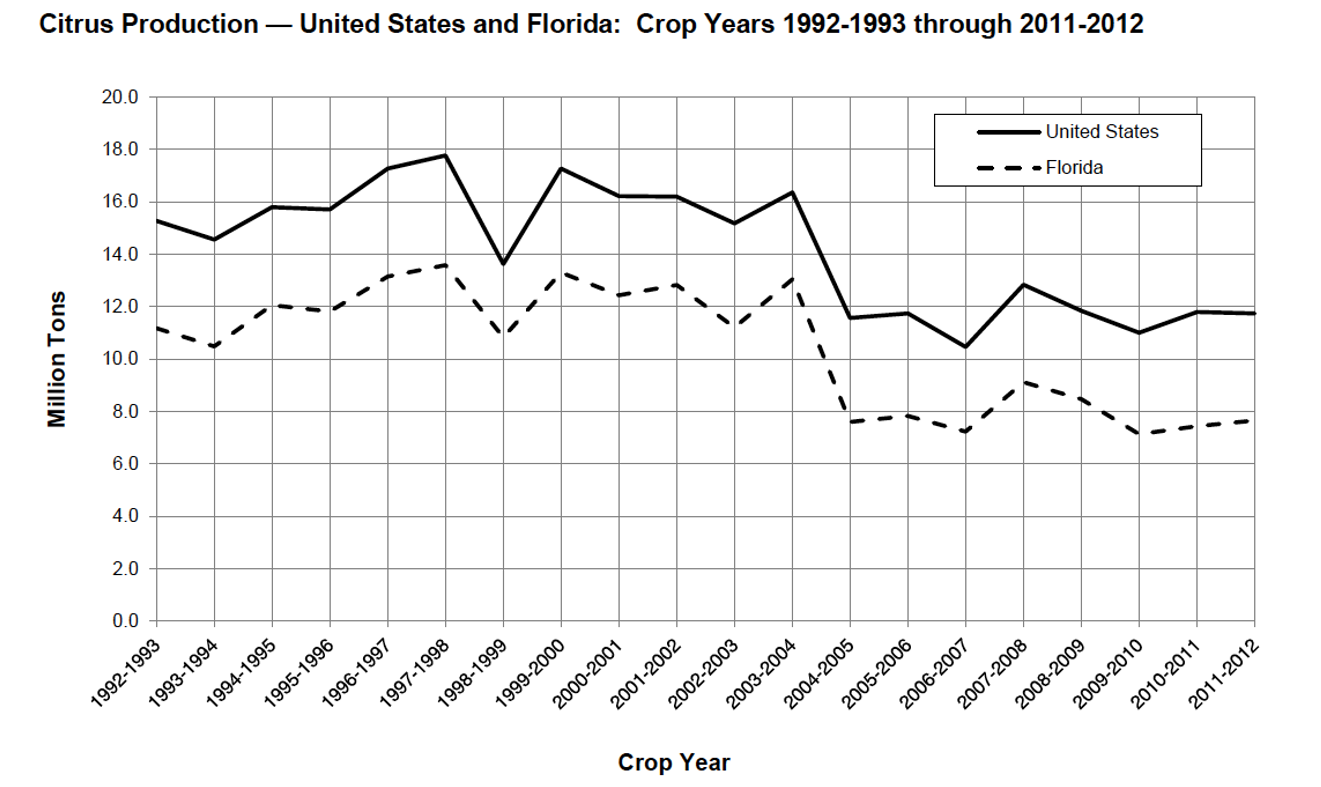
When it comes to orange production in the US, Florida is king. This graph shows the overall US production and Florida’s contribution to that total. (Source: USDA.)
Over the past few years Florida’s production of oranges has dropped. This has been due to an infestation of the Asian psyllid, an insect that transmits a bacterium that causes oranges to fall from the tree long before they’re mature. It was first detected in 2005.
Here is the data for orange production in Florida for the growing seasons from 2001 to 2012. Input this data into a spreadsheet. Create a third column to calculate the percent change.
| Year | Tons (1000's) |
|---|---|
| 2001–2002 | 727.6 |
| 2002–2003 | 718.1 |
| 2003–2004 | 679.0 |
| 2004–2005 | 641.4 |
| 2005–2006 | 576.4 |
| 2006–2007 | 554.4 |
| 2007–2008 | 538.9 |
| 2008–2009 | 530.9 |
| 2009–2010 | 517.1 |
| 2010–2011 | 503.6 |
| 2011–2012 | 495.1 |
Let’s measure the percentage drop in output over the past few years. Use this formula for percent increase and decrease:
\[ \text{Percent Change} = \frac{\text{New Value} - \text{Old Value}}{\text{Old Value}} \times 100 \]
Input a spreadsheet formula for calculating the percent change. Use a variation of this formula:
=(B2-B1)/B1 — Format the output as a percent.
| Year | Tons (1000's) | Percent Change |
|---|---|---|
| 2001–2002 | 727.6 | -- |
| 2002–2003 | 718.1 | -1.31% |
| 2003–2004 | 679.0 | -5.44% |
| 2004–2005 | 641.4 | -5.54% |
| 2005–2006 | 576.4 | -10.13% |
| 2006–2007 | 554.4 | -3.82% |
| 2007–2008 | 538.9 | -2.80% |
| 2008–2009 | 530.9 | -1.48% |
| 2009–2010 | 517.1 | -2.60% |
| 2010–2011 | 503.6 | -2.61% |
| 2011–2012 | 495.1 | -1.69% |
Since its big drop in crop production in 2005, there has been an average drop of 2.5% each subsequent year.
| Year | Tons (1000's) | Percent Change |
|---|---|---|
| 2005–2006 | 576.4 | -10.13% |
| 2006–2007 | 554.4 | -3.82% |
| 2007–2008 | 538.9 | -2.80% |
| 2008–2009 | 530.9 | -1.48% |
| 2009–2010 | 517.1 | -2.60% |
| 2010–2011 | 503.6 | -2.61% |
| 2011–2012 | 495.1 | -1.69% |
The change in output from 2005 to 2012 is the product of each year’s net percentage. A reasonable estimate is found using the average percent change.
\[ \text{Estimated Output in 2012} = \text{Output in 2005} \times (1 - 0.025)^7 \]
While crops have been in decline, the Winter of the Polar Vortex has put the current season’s harvest in further jeopardy.
The Florida Department of Citrus — http://fdocgrower.com — estimates a 4% to 8% drop in orange production over the next few years. Let’s see what that could look like. Let’s use our previous spreadsheet data.
| Year | Tons (1000's) | Percent Change |
|---|---|---|
| 2005–2006 | 576.4 | -10.13% |
| 2006–2007 | 554.4 | -3.82% |
| 2007–2008 | 538.9 | -2.80% |
| 2008–2009 | 530.9 | -1.48% |
| 2009–2010 | 517.1 | -2.60% |
| 2010–2011 | 503.6 | -2.61% |
| 2011–2012 | 495.1 | -1.69% |
Take the last data point and estimate the output five years out for the two percentage drops.
\[ \text{Estimate at 4% drop: } 495.1 \times (1 - 0.04)^5 \] \[ \text{Estimate at 8% drop: } 495.1 \times (1 - 0.08)^5 \]
Use these expressions to find the potential number of tons of oranges not produced over the next five years:
\[ \text{Tons Lost (4%)} = 495.1 - [495.1 \times (1 - 0.04)^5] \] \[ \text{Tons Lost (8%)} = 495.1 - [495.1 \times (1 - 0.08)^5] \]
What is the potential loss in the orange crop over the next five years? Estimate how many oranges this is. Estimate the volume this number of oranges would take up.
Think About It
- What role does climate play in agricultural output?
- How can mathematical models help forecast future crop yields?
- What assumptions are made in calculating average percent change?
- How would a greater-than-expected temperature shift affect the model?
- What are some economic consequences of a reduced orange harvest?
Video: Meet the Tree That Could Save Florida’s Citrus
In this June 2024 PBS NewsHour feature, learn how Florida’s citrus industry is adapting to climate and disease threats. The video explores research into disease-resistant orange trees and the challenges facing citrus growers today.
Watch the video here: https://www.youtube.com/watch?v=MTT-0I0aHzg