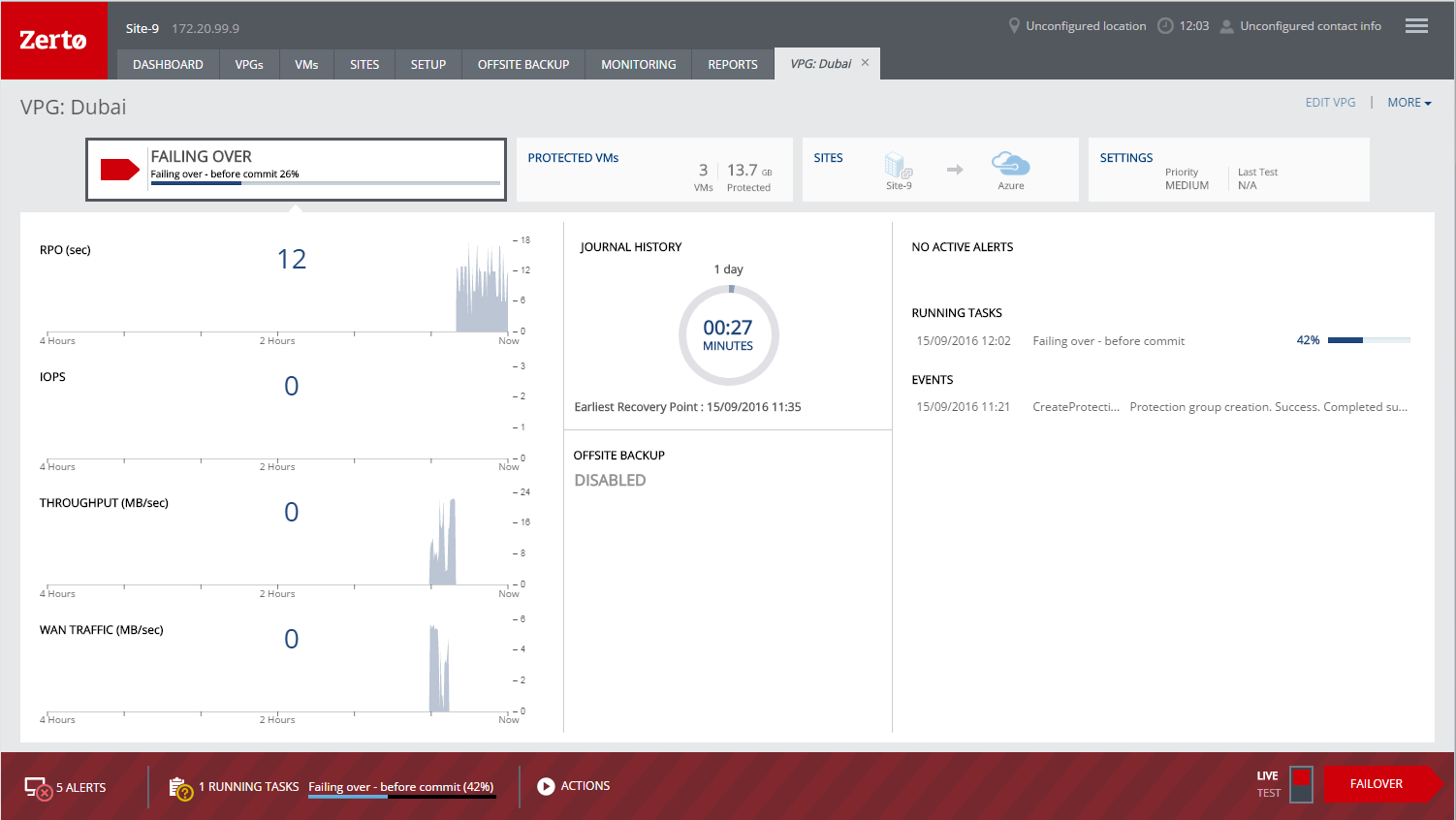
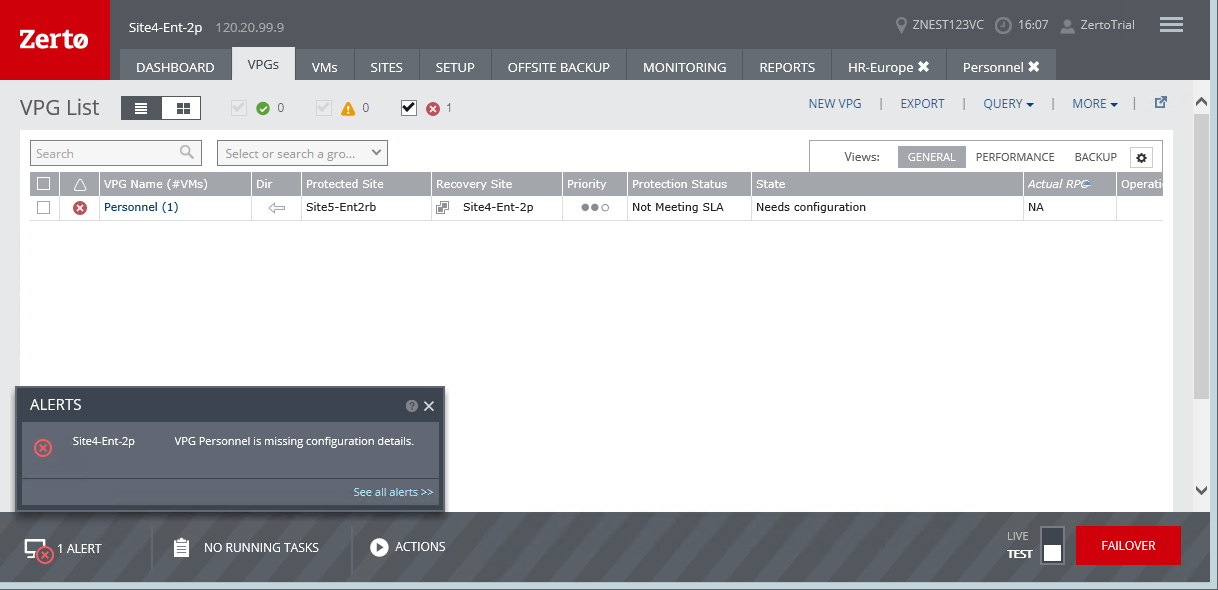
Initiating a Failover
You can initiate a failover, whereby the virtual machines in the virtual protection group are replicated to a set checkpoint in Azure.
You can initiate a failover to the last checkpoint recorded in the journal, even if the protected site is no longer up. You can initiate a failover during a test, as described in
Initiating a Failover During a Test.
If you have time to initiate the failover from the protected site you can. However, if the protected site is down, you initiate the failover from Azure.
Note: Any VPGs that are in the process of being synchronized, cannot be recovered, unless the synchronization is a bitmap synchronization.
IMPORTANT: |
Due to an Azure limitation, failing over Linux VMs with static IP is not supported. |
Prerequisites Before Failing Over to Linux Virtual Machines in Azure
Before attempting to failover certain Linux virtual machines, preparations to the virtual machine need to be made for the failover to be successful.
The following table lists the name of the supported Linux distribution and the link to follow instructions for preparation:
Linux Distribution | Link for Instructions |
Ubuntu (16.04, 14.04) | |
CentOS (6.3, 7.0) | |
RHEL (6.9, 6.7, 7.4) | IMPORTANT: dracut -f -v should be replaced with dracut -force -v |
To initiate a failover:
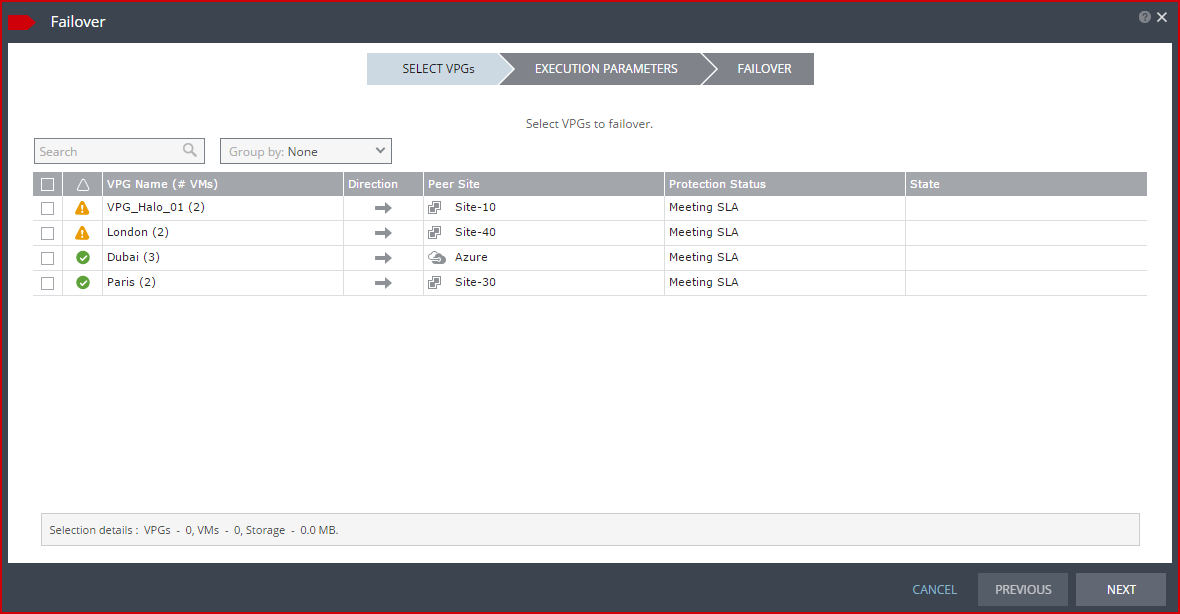
1. In the Zerto User Interface set the operation to LIVE and click FAILOVER.
The Failover wizard is displayed.
2. Select the VPGs to failover. By default, all VPGs are listed.
At the bottom, the selection details show the amount of data and the total number of virtual machines selected.
The Direction arrow shows the direction of the process: From the protected site To the peer, recovery, site.
3. Click NEXT.
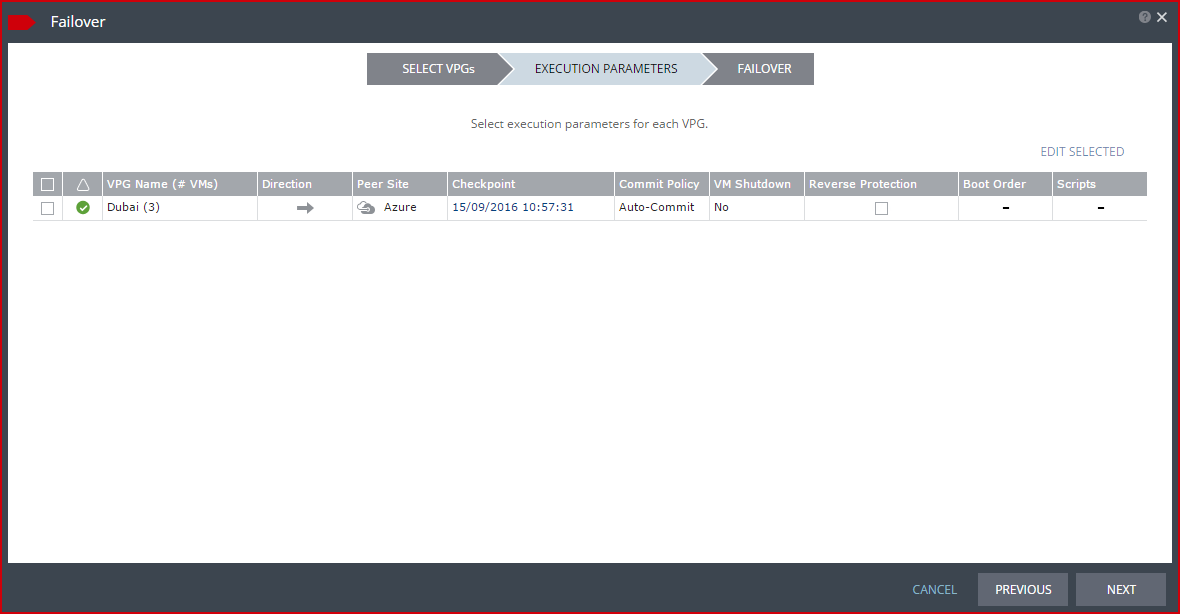
The EXECUTION PARAMETERS step is displayed.
You can change the following values to use for the recovery:
■ Commit Policy
■ Force Shutdown policy
You can also see if Scripts are defined for the VPG.
4. By default, the last checkpoint added to the journal is displayed. If you want to use this checkpoint, go to the next step. If you want to change the checkpoint, click the checkpoint.
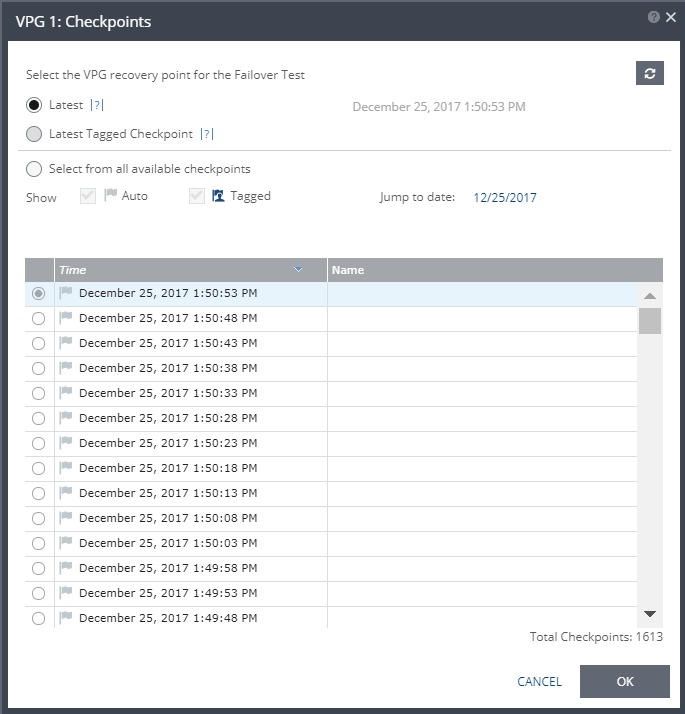
The {VPG-Name}: Checkpoints window is displayed.
When selecting the point to recover to:
■ The refresh button is initially grayed out and is enabled for clicking after 5 seconds. It is also grayed out for 5 seconds after being clicked, before being re-enabled.
■ A reminder to Click the refresh button to view the latest checkpoints is displayed 10 seconds after the refresh button is clicked to remind the user that there is a new Latest Checkpoint.
■ If the user has scrolled to, and selected, a checkpoint anywhere in the checkpoints list, clicking the refresh button will automatically return the user to the selected checkpoint in the list.
Latest: Recovery is to the latest checkpoint. This ensures that the data is crash-consistent for the recovery.
Latest Tagged Checkpoint: The recovery operation is to the latest checkpoint added in one of the following situations:
■ By a user.
■ When a failover test was previously performed on the VPG which includes the virtual machine.
■ When the virtual machine was added to an existing VPG after the added virtual machine was synchronized.
If you do not want to use the latest checkpoint, or latest tagged checkpoint, choose Select from all available checkpoints. By default, this option displays all checkpoints in the system. You can choose to display only automatic, or tagged checkpoints, or any combination of these types.
5. Select the checkpoint to use. Click the refresh button to refresh the list. You can choose from one of the following checkpoints:
6. Click OK.
7. To change the commit policy, click on the field or select the VPG and click EDIT SELECTED.
a) To commit the recovery operation automatically, with no testing, select Auto-Commit and 0 minutes.
b) Select None if you do not want an automatic commit or rollback. You must manually commit or roll back.
c) To test before committing or rolling back, specify an amount of time to test the recovered machines, in minutes.
This is the amount of time that the commit or rollback operation is delayed, before the automatic commit or rollback action is performed.
During this time period, check that the new virtual machines are OK and then commit the operation or roll it back.
The maximum amount of time you can delay the commit or rollback operation is 1440 minutes, which is 24 hours.
8. To specify the shutdown policy, double-click the VM Shutdown field and select the shutdown policy:
■ No (default) – The protected virtual machines are not touched before starting the failover. This assumes that you do not know the state of the protected machines, or you know that they are not serviceable.
■ Yes – If the protected virtual machines have a utility such as VMware Tools or Microsoft Integration Services available, the virtual machines are gracefully shut down, otherwise the Failover operation fails. This is similar to performing a Move operation to a specified checkpoint.
■ Force Shutdown – The protected virtual machines are forcibly shut down before starting the failover. This is similar to performing a Move operation to a specified checkpoint. If the protected virtual machines have VMware Tools or Microsoft Integration Services available, the procedure waits five minutes for the virtual machines to be gracefully shut down before forcibly powering them off.
9. Click NEXT.
10. Click OK. If a virtual machine is deleted from other VPGs, the journals of these VPGs are reset.
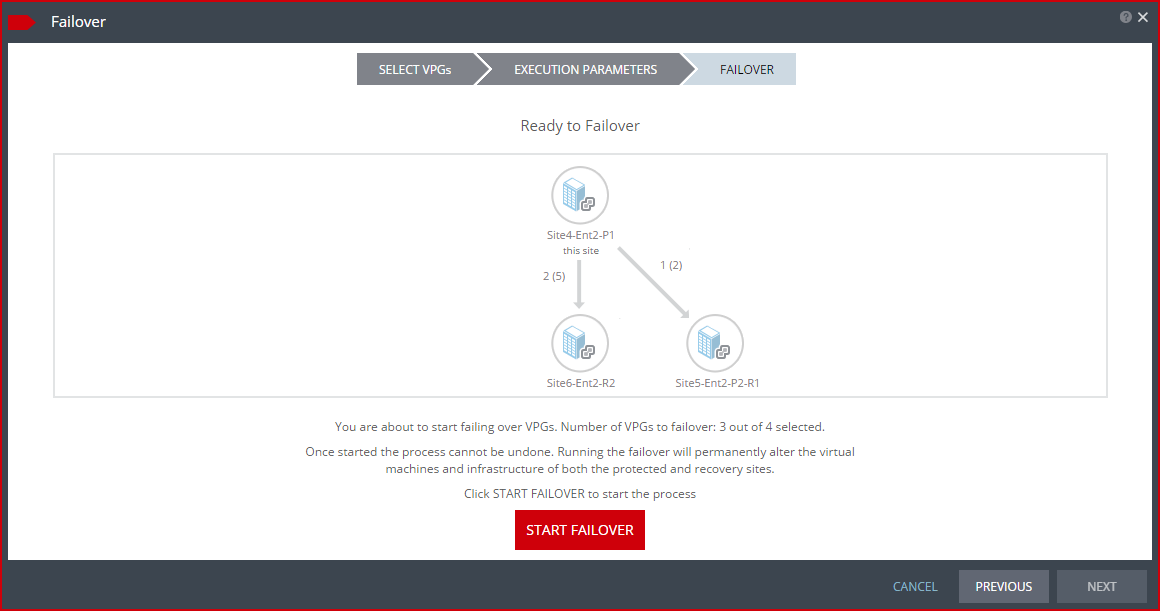
The FAILOVER step is displayed. The topology shows the number of VPGs and virtual machines being failed over to each recovery site. In the following example, 2 VPGs will be failed over to Site6-Ent2-R2, and they contain 5 virtual machines; and 1 VPG will be failed over to Site5-Ent2-P2-R2 and it contains 2 virtual machines.
11. Click START FAILOVER to start the failover.
A warning message appears, presenting a summary of your Commit Policy.
12. Review the Commit Policy summary, and either click Change Settings, or click START FAILOVER to start the failover.
Note: If any of the VPGs have at least one VM configured with a static IP, but the static IP is in use on the recovery site, a warning message appears enabling you to choose whether to continue with a dynamic IP, or to cancel the failover process.
If a commit policy was set with a timeout greater than zero, you can check the new virtual machines at the recovery site before committing the failover operation.
The failover starts by creating the new virtual machines on Azure to the point-in-time specified: either the last data transferred from the protected site or to one of the checkpoints written in the journal.
Note: If a virtual machine exists on Azure with the same name as a virtual machine being failed over, the machine is created and named in the peer site with a number added as a suffix to the name, starting with the number 1.
The status icon changes to orange and an alert is issued, to warn you that the procedure is waiting for either a commit or rollback.
All testing done during this period, before committing or rolling back the failover operation, is written to VHD disks. These virtual disks are automatically defined when the virtual machines are created on Azure for testing.
Note: You cannot take a snapshot of a virtual machine before the failover operation is committed and the data from the journal promoted to the moved virtual machine disks, since the virtual machine volumes are still managed by the VRA and not directly by the virtual machine. Using a snapshot of a recovered machine before the failover operation has completed will result in a corrupted virtual machine being created.
13. After checking the virtual machines in Azure, choose one of the following:
■ Wait for the specified Commit Policy time to elapse, and the specified operation, either Commit or Rollback, is performed automatically.
■ Click the
Commit or
Rollback icon (

) in the specific VPG tab.
Click Commit. The Commit dialog is displayed to confirm the commit.
Click Rollback to roll back the operation, removing the virtual machines that were created on the recovery site and rebooting the machines on the protected site. The Rollback dialog is displayed to confirm the rollback.
You can also commit or roll back the operation via the TASKS popup dialog in the status bar, or by selecting MONITORING > TASKS.
The default instance size for new virtual machines is
Standard D1 v2. If Standard D1 v2 instance size does not meet your needs, you can change this value in the
Policies tab of the
Site Settings dialog. For more information, see
“Configuring Disaster Recovery Policies”, on page 137. You can also change the instance size of new virtual machines when you create or edit a VPG.
Note: By default, every Azure virtual machine is created with additional temporary volume. This volume is in addition to the volumes associated with each protected virtual machine.
If you did not define a private IP for a virtual machine in the VPG definition, during recovery Azure sets the private IP from the defined subnet range.
Note: If the new virtual machines do not power on, the process continues and the virtual machines must be manually powered on.
■ If you do not specify Reverse Protection, the VPG definition is kept with the status Needs Configuration and the reverse settings in the VPG definition are not set.
■ Clicking EDIT VPG displays the Edit VPG wizard with the settings filled in, using the original settings for the virtual machines in the VPG from the original protected site, except for the volumes. To start replicating the virtual machines in the VPG, specify the disks to use for replication and optionally, make any other changes to the original settings and click DONE.