Zerto Virtual Replication Architecture
Zerto Virtual Replication provides disaster recovery between VMware ESX/ESXi hosts managed by vCenter Servers or Microsoft Hyper-V hosts managed by SCVMM to a public cloud, such as Amazon Web Services.
Zerto Virtual Replication comprises the following components:
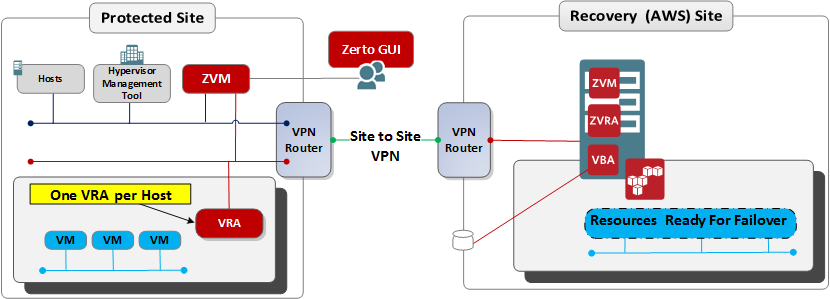
Zerto Virtual Manager (ZVM) – A Windows service that manages everything required for the replication between the protected site and AWS, except for the actual replication of data. Each Zerto Virtual Manager can manage up to 5000 virtual machines, either being protected or recovered to that site.
Virtual Replication Appliance (VRA) – A Windows service that manages the replication of data from protected virtual machines to AWS. A VRA can manage a maximum of 500 volumes.
Virtual Backup Appliance (VBA) – A Windows service that manages back-ups within Zerto Virtual Replication and is responsible for the repositories where offsite backups are stored. These repositories can be local or on a shared network.
Zerto User Interface – Recovery using Zerto Virtual Replication is managed by the Zerto User Interface in a web browser.
The following diagram shows how the main Zerto Virtual Replication components are deployed to provide disaster recovery across these sites.
When you plan to recover the enterprise site to a public cloud, Zerto Virtual Replication is installed in the cloud environment. Zerto Virtual Replication comprises the same components but the VRA runs as a service, so that the ZVM, VRA, and VBA all run as services on a single virtual machine instance in the public cloud.