|
| From the June 2015 edition of Carolina Journal, a monthly journal of news analysis and opinion from the John Locke Foundation |
|
Solar Lobbyist N.C.'s Fastest-Growing Occupation (a CJ parody) By Sunny Numbers Renewable Energy Correspondent RALEIGH — The effort in the General Assembly to get rid of renewable energy standards in North Carolina has had an unexpected effect: job growth.
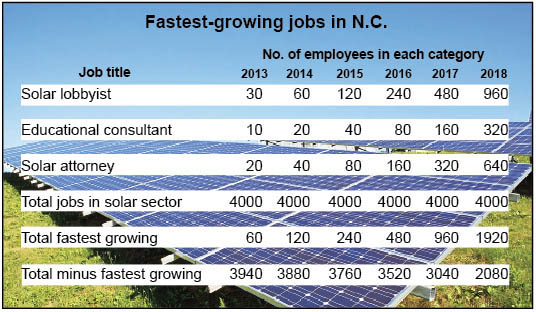
No, the huge jump in solar-related jobs has come in the area of lobbyists, lawyers, solar engineers, and industry consultants. According to North Carolina Department of Commerce research, these job areas skyrocketed as a percentage of solar and renewable energy-related jobs when legislative efforts began to eliminate the tax credits and subsidies for alternative energy. "It's understandable," said a legislator who asked not to be identified. "When you see your golden goose about to take it in the shorts, you work to protect your gravy train." Legislators noticed the jobs increase earlier than others. "Yeah," said another legislator who wished to remain anonymous, "you couldn't swing a dead cat in the legislative hallways over the last year or so without hitting an energy lawyer or lobbyist." The research, funded by grants from the federal Bureau of Labor Statistics and the North Carolina Solar Industry Association, anticipates the mix in overall solar industry employment in the state will change dramatically. In 2013, according to Commerce figures, just 30 people worked as solar industry lobbyists in North Carolina. That number doubled to 60 in 2014 and doubled again to 120 in 2015. At that rate there will be 960 industry lobbyists by 2018. Solar educational consultants and solar attorneys also doubled each year from 2013 to 2015. There were only 10 educational consultants in 2013 and 20 solar attorneys. In 2018, forecasts predict 320 consultants and 640 attorneys. Unlike the exponential growth of those three occupations, Commerce officials say the growth of solar industry installers and designers appears to be flat and soon will start declining. As installers become more productive, potential locations for new solar farms become harder to find, and as tax credits and other subsidies for solar installation expire, the role of "nonproducing" workers in the industry — led by lawyers and lobbyists — will rise, reports Commerce. Analysts noted that the total jobs forecast in the solar industry will remain at about 4,000 through 2018, but the three fast-growing "nonproductive" occupations within the industry will make up half the total jobs in that year. Solar industry advocates say solar energy has been an economic engine for North Carolina, and that only California installed more solar capacity in 2014 than North Carolina. They also acknowledge the industry has expanded because of tax credits for investors in solar energy and government mandates requiring North Carolina to produce a larger percentage of renewable energy in coming years. "How else could we get anyone to build a solar farm?" said one supporter of solar subsidies. "No one with any business sense would do it without taxpayers chipping in and assuming most of the risk." The subject of solar credits and subsidies became an issue in the U.S. Senate race between then-incumbent Kay Hagan and Thom Tillis, when Carolina Journal reported on the solar business activities of Hagan's son and husband last fall. "I don't see what all the fuss is about," one solar lobbyist told CJ. "Jobs is jobs, right?" "Parting Shot" is a monthly parody by Carolina Journal spoofed to look like a genuine news story. It appears on page 28 of the print version of CJ. |