Basic HTML Version




62
{ }
String into action with our guide to noodle
ingredients, shapes, sizes and strand types
ASIANNOODLES:
AQUICKTASTER
O O D L E S O F N O O D L E S
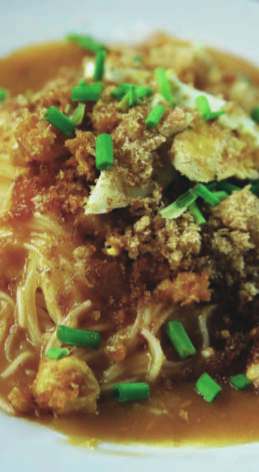
Pancit luglug
and pancit
palabok
The Philippines
Celebration nosh
The Hokkiens from China’s Fujian
province brought
pancit
(quick-
to-prepare noodle dishes) to the
Philippines to curb their homesickness.
Two of the many variations are pancit
luglug
and pancit
palabok
. Both are
smothered in a rich, orange shrimp
sauce then topped with shrimp,
tinapa
(smoked fish),
chicharon
(pork rind),
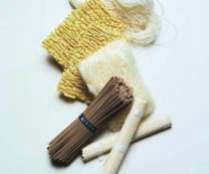
Bakmi
Chinese for “meat noodles”, these crooked, yellow wheat-
based noodles are about half as thick as the Japanese
udon
,
flatter and more springy.
Bee hoon/vermicelli
These white, rice-flour noodles are straight but wrap around
the bowl in circles. The Filipino pancit palabok uses the more
delicate version that resembles thick, silky strands of thread,
while the Singaporean laksa looks like white spaghetti.
Corn-starch noodles
Similar in shape and texture to the bee hoon found in
Singaporean laksa, but with less bounce in the bite, these
noodles are used in the Filipino pancit luglug.
Dangmyeon
Also known as cellophane or glass noodles on account of
their reflective, opaque appearance — and usually made with
sweet potato starch — the strands used for South Korea’s
japchae are straight, thick and flat.
Ramen
Traditionally wheat-based and made with mineral water,
these noodles are a sturdy, filling affair. The various types of
ramen differ in thickness and curliness — again, it depends
on where they were made.
Rice noodles
An over-arching category that covers bee hoon, pad Thai
and pho; the straight, medium-thick form is stir-fried for the
former, while types used for pho vary depending on the
region of provenance. Rice noodles are not as chewy or
heavy as dangmyeon.
hard-boiled eggs and green onions.
They differ in the type of noodles
used — thick corn-starch noodles
are used for pancit luglug, while thin
bihon
(vermicelli) are used for pancit
palabok. Over the years, these
dishes have been elevated from
their status as common fare. Now,
many Filipino-Chinese restaurants
offer them as “birthday noodles”.
Superstition has also been passed
down: as a birthday dish, these
noodles represent longevity, so they
should not be cut short. Usually
shared with others, pancit also
brings families and communities
together, creating stronger ties.
PHOTOS
LESTER LEDESMA (PANCIT PALABOK), GETTY IMAGES (MIX OF NOODLES)
Pancit luglug and pancit
palabok are usually served in
birthday parties and gatherings