Basic HTML Version





53
{ }
B E S P O K E B O H O L
the 25-room establishment. The name
comes from two Portuguese words,
amar
(to love) and
ela
(the sea), and
is a perfect fit: Amarela is located on
a gentle slope that offers panoramic
views of the Bohol Sea and its
neighboring islands. A stone path
leads one from the house down to
a private white sand beach, where
Doy and his two children pursue their
passion for diving.
Art enclave by the sea
Doy’s other passion, however, becomes
evident once you step inside the main
house. A true son of Bohol (he hails
from Antequera) and chairman of the
Bohol Tourism Council, he wanted
Amarela to evoke Old Bohol in its every
nook and cranny. To get this done, he
hired carpenters who worked as
habal-
habal
(motorcycle taxi) drivers by day,
to build furniture using wood reclaimed
from old houses. The results were
amazing. But what was even more
impressive was that the steady work
helped these artisans refine their craft,
encouraging them to pursue carpentry
full-time.
Doy now sees the resort as “a
springboard for Bohol craftsmen and
women to flourish.” Amarela’s interiors
showcase local artistry through restored
antique chairs and tables, intricate
wood carvings that embellish the
walls and windows, and a remarkable
Philippine art collection. When he met
Hermogena Borja Lungay (aka Nang
Nene), a Boholano artist in her eighties,
he was so impressed by her talent that
he commissioned her to paint scenes
of Old Bohol. Nang Nene’s pieces
remind one of the late great Fernando
Amorsolo’s rural Philippine scenes, and
now decorate the walls of Amarela.
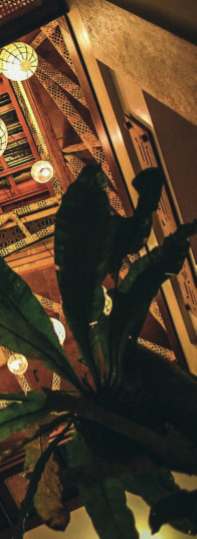
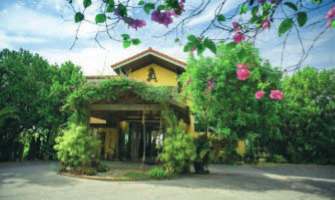
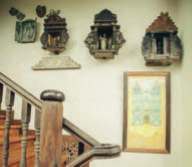
Top to bottom: The picturesque front entrance of Amarela Resort;
locally made art adorn the resort’s walls; (inset) resort owners
Ludichi and Doy Nunag’s mission is to support local artisans;
tarsier souvenirs come in all shapes and sizes. Opposite page:
Amarela’s elaborate ceiling and Amorita’s plunge pool
PHOTOS
JOREM CATILO