E
ileen Dickson has been giving tours of Boeing’s
Everett factory for the best part of 27 years and you
suspect some of her many jokes might be recycled.
“You could fit the Pentagon in the factory,” she says,
“though we say Red Square when Russians come.”
It’s a gag that has legs, because you can fit just about anything in
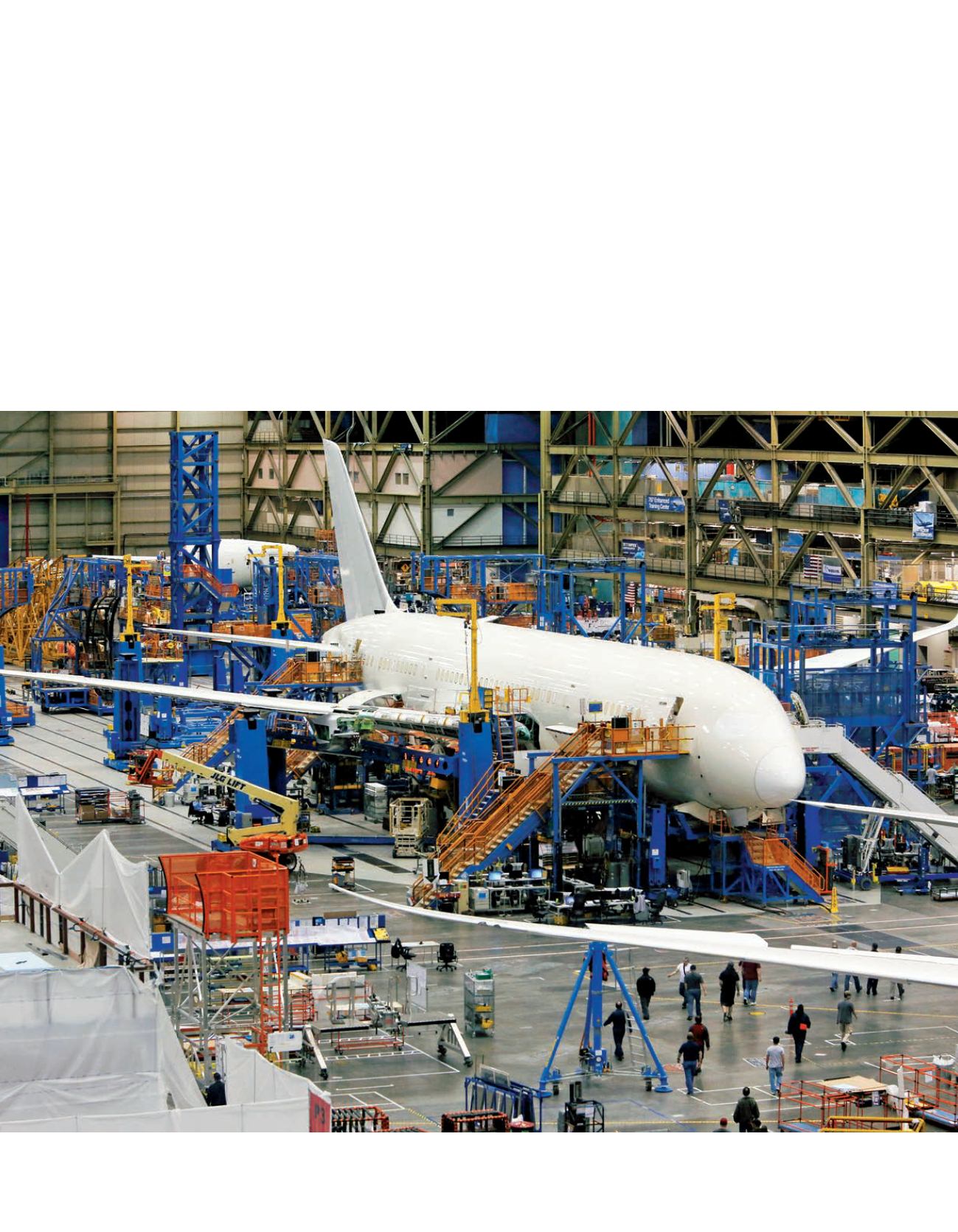
the factory near Seattle, which is the single biggest building in the
world by volume. It’s so vast there was an urban myth a few years
ago that it has its own ecosystem and clouds form in the roof of the
hangar causing rain.
That’s not true, but it is true that more than 30,000 people work
in the 13,400,000m
3
space every day. The plant has its own adjacent
stretch of freeway, a credit union, fire station, DVD rental shop,
phone store and water treatment plant. There are six branches
of Tully’s coffee shop (Seattle’s poor sister to Starbucks) and 19
cafeterias churning out 17,000 meals a day. If you look past the rows
of off-hours workers playing ping pong, you occasionally see hangar
doors the size of American football fields open to let some of the
world’s most iconic aeroplanes rumble out into the open.
This is where they put together the hulking 747, the world’s first
jumbo jet, as well as the mid-size 767 and 777 planes. But the big
news at Everett is the 787 Dreamliner, another mid-range plane
which is described as a “game-changer” by just about everyone I
speak to on a two-day tour of Boeing’s facilities.
Boeing has solved the problemwith the Dreamliner’s lithium-ion
batteries, which grounded planes earlier this year – and the focus
is now on what is simply an astonishing feat of engineering. The
1,200 or so mechanics, engineers, electricians and others currently
working on the Dreamliner at Everett (
see portraits
) generally purr
with approval at the mention of the name.
0 4 6 \
n


