82
MARCH2015
•
HEMISPHERESMAGAZINE.COM
curved in thepresenceof energyand
matter… [15minuteselapse]…Sohow
does everything fit inside this hole?
Here we are brought to the famous
quote: “It’s bigger on the inside.”
HEMISPHERES:
Okay, but this is all
conjecture, isn’t it? I mean, no one’s
ever seen awormhole.
TYSON:
Here’s the thing. Here’s the
beautiful fact of science: Once you
understand how things work, and if
yourequationsareaproperrepresen-
tationof nature, you canuse them to
probewhat youhaveyet todiscover.
Einstein’sgeneral theoryof relativity
accounts for every-
thing we see going
on in the universe. So
while we have yet to
find a wormhole, no
onedoubts theconcept
as derived from Ein-
stein’s general theory
of relativity, because
everything else that it
describesworks.
HEMISPHERES:
In
terms of conveying
these ideas to people
like me, condensing
them into sound bites,
isn’t there a risk that
you’ll end up oversim-
plifying things?
TYSON:
A sound bite is
not a college lecture, so
you can’t require that
it be completely infor-
mative. But it should
spark interest. So if I’m
describing, say, black
holes, the first thing
I might say is, avoid
»
CONTINUEDFROMPAGE62
them. Theydistort the fabric of space
and time, whichmeans they’ll distort
youaswell—they’ll ripyouapart atom
by atom as youdescend to the center.
Andmaybeyou’llsay, “Wow, that’scool,
Iwanttoknowmore.”Therearea lotof
thingsabout theuniverse that are fun.
HEMISPHERES:
Our understanding of
space is shifting all the time. Isn’t part
of the astrophysicist’s job to increase
our stockpile of known unknowns,
rather than certainties?
TYSON:
Both are happening at the
same time. There’s a famous saying:
“As theareaof ourknowledgegrows,
so toodoes theperimeterofour igno-
rance.”Thinkof [scientificknowledge]
asbeingacircle—theareaof thecircle
isgrowing, but so is theperimeter, the
boundarybetweenwhat’s insideand
what’s outside.
HEMISPHERES:
So your mandate is
largely to convey the wonderful mys-
tery of the universe.
TYSON:
Exactly. Partof the funof this
is guiding you along that boundary
between theknownand theunknown.
I’mwithyou in thecenterof thecircle
and I take you to the edge, to the
perimeter, sowe both peer out into
theunknown together.
HEMISPHERES:
Isn’t part of the prob-
lem thatwe’re hamstrungby the limits
of experience?There couldbe thingsout
there that are so outside our realm of
experience thatwe can’t imagine them.
TYSON:
That’swhyexperimentshavea
serendipitymode, sowe candiscover
stuffweneverthoughtor imaginedwas
there. I’ll give you an example: Some
yearsago, theheadoftheHubblespace
center said, “Why don’t we point the
telescopeatacompletelyemptypatch
ofsky, adullandboringpatch, and just
seewhat itdoes?”Whatcamebackwas
stunning, a rich tapestryof thousands
of galaxies that no one even knew
were there. It’s come to be known as
theHubble Deep Field, and it’s prob-
ablythemostfamousphoto
takenby the telescope.
HEMISPHERES:
Do you
ever feel yourself bumping
against the limits of your
own understanding?
TYSON:
Yes, butmaybenot
in thewayyou’re thinking.
I’venever at any time said
tomyself, “It’s impossible
for me to know this.” I’ve
never had that thought.
Some things are harder
thanothers for thehuman
mind to contemplate, sure,
but it’s not some gate for
which I don’t have a key.
Youcanalwaysknowmore
about something, whether
ornotyoucanknowevery-
thing about it.
HEMISPHERES:
Why should
I spend my time learning
how the universe works
rather than something
useful, like how to fix
acar?
CONTINUEDONPAGE83
»
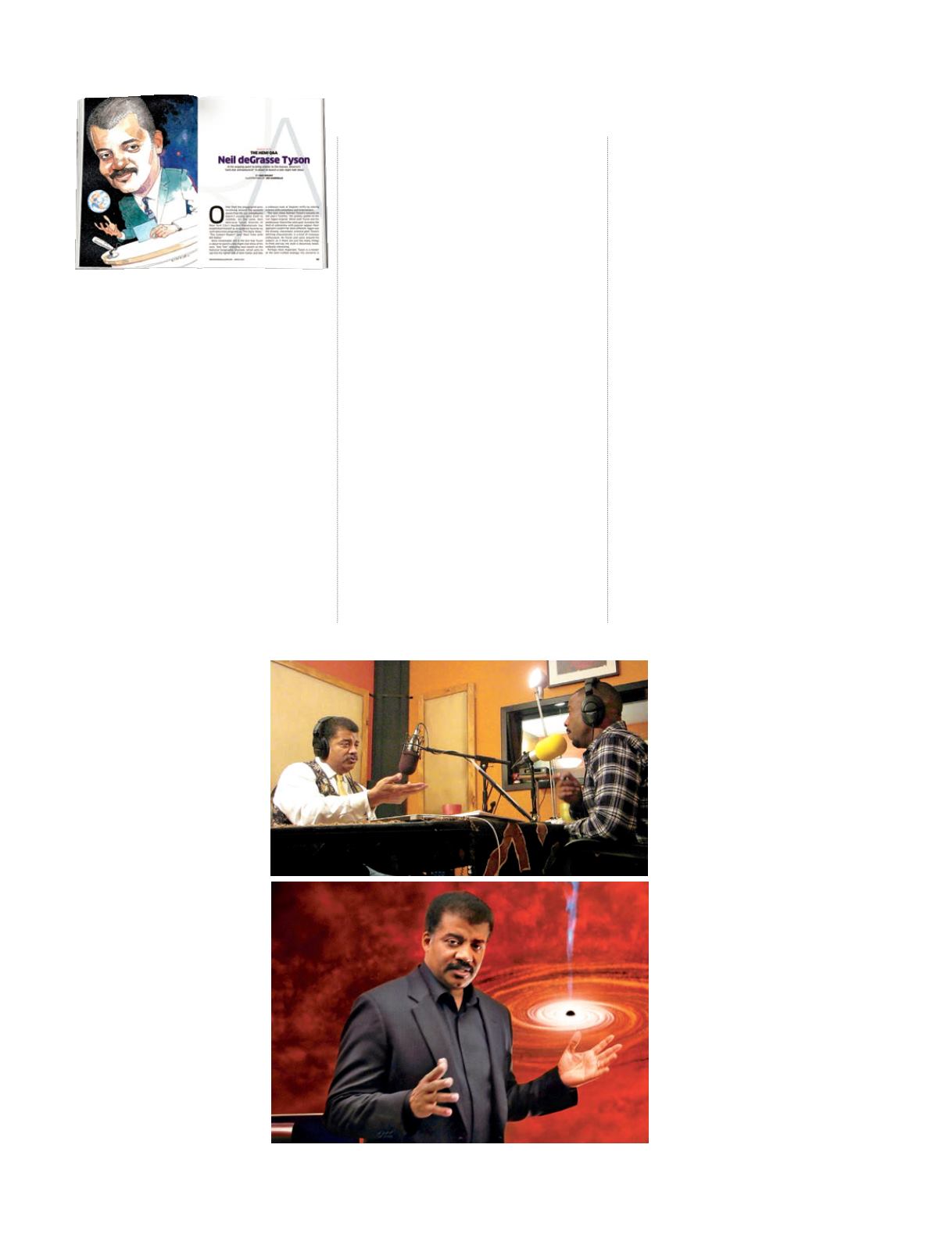
ASTRONOMICALAPPEAL
From top: Tysonwith comedianChuckNice
on “StarTalkRadio”; hosting “Cosmos”
COURTESYOF STAR TALK (TYSONWITHNICE); FOXVIAGETTY IMAGES (“COSMOS”)


