Basic HTML Version




HEMISPHERESMAGAZINE.COM
•
SEPTEMBER 2012
97
EUROPEAN PRESSPHOTO AGENCY B.V./ALAMY (MUSEUM OF INNOCENCE)
HERE’S THE THING(S)
An award-winning author displays
the items that inspired his work
Istanbul native and Nobel
Prize–winning author Orhan
Pamuk developed a strange
habit while writing his
2008 novel,
The Museum of
Innocence
. Having both
bought a 19th-century
house in the Çukur-
cuma district and used
it as a setting for his story
about a wealthy man, Kemal,
who worships his lover, Füsun, by
obsessively collecting the mun-
dane objects that touch her life,
Pamuk actually began collecting
the objects he wrote about.
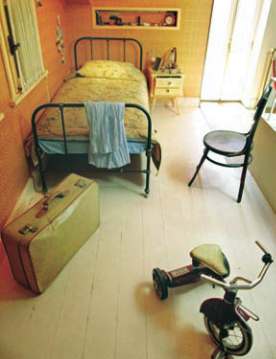
In April of this year, Pamuk
used those artifacts to open
the Museum of Innocence—a
hushed, ghostly affair, punctu-
ated only by muted gasps from
book-loving visitors viewing cases
of knickknacks—in that same
Çukurcuma row house. For Pamuk
fans, visiting the three-story
museum is making a pilgrimage
of sorts to contemplate items, like
Füsun’s 4,213 discarded cigarette
butts, the same way Kemal does.
“Attachment to things, piling them
together ... is common to human
hearts, in every geography,”
Pamuk has said. “And I really like
small, neglected museums.”
You nod but aren’t really pay-
ing a ention, because a cadre of
Gypsies has just set up a band in
front of your table and is playing
Turkish pop on a nasal-sounding
horn. Over the next several
hours, you sway in time to the
music, sipping
rakı
and waxing
poetic about howmuch you just
love the people of Istanbul until,
finally, your increasingly impa-
tient companion asks, red-faced,
“Can I order you a fish?”
DAY THREE
| You forgot to close
your curtains last night, and
now the sun, amplified by the
Bosporus, is glaring through
your porch window. It’s very beautiful,
even achingly so. You rouse yourself and
stumble downstairs for a fortifying cup
of Turkish coffee and a
simit
(sesame seed
bagel) with cheese, which youwill require
before taking a ferry across the strait to
Asian Istanbul.
You’d heard there was supposed to be
a subway connecting the two halves of
Istanbul by now, but workers keep finding
Byzantine relics under the water, halting
construction. Noma er: The ferry is pret-
tier, and you can soak in the salutary salt
breeze on your way. Some 15minutes later,
you dock at the fishing neighborhood of
Kadıköy
on the Asian coast. Here, trawling
nets formmakeshi canopies over trays of
fruits, vegetables, mezes and gli eringfish,
gills splayed todemonstrate freshness. You
buy a handful of the sour green plums
you’ve seen locals eating and explore the
shops, wincing with each tart bite.
Yourwanderingends around lunchtime,
so you opt to take one of themore harrow-
ing components of Istanbul’s delightfully
perplexingpublic transportationsystem—
a speedy, lawless shared cab known as a
dolmuş
, the Turkishword for “stuffed”—to
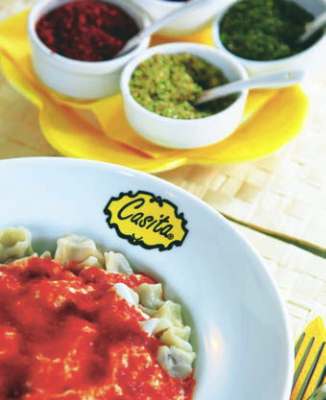
Casita
, just off the busy Bağdat Caddesi.
The restaurant specializes in
manti
, li le
fried pouches of dough filled with meat
and topped with yogurt that are popular
throughout Anatolia, as the Asian portion
of Turkey is known. After consuming a
PRICELESS
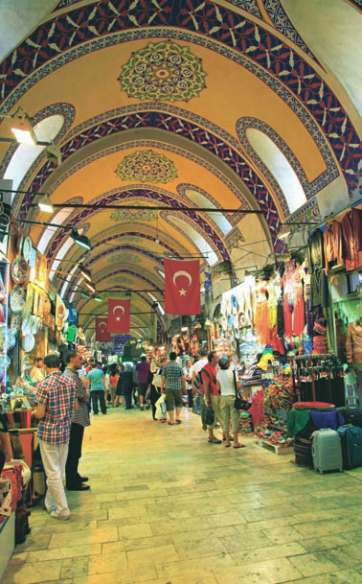
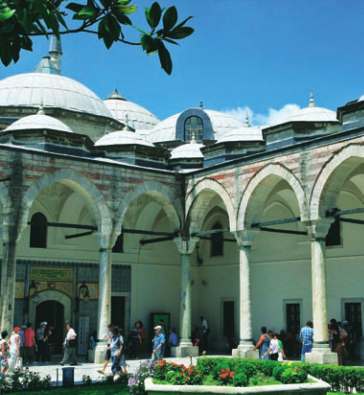
Clockwise from above,
Turkish ravioli at Casita; the treasure-
filled Topkapı Palace; bargain hunting
in the Grand Bazaar