Basic HTML Version



HEMISPHERESMAGAZINE.COM
•
SEPTEMBER 2012
75
W
HEN CONJURING IMAGES
of Scotland, even culturally
sensitive types tend to rum-
mage through an abject ra le
bag of clichés: sporrans, bagpipes, awee dram
of whisky. At some point one’s mind will flit,
however briefly, across a misty highland, a
hirsute clansman thundering through the
heather, swinginga large swordandhollering,
“You’ll never take our freedom!”
Historically, the Scots have beenportrayed
(by the English, mostly) as an aggressive
breed—a portrayal not entirely without
merit. The belligerents in
Braveheart
are
based in reality, as are the exuberant thugs
(modernrenditions of theScot-warrior arche-
type) in thenovels of Edinburghnative Irvine
Welsh. We should bear in mind, however,
that Scotland also gave us the philosopher
David Hume,
Peter Pan
creator J.M. Barrie,
radar inventor RobertWatson-Wa and, erm,
Gordon Ramsay.
This year Scotland is in the midst of an
effort to emphasize its status as a repository
of high culture and to tease its heritage into
a modern context. To this end, 2012 has been
designated the “Year of Creative Scotland,”
with a series of events and campaigns that highlight
the art, architecture, music, fashion and thought that
Scotland continues to produce at a remarkable clip.
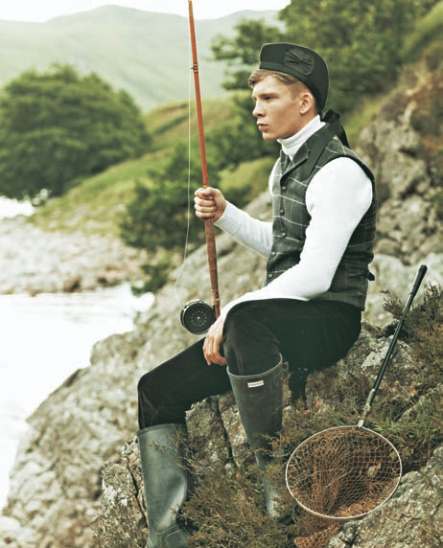
The images on these pages are emblematic of the
thinking behind the push to refine Scotland’s image.
The photographs were shot in two monumental, old-
as-the-hills citadels: Blair Castle and Errol Park. The
apparel includes offerings from Scottish designers
D.S. Dundee and Belinda Robertson, who employ
traditional materials and conceits while maintaining
a contemporary look that’s as suited to the streets of
Paris or Milan as it is to the Highlands. It is through
this mingling of historical and progressive influences
that modern Scotland seeks to define itself.
Tessa Hartmann, who six years ago founded the
annual Sco ishFashionAwards, says that toyingwith
stereotypes—“the haggis-and-shortbread persona”—
has become a trademark of the country’s booming
fashion industry. “People come here with images of
red hair and tartan,” she says. “So [at the 2012 awards]
we had fun with that, using these big, vibrant red
wigs.” The old clan colors were also an insistentmotif.
“Fashion, from punk couture to Karl Lagerfeld, can-
not get enough of tartan,” Hartmann says. “It’s about
celebrating heritage, taking it and giving it a new look.”
Asimilar impulse canbe seenat TheLighthouse, the
national center for designandarchitecture, inGlasgow.
The complex is housed in a 19th-century masterpiece
by Sco ish architect Charles Rennie Mackintosh, his
famous brick tower rising above amodular, hypermod-
ern extension. “The juxtaposition of the old and the
new,” says Ian Elder, the center’s manager, “pays hom-
age to Mackintosh, and to his architectural themes.”
While allowing that Glasgow is indeed home to
some highly ill-advised contemporary architecture,
Elder believes that The Lighthouse points to a more
“sympathetic” approach that has taken root in recent
years. “The tension is in how to maintain character”
while not appearing to be “frozen in time,” he says,
adding, “I think we’re ge ing the balance right.”
Simon Groom, director of Edinburgh’s Scottish
National Gallery of Modern Art, argues that the old-
versus-new debate rests on a false dichotomy. “New
things,” he says, “are always based on old ideas.” While
many museums segregate their artworks by histori-
cal period, Groom prefers a more fluid approach. “We
mix up the oldmasters with young artists whowill be
the old masters of tomorrow,” he says. “People think
contemporary art comes from Mars, but there is a
continuous line.”
As he speaks, Groom is getting ready for his
museum’s Picasso show—an exhibit that, in a way,
illustrates his point. “Picasso, inhis lifetime, was a very
challenging and misunderstood artist,” he says, then
adds, “Frommywindow I can see two huge jet engines
by a young artist named Roger Hiorns. He brought
themback fromAfghanistan, packed themfull of anti-
depressants, and now they lie on our grounds, posing
the immediate question of ‘What are we doing here?’”
If Hiorns’ depressed engines seem like a rather
strident expression of pacifist sentiments—well,
that too is very Sco ish. There’s a steely edge to this
small, craggy country, one that cuts into the highest
reaches of its culture. “Artists who come out of here
punch above their weight,” says Hartmann. “There’s
a hunger here. Because we don’t live in epicenters of
commerce, thatmakes the drive and edginess slightly
stronger than they would normally be.”