Basic HTML Version





































92
AUGUST 2012
•
HEMISPHERESMAGAZINE.COM
anything that’d been deployed in the consumer
market it was still by all rights cu ing-edge.”
Butwhilebrake steer isunprecedentedonthe
roadways, it’s useless if the car isn’t light enough
to benefit from it. That’s wherematerialsmake
all the difference. According to Burnham,
“the singlemost important innovation to come
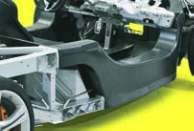
from [race cars] is the use of carbonfiber.”Much
of the 12C, including all of the driver’s cockpit,
is made from carbon fiber. “By using carbon,
we can reduce the weight of the car,” Burnham
says, “which improves the performance and,
most important, the efficiency of the car.”
Indeed, the McLaren supercar gets a
surprising 18 mpg average. Compared with
the Lamborghini Aventador (13 mpg) or the
Ferrari 612 Scaglie i (11), it might as well be a
Nissan Leaf. (Well, almost.) Andwhile that fuel
economy, coupledwith an interior that doesn’t
hurt to sit in, may seem damnably practical by
conventional supercar standards, that’s very
much the point. “Here’s the thing about the 12C
thatwe reckonedwasmost importantwhenwe
were designing it,” Burnham says. “We needed
it to be a realistic, comfortable, everyday car.
Most supercars drive like hell, but they also feel
like hell when you’re driving them. We wanted
something that
could
be smooth if a customer
needed it to be.”
Which of course led to my next question:
“Can I borrow one?”
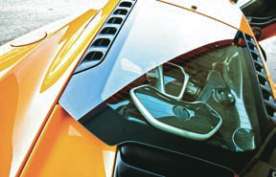
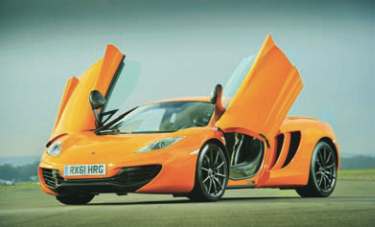
Parked outside my apartment
on a perfectly
still early-summermorning is a “papaya orange”
12C, a wedge of carbon fiber with a posture so
athletic it appears to be speeding while I’m
standing beside it
“MOST SUPERCARS DRIVE LIKEHELL,
BUTTHEYALSO FEEL LIKEHELLWHENYOU’RE
DRIVINGTHEM. WEWANTED
SOMETHINGTHAT
COULD
BE SMOOTH.”
CONTINUED ON PAGE 146
»
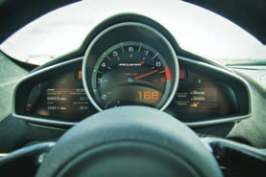
KINDER, GENTLER
The McLaren MP4-
12C, as seen from
the inside out
CHRIS BROWN (12C WITH DOORS UP); PATRICK GOSLING (DASHBOARD)