Basic HTML Version




146
AUGUST 2012
•
HEMISPHERESMAGAZINE.COM
CHRIS BROWN
FEATURES
||
SPEED FREAK
»
CONTINUED FROM PAGE 92
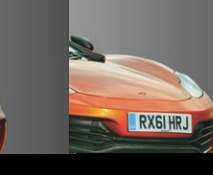
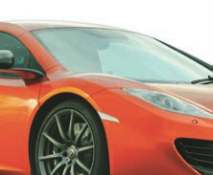
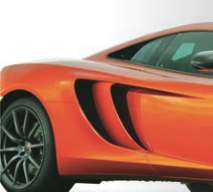
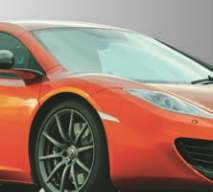
idly sipping an iced coffee. The driver’s-
side door opens vertically, like a blade on
a pair of scissors. The interior is unbur-
dened by gimmickry. There’s a large red
button that fires the engine. There are
paddle shi ers on thewheel, andadriving-
mode dial with three settings: normal,
sport and track. The seat—hand-stitched
leather and faux suede—hugs my frame
delicately. I feel almost coddled.
The 600 hp twin-turbo V-8 engine is a
highly modified evolution of a V-8 that
Nissan developed in the Indy Racing
League. How fast is it? To find out, I fire up
the engine, which purrs quietly; select the
normal drivingmode; andmakemyway to
BearMountain State Park, a hilly network
of winding roads 50 miles north of New
York City. The ride in normal mode is
smooth: controlled, balanced, disappoint-
ingly similar to the silky ride of a Cadillac
CTS. It’s enough to make me wonder,
This is a supercar?
The chassis rests on the 12C’s pièce de
résistance, the hydraulic suspension sys-
tem, a complicated network of hydraulic
pistons that adjust the ride each time the
car goes over so much as a pebble. “This
gives the driver tangible benefits every
time he’s in the car,” says Burnham. “It
allows us to offer serious comfort when
needed, and it can tighten up for the track.
It’s the game-changer.”
When I get to the on-ramp of the New
Jersey Turnpike, I switch to sport mode,
come to a complete stop and then slam
on the accelerator (radically undermining
the gas mileage). Yes, the 12C is fast. Very
fast. According to McLaren, in the time
it takes you, the average reader, to finish
this sentence, the 12C will have acceler-
ated from zero to well over 100 mph.
That’s unfathomably fast for just about
anyone but a race car driver, andMcLaren
achieves this speed by keeping theweight
down and by using the big-bore V-8 and
a radical Seamless Shi Gearbox, or SSG.
About that gearbox: The SSG is technol-
ogy that resembles that found in the F1
racer (the actual racing technology is so
secret that McLaren won’t acknowledge
it uses any gearbox at all). Regardless, it
could come from a Philip K. Dick novel.
Here’s how it works: When I’m driving
along the roads of Bear Mountain, with
their tight turns and blind driveways, I’m
using the paddles on the wheels to shi
up and down—a lot. When I apply light
pressure to one paddle, it sends amessage
to the transmission’s computer signaling
whether the next shi will be up or down.
By predicting my moves, the gearbox can
prepare, shaving fractions of a second
off the shift. This is very important in
a Formula 1 race, where companies like
McLarenwill spendmillions to gain a 10th
of a second per lap.
I focus on the brake steer on a couple
of radical turns near a trailhead on Seven
Lakes Drive. It works. In fact, I’m travel-
ing at such a high rate of speed that the
brake steer is actually practical, which
violates the first rule of supercars, but
which is nevertheless appreciated. The
turns are tight and fast, but smooth, not
at all violent.
Finally, there’s the wing, which is an
integral part of any sports car. Normally,
the wing (or spoiler) produces downforce
in the rear of the car. Sometimes the
downforce presses the rear tires into the
tarmac to improve traction; other times, as
in the case of the early Audi TT, the wing
is deployed at a certain speed to keep the
rear of the roadster from floating off the
ground. In the McLaren, the wing creates
downforce when required, but it also has
active hydraulic pistons that push it up to
act as an air brake when you need to slow
down—fast.
Which I do. I am, a er all, a responsible
adult. A father, a professional, a reason-
ably productive member of society, with
a practical streak that grows wider each
day. Still, as I make my way home in
normal mode, the hydraulic suspension
forgivingly erasing the bumpyNewJersey
roads, I find myself scanning the cockpit.
If I had a few hundred grand—I don’t,
but if I did—is this something that could
work? Is there room for, say, a car seat? Of
course not. It remains a supercar. Perish
the thought.
But then again, rules—even the invio-
lable ones—are made to be broken.
MIKE GUY,
former
Hemispheres
editor in
chief, is the editorial director at The Fix. His
writing has also appeared in
Rolling Stone
,
Details
and
Men’s Journal
.