Basic HTML Version


Invest in the U.S.
//
Manufacturing
S P E C I A L A D V E R T I S I N G F E A T U R E
fact, Moody’s lists theMountain State as
having the third-lowest business costs in the
nation.” Not surprisingly, Tomblin is selling
that message overseas. “When I became
governor, I promised to go anywhere to bring
jobs toWest Virginia,” he says. “In June, I did
just that – I traveledmore than 9,000miles
across the Pacific Ocean to Japan. I’mhappy
to report the trademissionwas a success.
Our meetings withHinoMotors secured
an additional $2.9million direct investment
in our state. Hino’s investment represents
more than new jobs, it represents a strong
business relationship and confidence in
West Virginia.
“Recent new investments and
expansions by global manufacturers as
diverse as Gestamp, Toyota, Constellium
and Hino Motors prove that West
Virginia is a great place to make things,”
the governor says.
TRENDSPANSMANY SECTORS
It’s not just the automotive sector that’s
coming back to the U.S. More than a third
of U.S.-based manufacturing executives
at companies with sales greater than
$1 billion are planning to bring back
production to the U.S. fromChina or are
considering it, according to a recent survey
by The Boston Consulting Group (BCG).
In addition to transportation, interest
in shi ing manufacturing to the U.S. is
particularly strong among companies in
several other sectors, including appliances
and electrical equipment, furniture, plastic
and rubber products, machinery, fabricated
metal products, and computers and
electronics. This isn’t a case of an economic
rebound engineered by protectionist
trade legislation. Nor is it caused by some
nostalgic desire to reestablish the U.S. as
a manufacturing-based economy. It is
simply a ma er of global market dynamics.
Interestingly, it also may be influenced by
the growing success of countries like India,
China and others, as they move away from
being export-based economies to being
consumer-based economies. “The actual
tipping point hasn’t happened yet, but we
believe it will begin to happen in earnest
in 2015 and will continue through the end
of the decade,” says Hal Sirkin, a senior
partner at BCG, who was a presenter at
President Barack Obama’s “Summit on Re-
Shoring” at the White House in January.
Sirkin uses China as an example of
how the new re-shoring paradigmworks.
But it could apply to any country where
labor costs were once low, but are now
rising along with the quality of life.
Manufacturing jobs began to leave U.S.
shores in large numbers when China
entered the WTO in 2001, Sirkin notes.
“Back then, wages in China were about 58
cents an hour, so it was an easy decision for
manufacturers to take operations to China,”
he says. “But as time goes on, a country
needs to grow its pool of skilled labor, so
wages begin to rise. What we have seen in
China is that wages are growing at between
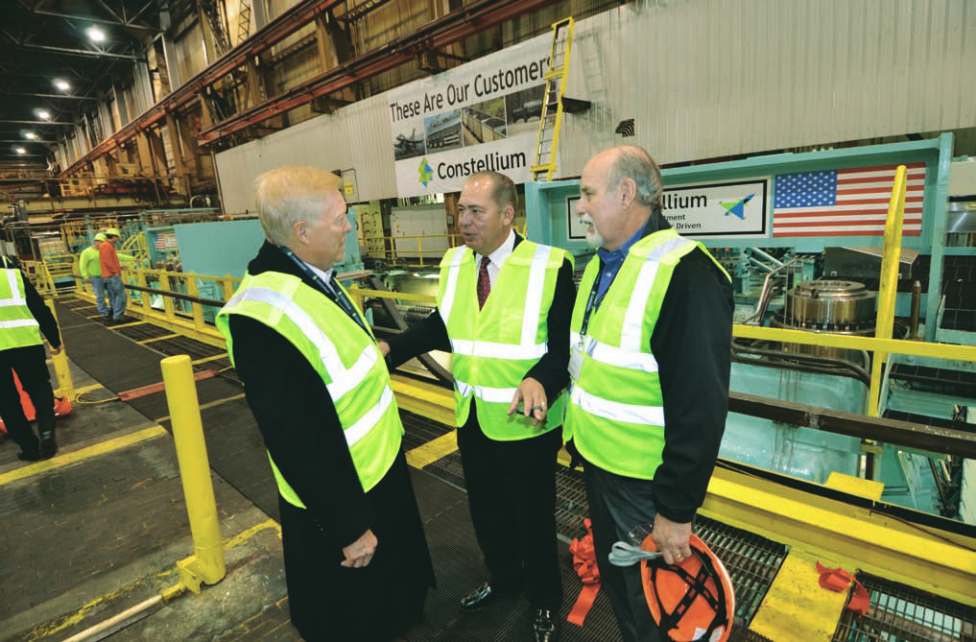
West Virginia Governor Earl Ray Tomblin meets with representatives
of Constellium at the company’s facilities in his state.
“New technology is also starting to allow for
significant advances in prototyping, especially
with something called 3-D printing.”