SEO Version


56
—GW
M
ario Adorf was born in
Zurich in 1930, to a
German nurse and an
Italian surgeon. Eighty-one years
later, he’s in the seventh decade of
a successful acting career which
shows no signs of slowing down.
This year, he’s exploring new
territory with edgy roles in
uncharacteristic projects.
He’s a familiar face in
Germany, though his public
image has always been coined by
his choice of characters. Back in
the 1970s, he was famous for
playing rogues and baddies.
International audiences got to
knowhimas OskarMatzerath’s
father in the Oscar-winning
arthouse hit
The TinDrum
. In
recent years, he’s established a
more charming onscreen
persona with roles such as the
womanising restaurant manager
in the hit 1997 comedy
Rossini
.
But as familiar as he is, Adorf
is perhaps even better known for
the roles he didn’t take, including
amafioso in
The Godfather
, but he
says he has no regrets: “I made
mistakes, but I’dmake them
again. I’ve always been consistent
inmy choice of roles and not
made any compromises.” The
actor is keen to play protagonists:
“It doesn’t have to be themain
protagonist,
Rossini
is proof of
that. But inHollywood, Germans
tend to only get ofered one-
dimensional bit parts.”
Behind that smooth facade, is
a very smart, thoughtful man.
Adorf could aford to retire to his
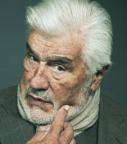
M A R I O A D O R F
A MAN FOR ALL SEASONS
He may have turned down a part in Coppola’s
The Godfather
but Mario Adorf still became Germany’s most famous actor.
At 81, he’s taking on challenging new roles in cutting-edge
films, and appealing to fans – of all ages – as much as ever
pub landlord fromHamburg’s St
Pauli district in Tarek Ehlail ’s
Die Gegengerade – 20359 St
Pauli
. In one scene, the actor
runs across the screen following
a street battle, covered in blood
and bellowing at a bunch of
football fans. It’s a pretty
uncharacteristic role for Adorf.
“Yes, I was initially quite
surprised that a young director
would want me for that kind of
part. For a while, young
filmmakers didn’t approachme,
because they probably thought
I’d be too expensive or too
domineering. But I always enjoy
working on big-screen
productions.”
Adorf is clearly still highly
ambitious and doesn’t let the
grass grow under his feet. When
we met in Hamburg, he’d just
come fromBerlin, where he’d
been working on a low-budget
short film by emerging director
Lola Randl. The filmhad a tight
budget and had to be shot in two
short weeks. But he was
determined to support the
project, and agreed to play the
part even before the screenplay
was finished.
As successful as Adorf has
been, he is aware of the stress
and pressure many actors are
under. “Peaks of success
followed by bouts of loneliness
– it goes with the territory. One
moment you’re standing on
stage in front of an adoring
public, and an hour later you’re
at home on your own. For many
actors it’s a burden, a kind of a
test of their mental strength and
resilience.”
He talks about a
contradiction inherent in his
profession, the fact that actors
have to be sensitive, but not so
sensitive that they become
vulnerable. “That’s often not
recognised, which is why some
actors become alcoholics. I
remember when acting was
about camaraderie. When I was
in theatre, the ensemble would
always get together after a
rehearsals. Nowadays, everyone
heads of in diferent directions.”
But Adorf learnt how to deal
with the highs and lows of acting
at a young age. He’s able to enjoy
his own company when he needs
to, keeping himself busy reading
or writing. And he needn’t fear
loneliness, as he has his wife
Monique to go home to. It’s his
second marriage and the couple
have been together since 1985.
They spend their summers in St
Tropez and winter in Paris. He’s
also inMunich a lot and has
lived in Rome. Adorf is a true
European. “I think Europe’s the
most beautiful part of the
world.” It’s a nice compliment.
Europe should in turn be
grateful he said no to Coppola.
house in St Tropez with his wife
Monique any time he liked, but
instead, he chooses to take on
new roles, and work with edgy
young German directors.
He’s interested in playing
idiosyncratic, imperfect
characters. Sometimes he’s
drawn to the role and sometimes
to the film. He took on his
current role in newmovie
Die
lange Welle hintermKiel
because
he was interested in the fate of
the Sudeten Germans in
Czechoslovakia. The film
explores the power of memory
and how individuals can have
very diferent memories of the
same historical event. The film
also throws looks at ageing, with
Adorf and his co-star Christiane
Hörbiger playing two elderly
people who feel misunderstood
by the younger generation.
Adorf is discerning about
which older characters he
portrays. He was recently
ofered the part of an ageing
cancer patient, but turned it
down: “The public doesn’t want
to see me play an old man, dying
from a terminal illness. They see
me as a man who’s old but still
has a lot of life in him.”
And it’s true – he’s full of
energy. He recently portrayed a
“I made mistakes, but I’d make
them again. I’ve always been consistent
in my choice of roles and not made
any compromises”
GW07-p050-056-Mario-LPSF_FINAL2.indd 56
16/1
Powered by FlippingBook Publisher