SEO Version



108
—GW
S C O T L A N D
team, Celtic, play in the UEFA
cup final. The frugal Scots
performed in exchange for food
and beer along the way. Celtic
lost the game, but the trip
became the stuf of legend. On a
bad evening, Catriona, one of
the local beauties yet to leave
Barra for the mainland, closes
the pub at 11pm. After giving
anyone who’s had too much to
drink a lift home, she calls it a
(very quiet) night and locks up.
Despite its small size – the
island is only 60km
2
– Barra
does have one big attraction:
Kisimul Castle, a tiny, ancient
fort perched atop a rock in the
middle of the sea, which
probably dates back to the 15th
century. In 2000, the castle,
which belongs to the MacNeil
clan, was leased to Historic
Scotland for 1,000 years, for the
princely annual sum of a pound
and a bottle of Talisker whisky.
The clan, which is now scattered
all over the world, still keeps
private rooms in the castle
which the acting chief stays in
during the big clan meets on the
island. Between April and
September, the site is open to
the public, and if you want to
visit it, you need to talk to
Catriona. She sometimes works
in the tourist ofce and can
arrange for visitors to be picked
up at the harbour in a small boat
and ferried over to the site.
On the way back from the
castle, it’s hard to miss Café
Kisimul, which is located
directly on the harbour. As well
as ofering standard Scottish
stodge like haggis and black
pudding, owners Rohail and
Pauline Bari also serve up
delicious Indian curries. Rohail
hails from India but has spent
most of his life living on the
Scottish mainland in Glasgow.
“After 40 years in Glasgow, I’d
had enough of the place,” he says,
smiling. “My friends like making
fun of the fact that I’ve not only
moved to the middle of nowhere,
but also chosen to live in the
most remote part of it.” Rather
than living in Castle Bay, his
small family reside on the
farthest corner of Vatersay
Island. Their cosy café, where
visitors are treated to Beatles
and Neil Young albums in their
entirety, is popular with locals
and visitors alike.
Barra’s most precious and
plentiful commodity, however,
is peace. Life moves at a slower
pace on the island. Stress is a
rare condition among the
islanders, and there’s always
time for a cup of tea or a chat
with the neighbours or the
postman. The stormy sea sets
the pace of life. It’s always been
that way, and as long as the
locals can make a living from
fishing and farming, it’s not
likely to change.
Travel info
Fly Germanwings to Edinburgh
then take a bus, car or train
through the idyllic Scottish
countryside toOban on the
western coast. From there, a large
car ferry will take you to Barra.
You can stay at the BeachHotel
(www.isleofarrahotel.co.uk) or,
if you want to get to know the
locals a bit better, try one of the
island’s numerous B&Bs.
www.isleofarra.com
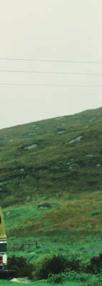
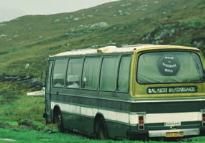
Mit diesem Bus sind die Vatersay
Boys bis nach Spanien gereist
The bus in which local band
the Vatersay Boys travelled to
Spain to see their team play
GW07-p101-108-Barra-LPSF.indd 108
14/1
Powered by FlippingBook Publisher