Basic HTML Version


ACROSSTHENETWORK
SMART ART
How things have changed
since graffiti pioneer Blek
le Rat began decorating
his native Paris during
the 1980s. The once-illegal
act is now actively
encouraged in some
places, as well as being the
focus of a growing tourist
trade. In London, at least
10 organisations lead
street art tours in the Brick
Lane area. They range
from free (provided by
iknowwhatilike.org
, an art
debate society), to about
£15 for a two or three-hour
tour with a private guide.
For a more personal touch,
look up Jay Pacer’s Art
Under the Hood tours
(
artunderthehood.com
),
or veteran graffiti
documenter Steam 156’s
London Graffiti Tours
(
londongraffititours.com
).
Many major cities have
books dedicated to key
areas – for example,
Urban
Illustration Berlin: Street
Art Cityguide
contains an
excellent fold-out map.
Barcelona has one of
Europe’s most developed
scenes, as a quick glance
at
flickr.com/groups/
barcelonastreetart
proves.
There are also free online
street art maps for various
cities (see
londonist.com
and
bristol-street-art.co.uk
for starters), while apps
such as the free Invisible
Walks Paris and the £1.99
Banksy London Tour
provide smartphone users
with an instant guide.
Check out street art
tours around
the network
In 2011, he also spent a fortnight in Australia – taking 4,000
pictures – and a fewweeks in Brazil, Argentina and Chile, where
he shot 9,000more. This brought Bofkin’s collection to 60,000.
By then, the time had come to start organising them,
so that when the website launched, users and potential buyers
would be able to find what they wanted quickly and easily.
Bofkin estimates that archiving his pictures has taken the
same amount of time as researching and travelling combined.
“Each image is classified in 15 different ways,” he explains.
“You can look up any photo in the database by location, the year
it was taken, the technique used, the surface it’s painted on, the
artist, the content and so on. If you want to look upmonkeys,
you can – I’ve got about 360. Another classification is cultural
themes, such as martial arts, smoking or politics. You can also
combine categories – monkeys and smoking, for example. I
have about 15 different smokingmonkeys fromaround the
world. It was a time-consuming process.”
Now that he’s working on the website full-time, along with a
web developer, Bofkin is “exploring” ways tomakemoney. He
and his partner are looking at iPad apps, online ads and books,
while they’vemade “minimal” money frommatching artists
with people who want something painted – bars or canvasses,
for example. Bofkin also wants to help artists sell images
online. But his biggest unfulfilled ambition is amuseum.
“Over the past 20 years, graffiti has gone frompublic enemy
number one to something that is appreciated and loved by a
much broader audience,” he says. “But it disappears every day,
so photography provides a permanent visual record. Our goal
is to be themuseum that helps preserve that visual record.”
Graffiti disappears every day… our goal is to be
themuseumthat helps preserve a visual record
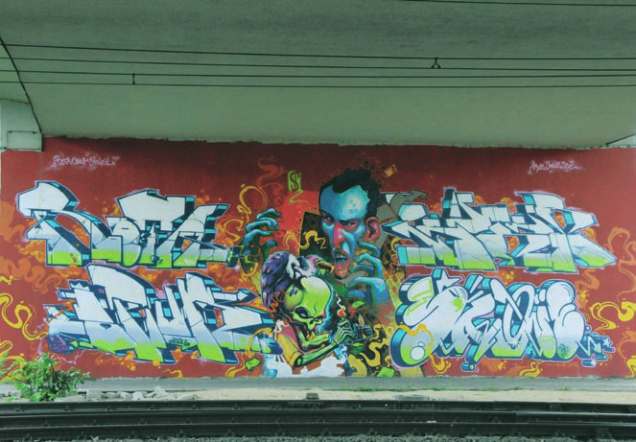
7
“This was painted by
about six different
artists, but the key onewas
a guy calledAryz, from
Spain – he’s the blue-faced
character. It was painted
as part of theMeeting
of Styles Festival inMainz-
Kastel, Germany. This is a
legal graffiti festival that
brings together artists to
paint very large areas in
different cities. It has taken
place in about 20 countries
in the past decade, and
many nowhave their own
satellite festivals.”
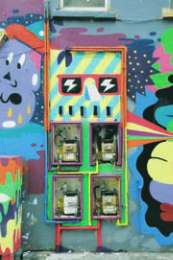
8
“This was painted
by a British artist
calledMalarky. It was on
the side of a newsagent
in Shoreditch, east
London, which is the city’s
street-art heartland. It’s
a brilliant use of what
was already there – he’s
used the gasmeters as
part of the robot. Like
most of these pieces, this
disappeared long ago.
There also used to be a
Banksy tag inside one of
themeter boxes, but that
too has been painted over.”
7
8
108
TRAVELLER