Basic HTML Version



I visited 76 cities inGermany, plus 15 in
Holland and Switzerland, in under amonth
he got serious. For the next fewmonths he spent his
weekends driving arounddifferent Spanish cities,
gathering a further 10,000 images. Hewanted to take
photos on a full-time basis, sohe spoke to a contact
fromthe financial worldwho sawpotential and they
formed a company. The investor also agreed to fund
further trips. That was in 2011 – the year that Bofkin
embarkedonan epic graffiti adventure that sawhim
spend awhole summer traversingEuropewithhis
camera, seekingout the best street art.
“For the planning I used a bunch of map
websites that were graffiti specific,” he says.
“I contacted artists through Facebook and Flickr.
Then when I arrived in a country, I typically had
friends through connections with breakdancing or
graffiti. I would go into paint shops and ask people
where to look. Sometimes, once I was at a wall, I’d
meet somemore artists and they’d tell me about
another spot to take pictures. Basically, the project
involves using a wide variety of resources, which is
why it’s so time-consuming.”
Staying in cheap hotels andmotels, hiring cars
and driving from sunrise to sunset, he got to know
the local scene and took countless pictures. It was
real work, not a holiday. He ate fast food
and didn’t get hangovers. On one leg of the trip
he flew into Berlin to visit Germany, Holland and
Switzerland. Before themonth was over, he flew out
of Zurich with a further 10,000 images.
“On that trip I visited 76 cities inGermany, plus
15 inHolland and Switzerland,” Bofkin says. “For
others I’ve taken trains and tried to do everything
on foot, but inmost cities it’s a lot easier if you have
a car. I frequently come close tomissing flights,
because there’s always onemore photo.”
5
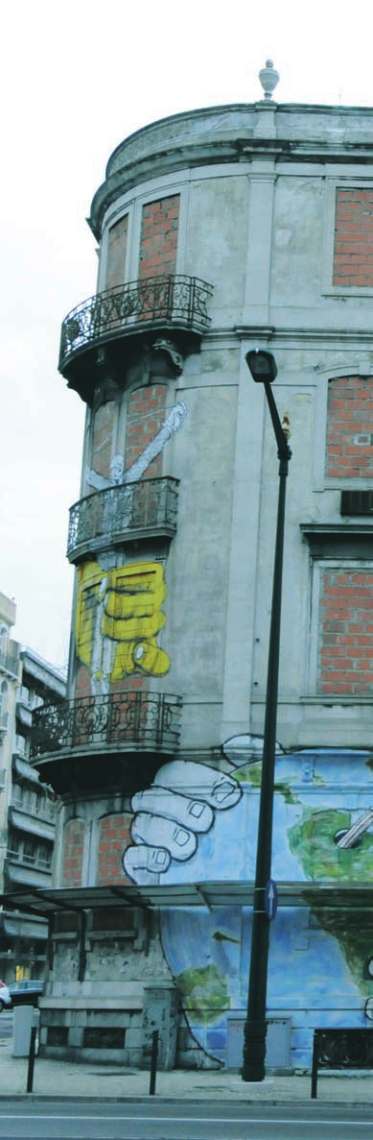
“This was on amain
road in central Lisbon,
and I had towake up
before sunrise to get a
picturewithout any cars.
It was painted by an
Italian artist called Blu
as part of a project to give
Lisbon’s empty buildings
some purpose, so it’s legal.
It’s also epic and typical of
Blu’s style. He does lots
about anti-consumerism
and bad politics – street art
is one of the last legitimate
forms of public protest.”
6
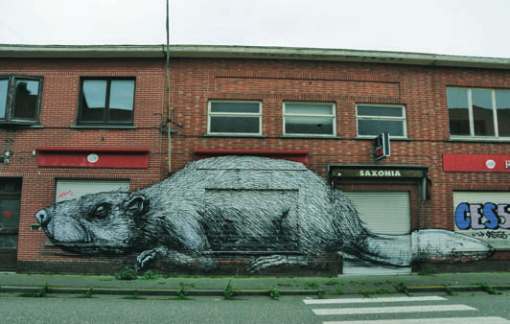
“This was by Roa, in
an abandoned village
calledDoel inBelgium.
The story behind the space
is amazing. The village is
really close to the port of
Antwerp, and the port
had plans to expand so
the villagewas cleared.
Then theCredit Crunch
happened and the port
didn’t expand, so the
empty villagewas just left
there. Street artistsmoved
in and painted a lot of the
houses, inside and out.”
6
106
TRAVELLER