Basic HTML Version



ACROSSTHENETWORK
In the 19th century, tree houses entered another phase,
one where fact and fiction began to blend. In 1845, a cabaret
called Le Grand Robinson opened in the town of Le Plessis-
Piquet near Paris. Taking place in a row of interconnected
tree houses, this cabaret, which derived its name from the
1812 novel
Der Schweizerische Robinson
(
The Swiss Family
Robinson
), had as many as 200 tables at its height.
Fast-forward to the present day, andmany of the same
ideas that inspired these early structures are still verymuch
alive in their contemporary descendants – from the desire for
isolation to the need to be close to nature. There’s also a far
moremodern rationale: since the 1990s, there’s been a steady
rise of interest in ecologically responsible and sustainable
architecture. Andwhat could bemore responsible or
sustainable than a tree house?
Today, you’ll find an abundance of firms specialising in
the design of high-end tree houses, which range in price from
several thousand euros for themost basic designs tomillions
– the AlnwickGarden tree house in the north-east of England
cost £3.3m [€4.1m] and includes a restaurant. These arborial
wonders nowhouse holiday-makers and conference guests,
sit in people’s gardens and on the grounds of stately homes.
Former cabinetmaker AndreasWenning is one of the
best-known tree-house craftsmen. Born in 1965, the Bremen-
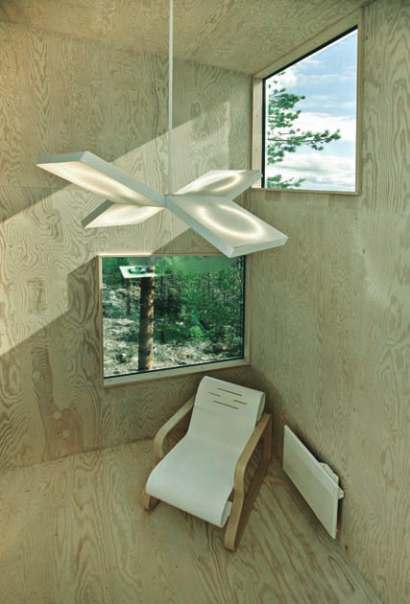
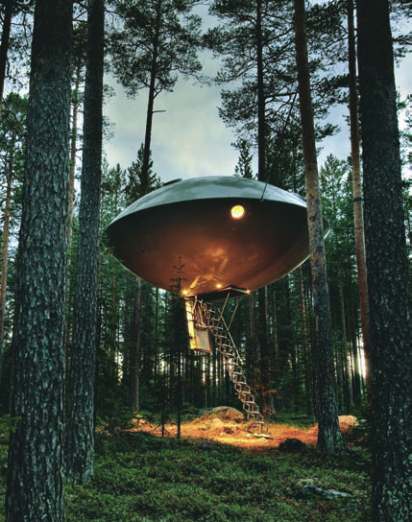
Left,
TheUFO, which sleeps four, at The Treehotel,
Sweden;
below,
interior of TheMirrorcube, also
at The Treehotel;
opposite,
Kapellerput, designed
byDansmonArbre, for conferences andmeeting
rooms inTheNetherlands
based designer is part of the Baumraumgroup, a company
that has built some of themost exciting contemporary
tree houses across Europe. So what’s so great about these
structures?Wenning sums it up succinctly on his website:
“[They’re] a promise of adventure for the kids, a retreat
for the adults, a romantic hideaway close to nature. These
special little dwellings installed up among the trees fire
our imagination, bringing back childhoodmemories and,
with them, the desire to climb up and enter amagic world
amongst the foliage. To play up there, to work undisturbed,
to relax, to daydream…”
Wenning’s designs apply cutting-edge principles
of architecture to create thoroughlymodern-looking
structures, such as the cube-likeMagnolie und Tanne house
near Osnabrück in north-west Germany, but others take
a very different, no less ambitious, approach. Dans mon
Arbre, a collective based inGrenoble, take particular
80
TRAVELLER