Basic HTML Version



64
|
TRAVELLER
THE EXPERIENCE IS
unforgettable. Traipsing through
an unimaginably cold desert in the half-light of dawn,
stumbling with unspent sleep, you follow a Berber and
his donkey through the siq, a narrow
thaniya
(canyon)
of space bisecting a solid rock face. After about 20
minutes of plunging ahead into the grey darkness,
the man stops and turns, motioning you to look in
front. Sure enough, cleaving the path ahead is a gap,
light falling onto the unmistakable smoothness of
man-made carvings, contrasting with the roughness
of the bare rock.
As you emerge, squinting into the light, al Khazneh,
a 2,000-year-old temple carved entirely out of a
mountain of red sandstone, seems to rear up into view.
Burnished by the early morning sunlight, the red stone
glows as if the light comes from within and it’s so
beautiful that for a minute you just want to cry.
It’s a moment that visitors never forget, but even
if you’ve never been to Petra, you’ll almost certainly
be familiar with the city’s chiselled good looks. The
temples and caves of this ancient metropolis, hewn
out of red and white sandstone cliffs in the wadis of
southern Jordan, have found stardom in everything
from the bible to comic books and even Hollywood.
Moviegoers will no doubt recognise the city’s most
FEATURES
|
AMMAN
famous site, al Khazneh (the Treasury), from the
climax of the 1989 film
Indiana Jones and the Last
Crusade,
when Harrison Ford and Sean Connery
sought the Holy Grail inside it, and the dusky pink
temple also found fame in Hergé’s 1958 Tintin
adventure
The Red Sea Sharks
.
But while the best-known bits of Petra have been
well trammelled in recent times – indeed, nearly one
million set foot there in 2010 – there is far more to
see here beyond the siq and the Khazneh. This year, a
host of events are planned as the metropolis celebrates
200 years since its rediscovery by the Swiss explorer
Johann Ludwig Burckhardt, including a concert by
leading Jordanian musician Tareq al Nasser; the Petra
Marathon on 8 September (
petra-marathon.com
) and,
in October, a special performance of the musical Petra
Rocks (
visitjordan.com/uk
).
The anniversary is also a good opportunity to
venture further into the city’s hidden corners. Built
by the Nabataeans, ancient nomads who traded
myrrh, incense, spices, gold and silver from India
before settling here around 312 BC, Petra became a
place of terrific grandeur. At the height of its power
(between the second and first century BC), there were
around 20-30,000 people living in the city, whose
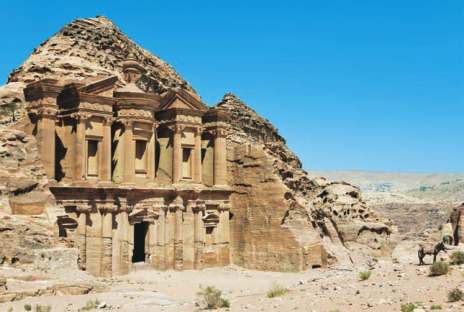
The facade of the
Deir, most likely used
as a temple, is 30m
high, making it one of
Petra’s largest
monuments