Books
58 AMERICANWAY
JULY 1 2009
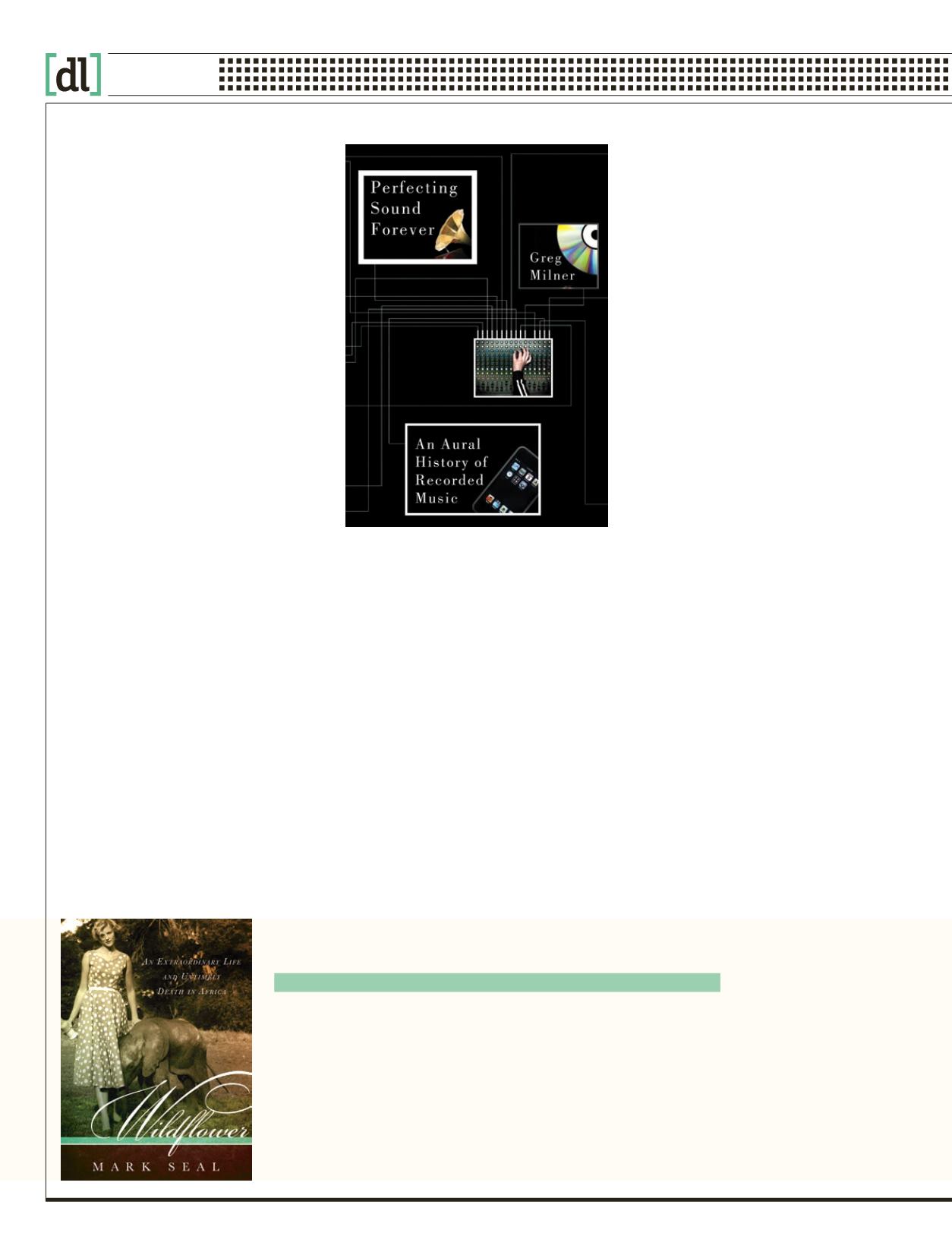
Author GregMilner
documents the
not-always-harmonious
history of recording in
PerfectingSound
Forever
. ByBobMehr
Book
on
Tape
GreG Milner
has always listened to music in a
different way than most people. “Ever since I can
remember, Iwould try to think not in terms of lyrics
or hooks, but sonics,” Milner says. “[I’d ask myself,]
‘What is it that makes a record good, and what is
it that people like about it?’” Milner, a former edi-
tor at
Spin
magazine and the coauthor of
Metallica:
This Monster Lives: The Inside Story of Some Kind
ofMonster
, explores those questions in an insightful
new book called
PerfectingSound Forever: AnAural
History of RecordedMusic
(Faber&Faber, $35).
Milner’s book isn’t intended to be a comprehen-
sive study but rather a dynamic journey through a
century of recording that captures the flash-point
moments and technological innovations of the past
100 years aswell as the philosophical and aesthetic
debates that have cropped up in the wake of those
occurrences. While artfully tracing the evolution of
in January 2006,
wildlife activist and Oscar-nominated documentarian Joan Root was shot and killed at her home on
Kenya’sLakeNaivasha,where for years shehadworked toprotect the landand theanimals that inhabited it. Policebelieve it
was a robbery gone bad, but others suspect shewasmurderedby peoplewho disagreedwith her conservation efforts. Still
unsolved, Root’smurder has garneredworldwide attention, even inspiring a film, with Julia Roberts rumored to play Root.
Talented authorMark Seal (whosework has been featured a great deal in
AmericanWay
) honors Root’s extraordinary life
and investigates hermysterious death in
Wildflower
, a beautiful andgripping tale about a life cut tragically short.
WeCan’tPutDown…
Wildflower: AnExtraordinary Life andUntimelyDeath inAfrica
byMarkSeal
|
(RandomHouse, $26)
recording from the days of Thomas Edison to the
dawn of the digital age, Milner reveals that in the
musicworld, history often repeats itself.
“The argument has always fundamentally been
about
what
a recording is supposed to be, whether
it’s supposed tocaptureaperformance—amoment
in time— orwhether it’s supposed to be an artifact
in itsown right,” heexplains. “It seems likewhenever
new technologies come around, they provide ways
for people to revive that age-olddebate.”
Deftlybalancing technical insightswitha compel-
ling anecdotal narrative, Milner touches on the key
elements that draw listeners to the sounds coming
from their stereos. Chief among them is the role and
prominence of percussion. “Maybe because it’s a
primordial thing— drumswere so important in our
development, evolutionarily speaking— that causes
people tonotice it andfixate on it,”Milner says. “But
you can listen to almost any piece of music and fig-
ure out when it was recorded largely by the drum
sounds. So, often, it’s the first and last thing that’s
thought of.”
Milner alsoexplores hot-button issues suchas the
“loudnesswars,” a dominant trend over the past de-
cade of albums beingmastered at increasingly loud,
almost distorted levels. “That’s a situation that re-
ally causes grief to [mastering] engineers,” he says.
“Theypride themselves onbeing thesehighly trained
peoplewith thesegolden ears, but inorder to stay in
business, they have to do stuff that they consider ri-
diculous hackery. They’re doing exactly the opposite
ofwhat theywere trained to do.”
Perfecting Sound Forever
also provides a fasci-
nating peek into the studio subculture, thanks to in-
terviewswith industry giants such as Power Station
studio impresario Tony Bongiovi, British producer
HughPadgham, superstarmixerBobClearmountain,
and indie-rock controversialist SteveAlbini.
“Those kinds of engineers and producers are an
interesting bunch,”Milner says. “They tend to take a
longviewofmusic,beyondthepurelytechnical,which
is something I thinkwould surprisemost people.”
While computer programs like Pro Tools and in-
expensive home setups have altered (and to a large
extent, diminished) the role of the traditional studio,
Milner says that those he spoke to for the book are
cautiously optimistic about the future of recording.
“Granted, there are a lot of peoplewho feelmusic
is sounding really bad right now, between the mas-
tering, the use of Auto-Tune, and the way everyone
listens to compressed, poor-quality sound files on
their iPods,” Milner admits. “It’s not that they’re
Luddites, but they feel like, ‘Why bother? What’s
the point of laboring over a record if it’s going to go
throughall theseprocesses that negateall the things
wework toachieve?’ Still, I think it’s safe to say that
we’ll probably be talking about and debating these
same kinds of issues for a long time to come.”


