B U S I N E S S
ployeesstillmakeeachpairof shoesentirely
byhand.
Shoemaking, also known as cordwain-
ery or cobbling, is a craft that was, of
course, widely practiced at the time of the
store’s founding. Moneyedmen of that era
wouldn’t considerwearinganythingbut the
finest footwear, andJohnLobbbootmakers
did verywell serving the aristocratic niche.
Itwas a rite of passage for upper-class boys
to get their first pair of John Lobbs when
they graduated from university and were
preparing to enter thebusinessworld.
But with the eventual advancement of
technology, machines slowly began to re-
place traditional shoemakers, allowing re-
tailers to manufacture exponentially more
productata fractionof thecost.Themodest
Lobb shopneverbudged, though.The store
soldieredon at thehands of several genera-
tions of Lobbs, each of whichwas sure that
theircraftwouldcontinue tobeappreciated
bya select segment of thepopulation.
They were right. John Lobb remains
the brand of choice for many nobles and
notables. Frank Sinatra and Dean Martin
bought shoes here; so did Groucho Marx
and stage stars like Rex Harrison and Sir
LaurenceOlivier. And today, the shoes con-
tinue tobea favoriteofBritishroyals, justas
theywere in the nineteenth century. Prince
Charles aswell asQueenElizabeth andher
husband,PrincePhilip, havegiven the shop
royal warrants as a sign of their confidence
in its enduring quality. (For further en-
dorsements, patrons can look to the signed
thank-you notes from various kings and
queens that are framedaround the shop.)
If the client list seems exclusive, it’s for
good reason. In this mass-production era,
a pair of handcrafted shoes is a luxury,
and one that doesn’t come cheap. A typical
pair of John Lobbs costs in the ballpark of
$5,000, with extras such as exotic skins or
laces costingevenmore. Sowhywouldany-
onepay suchaprice for footwear, especially
given the fact that French fashion house
Hermes sells a less-expensive line of ready-
madeLobbs?
“All I can say is it’s very skilled hand-
work,” Lobb says. “The materials are ex-
pensive, and the amount of skill and effort
that goes intoeachpair is considerable. It is
not appreciated by many people. They see
one shoe and look at another shoe and say,
‘What’s the difference?’ But we are crafting
somethingunique for each individual.”
To really undersTand
the worth of
these one-of-a-kindworks, onemust learn
the intricacies of the shoemaking process.
First, a fitter takesmeasurements of a cus-
tomer’s feet. This is a fairly straightforward
procedure inwhichhemeticulously records
anything that might affect the fit of the
shoes. Next, a last maker uses the fitter’s
notes to construct a woodenmold of each
foot.Thesemolds, knownas lasts, are saved
andused for any futureorders.
A workman called the closer then cuts
paper patterns that define the style of the
shoe andpasses themon toa clicker,whose
task it is to cut the eight pieces of leather
thatwill bepieced together. The closer then
shapes the leather around the last before a
maker delicately joins the upper part of the
shoe to the sole.
At this point, a socker inserts the insole
covering,whichbears thenameof the shop.
The shoemust thenbe left on the last for a
weekor so to setproperly. Finally, the last is
removed, finishing details such as laces are
added, and the shoe is polished. One final
craftsmanmakesprecisewooden shoe trees
fitted exactly for each pair of shoes so that
theywillmaintain theproper shape.
Elapsed time of the process from start
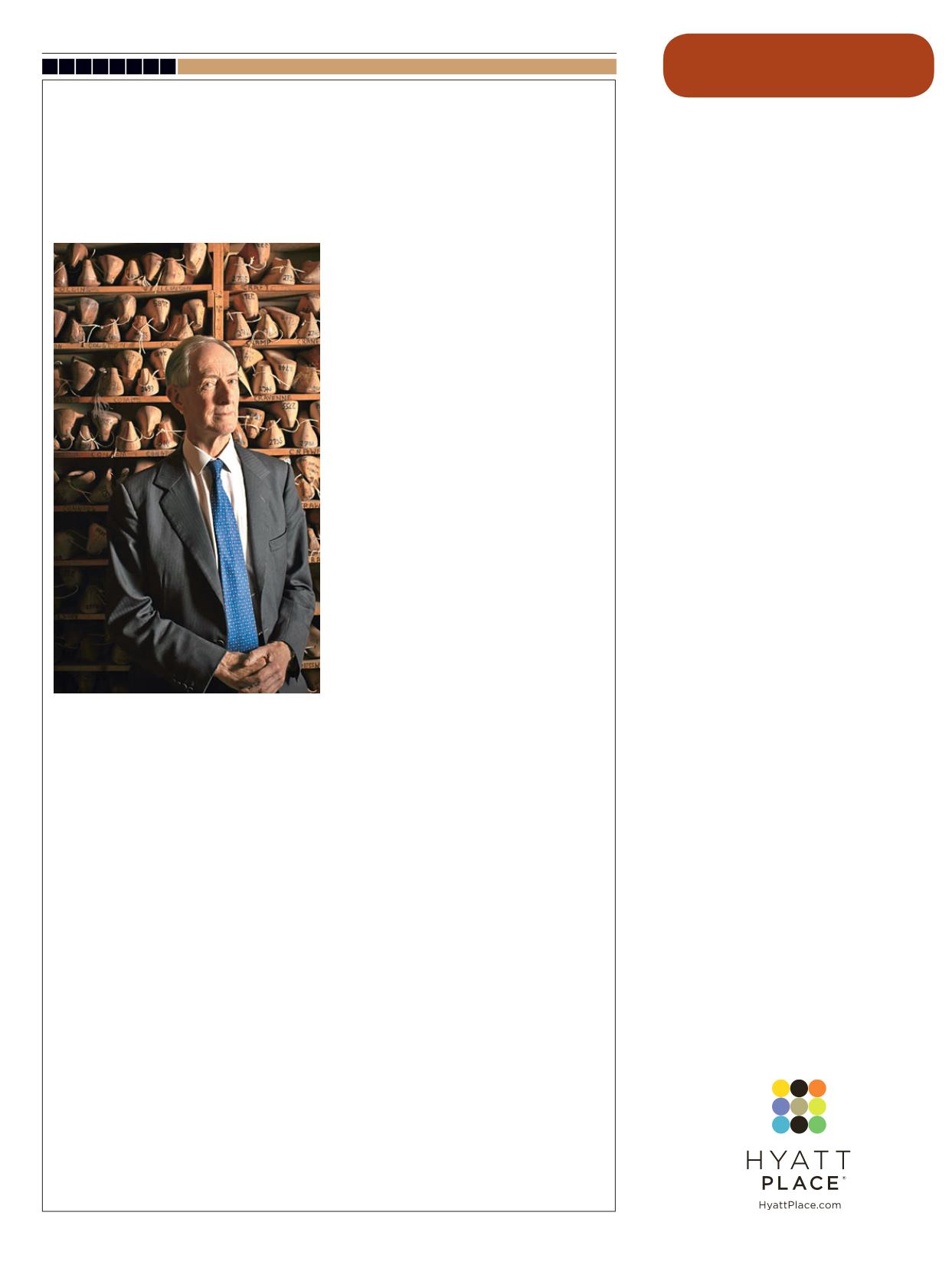
JohnLobb
4W\Rg]c` >ZOQS
Actual number of hotels and locations subject to changewithout notice.
/ZOPO[O
0W`[W\UVO[
/`Wh]\O
>V]S\Wf AQ]bbaROZS
BS[^S BcQa]\
/`YO\aOa
@]US`a
1OZWT]`\WO
2OdWa 2cPZW\ 4`S[]\b
=\bO`W];WZZa AOQ`O[S\b]
1]Z]`OR]
1]Z]`OR]A^`W\Ua 2S\dS` !
1]\\SQbWQcb
;WZT]`R ;gabWQ C\QOadWZZS
4Z]`WRO
0]\WbOA^`W\Ua
4b :OcRS`ROZS
8OQYa]\dWZZS :OYSZO\R ;WO[W
=`ZO\R] AO`Oa]bO
BO[^O ESab>OZ[0SOQV
5S]`UWO
/bZO\bO 1]Zc[Pca
7ROV]
0]WaS
7ZZW\]Wa
1VWQOU] "
7\RWO\O
4]`bEOg\S 7\RWO\O^]ZWa
A]cbV0S\R
9O\aOa
9O\aOa1Wbg B]^SYO
9S\bcQYg
4Z]`S\QS :SfW\Ub]\ :]cWadWZZS
:]cWaWO\O
0Ob]\@]cUS 1]dW\Ub]\
;O`gZO\R
0OZbW[]`S
;OaaOQVcaSbba
0]ab]\
;WQVWUO\
2Sb`]Wb ! 5`O\R@O^WRa
;W\\Sa]bO
;W\\SO^]ZWa
;WaaWaaW^^W
8OQYa]\
;Waa]c`W
9O\aOa1Wbg
<SdORO
:OaDSUOa @S\]
<Se8S`aSg
4OW` :Oe\ ;b :Oc`SZ >`W\QSb]\
ASQOcQca
<Se;SfWQ]
/ZPc_cS`_cS
<SeG]`Y
5O`RS\1Wbg AO`Ob]UO
<]`bV1O`]ZW\O
1VO`Z]bbS ! 5`SS\aP]`]
@OZSWUV
=VW]
1W\QW\\ObW 1ZSdSZO\R
1]Zc[Pca
=YZOV][O
=YZOV][O1Wbg BcZaO
=`SU]\
>]`bZO\R
>S\\agZdO\WO
0SbVZSVS[ >WbbaPc`UV
A]cbV1O`]ZW\O
1VO`ZSab]\ 1]Zc[PWO
5`SS\dWZZS
BS\\SaaSS
1VObbO\]]UO 5S`[O\b]e\
;S[^VWa <OaVdWZZS #
BSfOa
/cabW\ 1]ZZSUSAbObW]\
2OZZOa % 3Z >Oa]
4]`bE]`bV ! 6]cab]\
AO\/\b]\W] !
CbOV
AOZb :OYS1Wbg
DW`UW\WO
1VO\bWZZg 1VSaO^SOYS
6S`\R]\ @WQV[]\R !
@]O\]YS AbS`ZW\U
EOaVW\Ub]\
ASObbZS
EWaQ]\aW\
;ORWa]\ ;WZeOcYSS
:]QObW]\aQ][W\Ua]]\


