V A N T A G E P O I N T
AMERICANWAY
FEBRUARY 1 2008
8
PHOTOGRAPHBYCHETSNEDDEN
We’d love to hearwhat you think about our
airline and our employees. Pleasewrite to us
atwww.aa.com/customerrelations.
theUnited States and by 2002 inEurope.
Through retirements, thepurchaseofnew-
er aircraft, and the retrofittingof someold-
er planes, themakeoverwas accomplished.
And the effects of the transformation have
been remarkable. The FAA reports that in
the United States, the number of people
exposed to unacceptable levels of aircraft
noise has fallen by more than 90 percent
since 1975.
Of course, as with all things in life, we
can do better. At American, we plan to
lower the volume evenmore as we refresh
ourfleetwith thenext generationof jet air-
craft.Between2009and2012,we’llbe tak-
ing delivery of dozens of newBoeing 737s.
The environmental benefits are manifold:
In addition to being quieter, these aircraft
willburn less fuel andemit lessgreenhouse
gases.
Our ability to reduce the impact of noise
on communities is a function not just of
what we fly but also of how we fly. To il-
lustrate, aircraft are routedaway from resi-
dential areas whenever possible — often
over large bodies of water and industrial
areas —when flying at low altitudes (i.e.,
during takeoff and landing).
Our progress to date has been encour-
aging. But, realistically speaking, until
someone invents a silent jet engine — or
until gliders become a feasible means of
international travel — airlines everywhere
aregoing tohave tokeepworkinghardand
thinkinghardabout how toget the volume
down.AtAmericanAirlines, that’swhatwe
intend todo.
Thank you forflyingwithus today.Have
agreat trip!
LoweringtheVolume
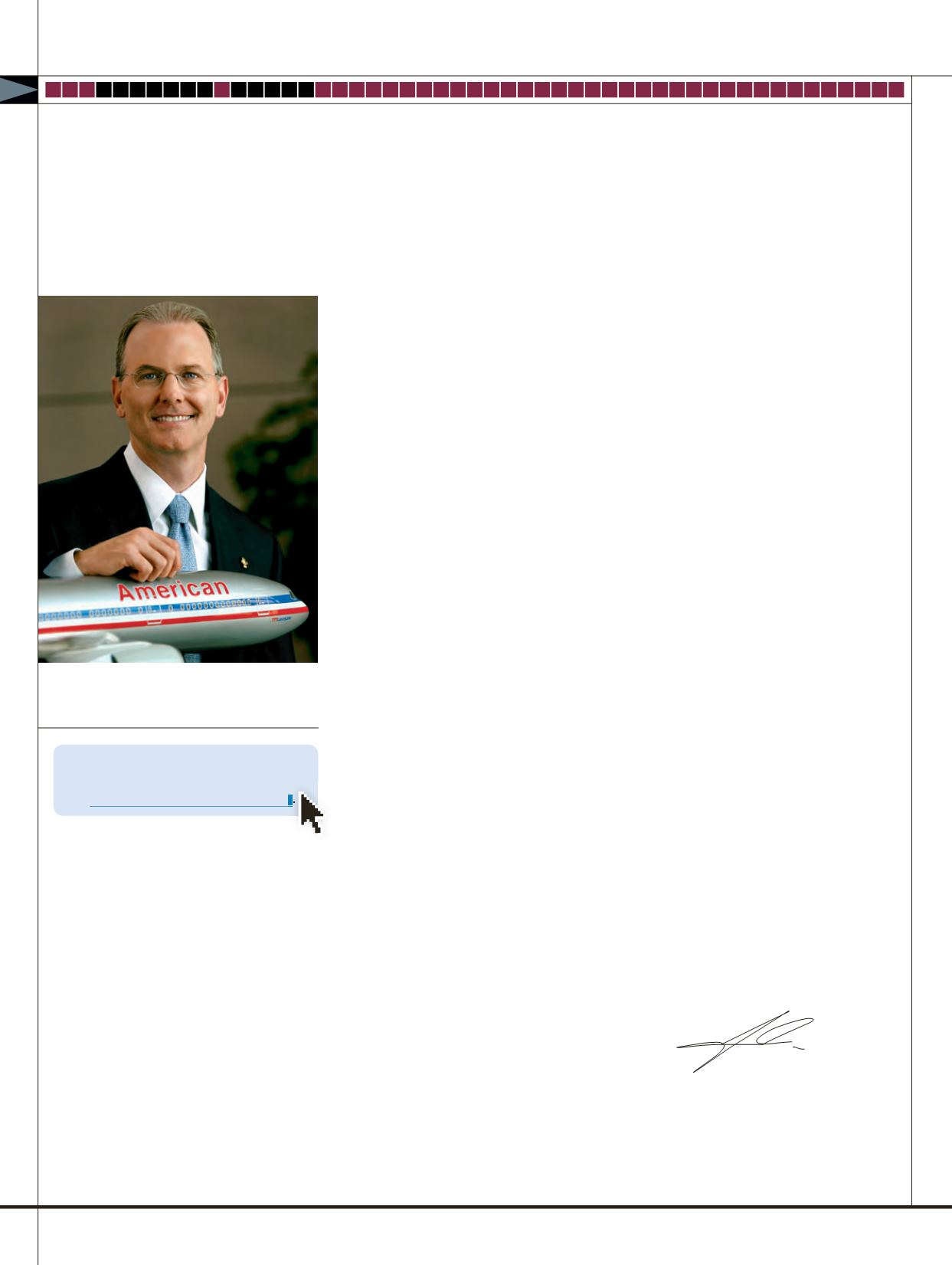
Gerard J. Arpey
Chairman&CEO
AmericanAirlines
LOOKWHAT’S NEW
Want to signup for free e-mail notificationof
GerardArpey’s columnor to seepast columns?
Go to
I
In this issue, I’mgoing to stickwith the en-
vironmental theme I began last month by
talking about noise — another element of
our eco-challenge— andwhat we’re doing
tomakeour operations asquiet aspossible.
Wedon’tusuallymakea lotofnoiseabout
it (rim shot), but I’mpleased to report that
the airlines — working in collaboration
with the Federal Aviation Administration
(FAA), the aircraft and engine manufac-
turers, and communities around the world
—havemade significant progress in recent
yearswhen it comes tonoise reduction. For
example, new technologies have enabled
mainframe manufacturers to reduce the
soundscreatedby thedisplacementof airas
planesmove through the sky. Enginemak-
ershavehelped lower thevolumeby, among
other things, reducing the noise created by
engine exhaust. Today, jet engines are 60
percent quieter than they were in 1960.
American and other airlines have seized
on each roundof advances, replacingolder,
louder aircraft with newer planes that in-
corporate the latest technology.
The FAA has implemented, over time,
increasingly stringent noise standards. The
story of the Boeing 727 is emblematic of
how the modern airline fleet has evolved
as new standards have taken effect. In the
1970s, the first generation of airline jets
was replacedby the727. If youwere to look
at the American Airlines fleet of 10 years
ago, you would see a lot of 727s. Today,
those aircraft have all been retired, sold, or
recycled; they’ve been replaced by quieter,
more advanced jets, including the latest-
generation737.
In the early 1990s, authorities in the
UnitedStatesand inEuropemandated that
the noisiest aircraft be phased out, begin-
ning in 1994. The transformation to the
new standard had to be done by 2000 in


