38 AMERICANWAY
OCTOBER 1 2007
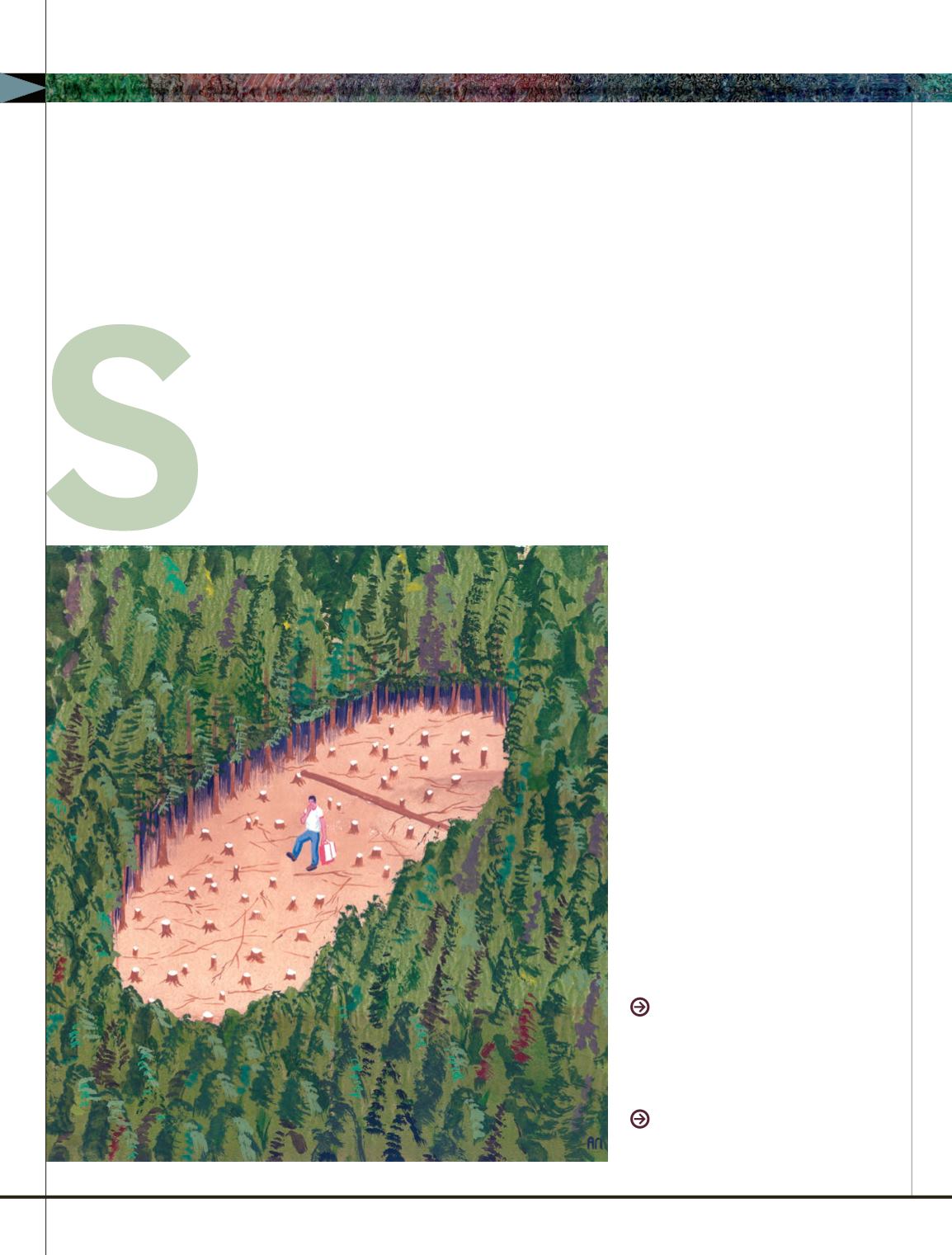
ILLUSTRATIONBYALEXNABAUM
SO, YOUWANT
to save the earth.
While that’s noble and all, figuringoutwhich are themust-dos amid the slewof should-
dos bandied about by talking heads can get mighty confusing pretty quickly. Luckily, you
haveus to cut throughall that chatter.
We checked inwith some experts tofindout their top tips fordecreasing your impact on
the earth—otherwiseknownas reducing your carbon (or ecological) footprint.
“A carbon footprint is really a visual metaphor for what kind of energy and resources
eachofus
[
usesaswego throughourday
]
,” saysLisaWise, executivedirectorof theCenter
for a NewAmericanDream. “If you have a large footprint, it means you require a large
TreadLightly
Get ready to shrink your footprint onMother Earth.
NoBirkenstocks necessary.
By JennaSchnuer
number of environmental resources to sus-
tain your place on this planet. The smaller
the footprint, the more sustainable your
lifestyle is.”
To put it more scientifically, a carbon
footprintmeasures “the impact human ac-
tivities have on the environment in terms
of the amount of greenhouse gases pro-
duced, measured in units of carbon diox-
ide,” according to CarbonFootprint.com (a
website where you canmeasure your own
usage). Nowadays, Americans are among
the leaders inusingup theearth’s resources
—which isnot exactly somethingyouwant
to be known for. The average American
“generates about 15,000 pounds of carbon
dioxide every year from personal trans-
portation, home energy use, and from the
energy used to produce all of the prod-
ucts and services we consume,” according
to ClimateCrisis.net. And that, the World
Wildlife Fund’s Living Planet Report says,
gobbles up nearly 24 acres’ worth of natu-
ral resources during a lifetime. Compare
that with the average carbon footprint of
the Italians, which is seven acres; of the
Japanese, which is 12 acres; and of the
Indonesians, who tread lightly, using just
three acres per person.
But nomatter howwell (or poorly) each
individual country is doing, it all adds up
to a not-so-pretty picture: Since the late
1980s, the footprint of the collective popu-
lation on earth has exceeded what can be
sustained by a whopping 20 percent or
more. If we keep it up, by the year 2050,
the world’s population will have used up
between 180and220percent of the earth’s
biological capacity.
Most environmental agencies aim for
an 80 percent reduction in overall carbon
emissions by 2050. “That is really almost a
nonnegotiablenumber,” saysWise.
Todo yourpart, consider these steps:
First, take a carbon footprint checkup
of your own life to see where — and how
heavily — you stand on the earth. Online,
head to MyFootprint.org or SafeClimate
.net/calculator toplay thenumbers game.
Swap out your incandescent lightbulbs
for compact fluorescent bulbs. “They use
about 66 percent less energy, and they last
When cars cruise at 65miles per hour rather than at 55miles per hour, the carbonmonoxide emissionsmore thandouble permile driven.
}


